SSC CHSL 30 November 2025 · Shift 1 · General Intelligence — questions with answers · ShikshaSphere
Chapter 189 of 200
30 November 2025 · Shift 1
General Intelligence
25 questions ~25 min readFree
25 questions
A
26
Each item describes a situation and is followed by four possible responses. Indicate the response you find most appropriate. Choose only one response for each item. The responses will be evaluated based on the level of appropriateness for the given situation. An online education platform has a new course ready, but some errors have been found in its content. The company can either launch the course on the scheduled time or delay it for some time to make improvements. What would be the most sensible decision?
A.Launch the course on time and make corrections later
B.Cancel the course completely
C.Release the course to all users without making any improvements
D.Delay the launch and ensure the quality of the content
Solution
Situation judgement
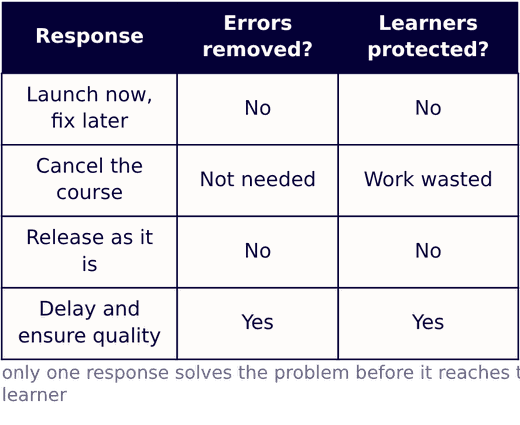
In a situation-judgement item the best response is the one that removes the actual problem without creating a bigger loss.
The actual problem here is faulty content, and the cost of a short delay is far smaller than the cost of teaching thousands of learners something wrong.
Delaying the launch fixes the errors before any learner sees them and protects the platform's credibility, so it is the balanced and responsible choice.
Launching now and correcting later (a) or releasing the course untouched (c) both push a defective product to the learners, while cancelling the course (b) throws away work that only needs a short correction.
Hence option (d) is correct.
27
The Latin root 'dict' means:
A.To hear
B.To write
C.To say
D.To read
Solution
Latin word roots
A root carries the core idea that survives in every word built on it, so test 'dict' against familiar English words.
To 'dictate' is to say words aloud for someone else to write, a 'verdict' is what is truly said by a jury, and to 'predict' is to say beforehand — in each of them the idea is speaking.
So the Latin root 'dict' (from the verb dicere) means 'to say / to speak'.
The other options belong to different roots: 'to hear' is aud (audience, audible), 'to write' is scrib/script (scribble, manuscript) and 'to read' is leg/lect (legible, lecture).
Hence option (c) is correct.
28
Read the following statement carefully and identify the inference that follows.Statement:
The government has announced a new environmental fee on private vehicles.
Inference:
I. The government is trying to reduce air pollution.
II. This fee will generate additional revenue for the government.
III. This fee will be implemented in only one city.
A.If only I follows
B.If only II follows
C.If both I and II follow
D.If both II and III follow
Solution
Statement and inference
An inference follows only if it is a reasonable extension of what the statement itself contains; anything the statement never touches must be rejected.
Inference I follows: a fee is called an 'environmental' fee and is placed on private vehicles precisely to discourage their use, and the purpose of discouraging them is cleaner air.
Inference II follows as well: every fee collected by the government becomes money in the government's hands, so extra revenue is a direct consequence.
Inference III does not follow: the statement mentions no city, no state and no boundary of any kind, so restricting the fee to a single city is pure guesswork.
Both I and II follow, so option (c) is correct.
29
Few of the letters are given followed by a question mark (?) these letters are following a specific pattern you have to give the correct option which can replace question mark.
Which letter replaces the question mark: Y, U, Q, M, ?
A.I
B.J
C.K
D.L
Solution
Letter series
Replace each letter by its position in the alphabet: Y = 25, U = 21, Q = 17, M = 13.
Each position is 4 less than the one before it, so the rule is -4.
The next position is 13-4=9, and the 9th letter of the alphabet is I.
Hence option (a) is correct.
30
Find the next element that replaces the ? Logically
30, 70, 150, 310 ?
A.635
B.625
C.630
D.640
Solution
Number series
Test the first two terms with a multiply-and-add rule: .
The same rule holds all through: and .
So the next term is .
The differences also double every step, and 310+320=630 confirms the same value.
Hence option (c) is correct.
31
Find the next element that replace the ? Logically
64, 136, 280, 568, ?
A.1,206
B.1,145
C.1,344
D.1,144
Solution
Number series
The terms roughly double, so try a rule of the form 'double and add a fixed number'.
, and the same rule works again: and .
So the next term is .
The differences also double each time, giving 568+576=1144 as a check.
Hence option (d) is correct.
32
In each of the following question, there is a certain relationship between two given numbers on one side of (::) and one number is given on another side of (:) where another number is to be found from the given alternatives, having the same relationship with this number as the numbers of the given pair bear. Choose the best alternative.
7:3::8:?
A.6
B.4
C.3
D.19
Solution
Number analogy
Compare the two numbers of the given pair: 7-3=4, so the second number is 4 less than the first.
Rule: second number = first number .
Apply the same rule to 8: 8-4=4.
Hence the number that completes the analogy is 4 — option (b).
33
Find the missing number pair in the following series.
(2, 5), (3, 10), (5, 26), (7, 50), (11, 122), ?,
A.
B.
C.
D.
Solution
Number pair series
Read the first number of every pair: 2, 3, 5, 7, 11, …, 17 — these are consecutive prime numbers, so the missing pair must start with the prime between 11 and 17, i.e. 13.
Now link the two numbers inside a pair: , , , , .
The rule is therefore (prime n, ), and the last given pair confirms it: .
For n=13: .
So the missing pair is (13,170) and option (b) is correct.
The traps use non-primes: 12, 14 and 15 are composite, so options (a), (c) and (d) break the first half of the rule at once.
34
Which of the following is the odd one out based on origin ?
A.Mountain
B.Valley
C.Dam
D.Plateau
Solution
Odd one out
The question fixes the test itself: group the four by how they came into being.
A mountain, a valley and a plateau are landforms shaped by natural forces — folding of the crust, erosion by rivers and upliftment over thousands of years.
A dam is built by human beings across a river to store water and generate power, so its origin is artificial.
The one item of man-made origin is the dam, so option (c) is correct.
35
In this question, four words have been given, out of which choose the odd one out.
Windows, Android, MS Word, Linux
A.Windows
B.Android
C.MS Word
D.Linux
Solution
Odd one out
All four names belong to computing, so sort them by the kind of software they are.
Windows, Android and Linux are operating systems: they manage the hardware and let other programs run on the machine.
MS Word is application software — a word processor that itself needs an operating system to run on.
The odd one out is therefore MS Word, so option (c) is correct.
36
Select the correct options from the given alternatives 3151, 3192, 3233, 3274 ?
A.3313
B.3315
C.3316
D.3317
Solution
Number series
Take the difference between consecutive terms: 3192-3151=41.
The same gap repeats: 3233-3192=41 and 3274-3233=41, so this is an arithmetic series with common difference 41.
The next term is 3274+41=3315.
Hence option (b) is correct; the other choices differ from it by 2, 1 and 2 and would break the constant gap.
37
Pick the correct options from below.
26, 217, 50, 513, ?
A.729
B.82
C.101
D.125
Solution
Alternate number series
The terms rise and fall sharply, which is the signal to split the series into alternate positions.
Odd places give 26, 50, ? and here and — squares with 1 added.
Even places give 217, 513 and here and — cubes with 1 added.
So the base numbers simply run 5, 6, 7, 8, 9 in order; they are squared at the odd places and cubed at the even places, and 1 is added every time.
The fifth term stands at an odd place with base 9, so it is .
Hence option (b) is correct; 729 is and would be right only if the term stood at an even place.
38
In the question below there are three statements followed by two conclusions I and II. You have to take the given statements to be true even if they seem to be at variance from commonly known facts and then decide which of the given conclusions logically follows from the three statements disregarding commonly known facts.Statements:
Only Truck are Vehicle.
Some Truck are Bulky.
All Metal are Bulky.
Conclusions:
I. Some Vehicle are not Metal.
II. Some Metal are Truck .
A.Both conclusions I and II follow
B.Only conclusion II follows
C.Only conclusion I follows
D.Neither conclusion I nor II follows
Solution
Syllogism
'Only Truck are Vehicle' reverses into 'All Vehicle are Truck', so the whole of Vehicle lies inside Truck.
The other two statements say that a part of Truck lies inside Bulky and that the whole of Metal lies inside Bulky.
Metal is tied only to Bulky; nothing fixes whether Metal reaches the truck part of Bulky, so Metal has no definite link with Truck or with Vehicle.
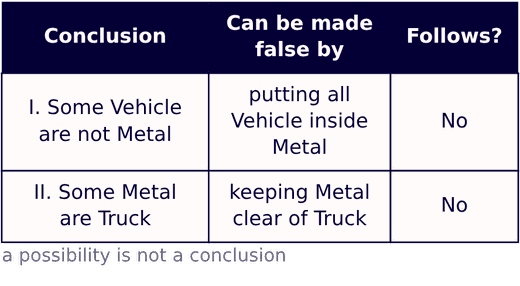
Conclusion II can be made false: draw Metal entirely in the part of Bulky that contains no truck, and all three statements still hold, so 'Some Metal are Truck' is only a possibility.
Conclusion I can be made false in the mirror way: draw the whole of Vehicle inside Metal (and inside the bulky trucks), and again every statement holds, so 'Some Vehicle are not Metal' is only a possibility.
A conclusion follows only when it is true in every arrangement, and each of these is true in some arrangements and false in others.
Hence neither conclusion follows — option (d).
39
What comes next in the following series ?
M15, ?, S45, V60, Y75
A.P30
B.031
C.Q30
D.R29
Solution
Alphanumeric series
Break each term into its letter and its number, and treat the two parts as two separate series.
Letters: M(13), ?, S(19), V(22), Y(25) — from S onward every letter is 3 places ahead of the one before, so the missing letter is at 13+3=16, which is P.
Numbers: 15, ?, 45, 60, 75 — they go up by 15 each time, so the missing number is 15+15=30.
Joining the two parts gives P30, so option (a) is correct.
Option (c) keeps the number but takes the letter Q(17), which is only 4 places before S, and option (d) breaks both parts at once.
40
Which of the following is the odd one out in the given series?
3Y, 5X, 7W, 9V, 11U,
A.3Y
B.7 W
C.5 X
D.9V
Solution
Odd one out in series
Read the two halves of each term separately.
The letters Y, X, W, V, U move back exactly one place every time, so they are perfectly regular and cannot single out any term.
The numbers are 3, 5, 7, 9, 11 — all of them odd, so oddness is not the test either.
Test them for primeness instead: 3, 5, 7 and 11 are prime, but is composite.
The term carrying the composite number is 9V, so option (d) is correct.
41
Which of the following letter cluster will come next to the series ?
WB, DW, KR, RM, ?
A.VY
B.YX
C.YH
D.VR
Solution
Letter cluster series
Split every cluster into its first letter and its second letter and follow the two chains separately.
First letters: W(23), D(4), K(11), R(18) — each step adds 7, since 23+7=30 becomes 4 after one full cycle of 26.
So the next first letter is 18+7=25, i.e. Y.
Second letters: B(2), W(23), R(18), M(13) — each step subtracts 5, since 2-5=-3 becomes 23 after one cycle.
So the next second letter is 13-5=8, i.e. H.
The missing cluster is therefore YH, so option (c) is correct.
42
What comes next in the series:
96, 48, 24, 12, ?
A.6
B.5
C.7
D.6.5
Solution
Number series: division
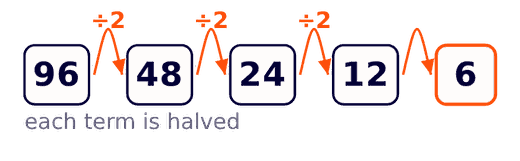
Compare each term with the one before it instead of looking at differences.
, and , so every term is half of the previous one.
Next term , so option (a) is correct.
43
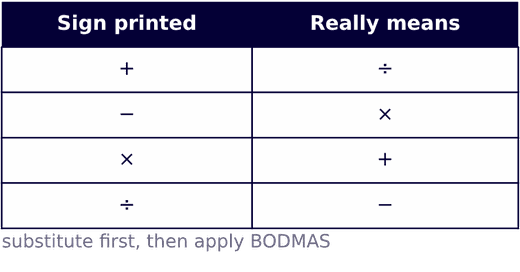
If + means ÷ , - means × , × means +, and means -, find:
?
A.38
B.39
C.41
D.42
Solution
Symbol substitution
Replace every sign by the meaning given, and only then apply BODMAS.
The expression becomes .
Division and multiplication come first: and .
Now 40+3-2=41.
Hence option (c) is correct.
44
Choose the related word from the given alternatives
Temperature : Kelvin :: Pressure : ?
A.Pascal
B.Joule
C.Watt
D.Newton
Solution
Analogy: SI units
The pair joins a physical quantity with its SI unit.
Kelvin (K) is the SI unit of temperature, so the answer must be the SI unit of pressure.
Pressure is measured in pascal, where 1 Pa is one newton per square metre.
Joule measures energy, watt measures power and newton measures force, so option (a) is correct.
45
Choose the related word from the given alternatives
Swan : Cygnet :: ? : Kit
A.Goat
B.Deer
C.Sheep
D.Fox
Solution
Analogy: young ones
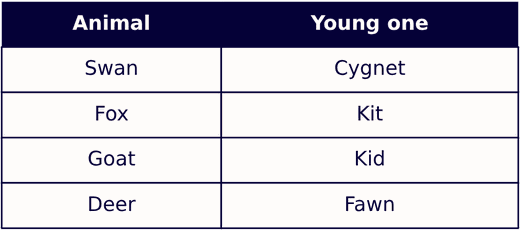
The pair joins an animal with the special name of its young one.
The young one of a swan is called a cygnet.
On the same pattern, the young one of a fox is called a kit.
A young goat is a kid, a young deer a fawn and a young sheep a lamb, so option (d) is correct.
46
What comes next ?
4, 14, 45, 139, 422, ?
A.1270
B.1274
C.1272
D.1276
Solution
Number series: ×3 pattern
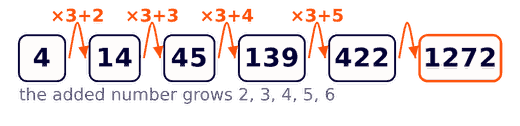
Each term is a little more than three times the one before it, so test 'multiply by 3, then add a rising number'.
The number added rises by 1 each time, so next .
Hence option (c) is correct.
47
Identify the pattern in the following sequence.
20, 42, 72, 110, 156, ?
What is the next number in the sequence?
A.210
B.198
C.204
D.216
Solution
Number series: differences
Take the consecutive differences: 42-20=22, 72-42=30, 110-72=38, 156-110=46.
These differences themselves grow by 8 each time, so the next difference is 46+8=54.
Next term =156+54=210.
The same terms can be read as , so the next is .
Hence option (a) is correct.
48
Select the option that is related to the fifth number in the same way as the second number is related to the first number and fourth number is related to third number.
(NOTE: Operations should be performed on the whole numbers, without breaking down the numbers into its constituent digits. E.g. 13 - Operations on 13 such as adding /subtracting /multiplying etc. to 13 can be performed. Breaking down 13 into 1 and 3 and then performing mathematical operations on 1 and 3 is not allowed)
7551 : 8502 :: 3548 : 4499 :: 6264 : ?
A.7215
B.7115
C.7315
D.7425
Solution
Number analogy
As the note directs, work on the whole numbers and simply compare them.
8502-7551=951
4499-3548=951
So the second number of every pair is 951 more than the first.
6264+951=7215, so option (a) is correct.
49
Select the option that is related to the second number in the same way as the third number is related to the fourth number and fifth number is related to sixth number.
(NOTE: Operations should be performed on the whole numbers, without breaking down the numbers into its constituent digits. E.g. 13 - Operations on 13 such as adding /subtracting /multiplying etc. to 13 can be performed. Breaking down 13 into 1 and 3 and then performing mathematical operations on 1 and 3 is not allowed)
? : 5239 :: 187 :-803:: 1781 : 791
A.6229
B.6227
C.6228
D.6225
Solution
Number analogy
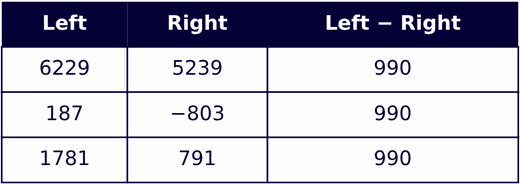
Read the two complete pairs first and find how the left number relates to the right one.
187-(-803)=187+803=990
1781-791=990
So in each pair the left number is 990 more than the right number.
Missing number =5239+990=6229, so option (a) is correct.
50
In the following question, four letter-number pairs are given. The letter-number on the left side of ( - ) is related to the letter-number on the right side of (-) with some Logic / Rule/Relation. Three pairs are similar on the basis of same Logic/Rule/Relation. Select the odd one out from the given alternatives.
(NOTE: Operations should be performed on the whole numbers, without breaking down the number into its constituent digits. E.g. 13 - Operations on 13 such as adding /subtracting /multiplying etc. to 13 can be performed. Breaking down 13 into 1 and 3 and then performing mathematical operations on 1 and 3 is not allowed)
A.BD332 - D1498
B.CI440 - EN660
C.ML556-0Q834
D.NA484 - PG726
Solution
Odd letter-number pair
Check the letters and the number of each pair separately.
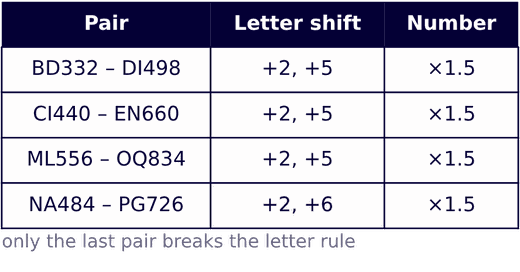
Numbers: , , and , so the number rule holds everywhere.
Letters: B→D and D→I is +2 and +5; C→E, I→N is again +2 and +5; M→O, L→Q is also +2 and +5.
In NA484 – PG726 the first letter moves N→P (+2), but the second moves A→G, which is +6 instead of +5.
That pair breaks the letter rule, so option (d) is the odd one out.
Finished reading? Now test yourself.
The same 25 questions, but with a timer and the answers hidden — 15 minutes.

 Delaying the launch fixes the errors before any learner sees them and protects the platform's credibility, so it is the balanced and responsible choice.
Launching now and correcting later (a) or releasing the course untouched (c) both push a defective product to the learners, while cancelling the course (b) throws away work that only needs a short correction.
Hence option (d) is correct.
Delaying the launch fixes the errors before any learner sees them and protects the platform's credibility, so it is the balanced and responsible choice.
Launching now and correcting later (a) or releasing the course untouched (c) both push a defective product to the learners, while cancelling the course (b) throws away work that only needs a short correction.
Hence option (d) is correct.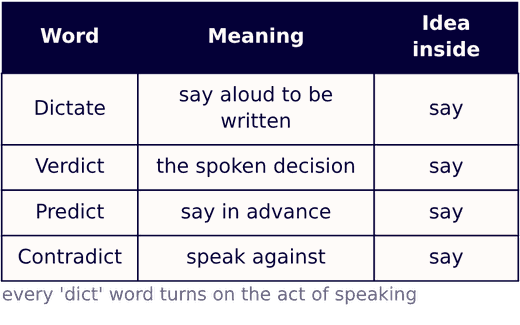 To 'dictate' is to say words aloud for someone else to write, a 'verdict' is what is truly said by a jury, and to 'predict' is to say beforehand — in each of them the idea is speaking.
So the Latin root 'dict' (from the verb dicere) means 'to say / to speak'.
The other options belong to different roots: 'to hear' is aud (audience, audible), 'to write' is scrib/script (scribble, manuscript) and 'to read' is leg/lect (legible, lecture).
Hence option (c) is correct.
To 'dictate' is to say words aloud for someone else to write, a 'verdict' is what is truly said by a jury, and to 'predict' is to say beforehand — in each of them the idea is speaking.
So the Latin root 'dict' (from the verb dicere) means 'to say / to speak'.
The other options belong to different roots: 'to hear' is aud (audience, audible), 'to write' is scrib/script (scribble, manuscript) and 'to read' is leg/lect (legible, lecture).
Hence option (c) is correct.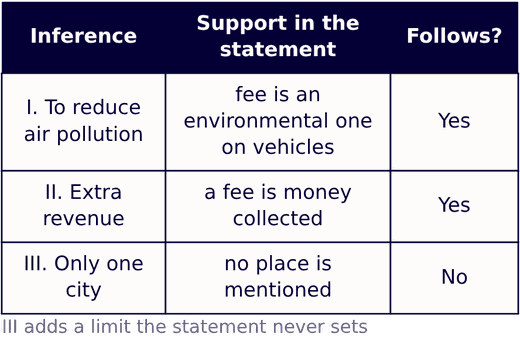 Inference I follows: a fee is called an 'environmental' fee and is placed on private vehicles precisely to discourage their use, and the purpose of discouraging them is cleaner air.
Inference II follows as well: every fee collected by the government becomes money in the government's hands, so extra revenue is a direct consequence.
Inference III does not follow: the statement mentions no city, no state and no boundary of any kind, so restricting the fee to a single city is pure guesswork.
Both I and II follow, so option (c) is correct.
Inference I follows: a fee is called an 'environmental' fee and is placed on private vehicles precisely to discourage their use, and the purpose of discouraging them is cleaner air.
Inference II follows as well: every fee collected by the government becomes money in the government's hands, so extra revenue is a direct consequence.
Inference III does not follow: the statement mentions no city, no state and no boundary of any kind, so restricting the fee to a single city is pure guesswork.
Both I and II follow, so option (c) is correct.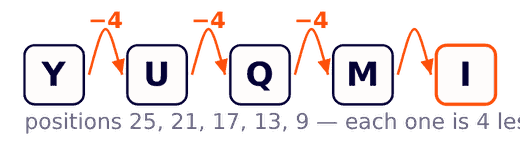 The next position is 13-4=9, and the 9th letter of the alphabet is I.
Hence option (a) is correct.
The next position is 13-4=9, and the 9th letter of the alphabet is I.
Hence option (a) is correct.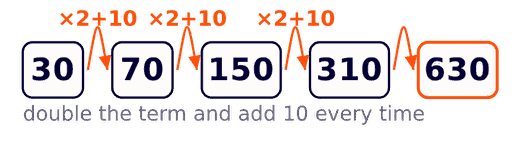 So the next term is .
The differences also double every step, and 310+320=630 confirms the same value.
Hence option (c) is correct.
So the next term is .
The differences also double every step, and 310+320=630 confirms the same value.
Hence option (c) is correct.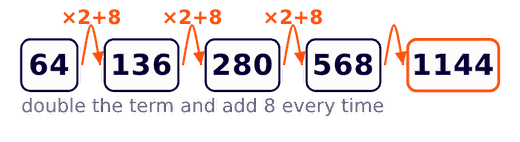 So the next term is .
The differences also double each time, giving 568+576=1144 as a check.
Hence option (d) is correct.
So the next term is .
The differences also double each time, giving 568+576=1144 as a check.
Hence option (d) is correct.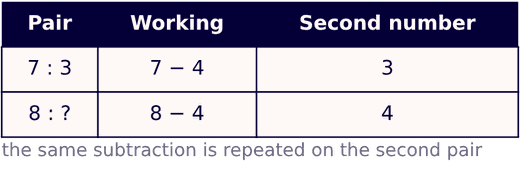 Apply the same rule to 8: 8-4=4.
Hence the number that completes the analogy is 4 — option (b).
Apply the same rule to 8: 8-4=4.
Hence the number that completes the analogy is 4 — option (b).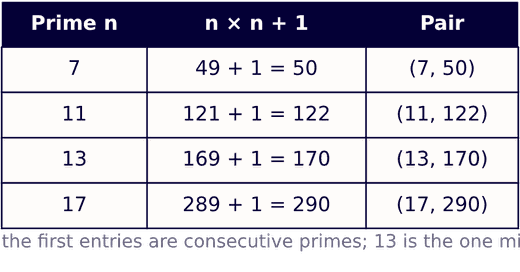 For n=13: .
So the missing pair is (13,170) and option (b) is correct.
The traps use non-primes: 12, 14 and 15 are composite, so options (a), (c) and (d) break the first half of the rule at once.
For n=13: .
So the missing pair is (13,170) and option (b) is correct.
The traps use non-primes: 12, 14 and 15 are composite, so options (a), (c) and (d) break the first half of the rule at once.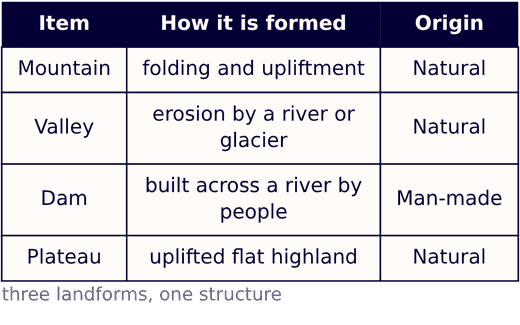 A mountain, a valley and a plateau are landforms shaped by natural forces — folding of the crust, erosion by rivers and upliftment over thousands of years.
A dam is built by human beings across a river to store water and generate power, so its origin is artificial.
The one item of man-made origin is the dam, so option (c) is correct.
A mountain, a valley and a plateau are landforms shaped by natural forces — folding of the crust, erosion by rivers and upliftment over thousands of years.
A dam is built by human beings across a river to store water and generate power, so its origin is artificial.
The one item of man-made origin is the dam, so option (c) is correct.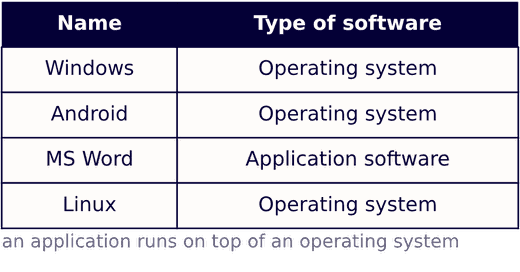 Windows, Android and Linux are operating systems: they manage the hardware and let other programs run on the machine.
MS Word is application software — a word processor that itself needs an operating system to run on.
The odd one out is therefore MS Word, so option (c) is correct.
Windows, Android and Linux are operating systems: they manage the hardware and let other programs run on the machine.
MS Word is application software — a word processor that itself needs an operating system to run on.
The odd one out is therefore MS Word, so option (c) is correct.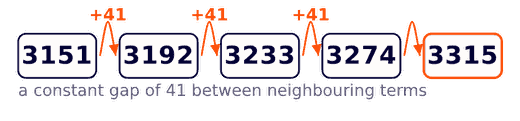 The next term is 3274+41=3315.
Hence option (b) is correct; the other choices differ from it by 2, 1 and 2 and would break the constant gap.
The next term is 3274+41=3315.
Hence option (b) is correct; the other choices differ from it by 2, 1 and 2 and would break the constant gap.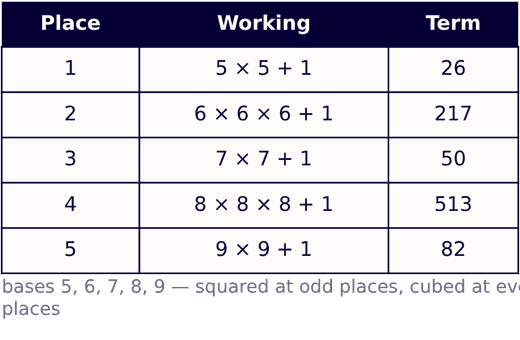 So the base numbers simply run 5, 6, 7, 8, 9 in order; they are squared at the odd places and cubed at the even places, and 1 is added every time.
The fifth term stands at an odd place with base 9, so it is .
Hence option (b) is correct; 729 is and would be right only if the term stood at an even place.
So the base numbers simply run 5, 6, 7, 8, 9 in order; they are squared at the odd places and cubed at the even places, and 1 is added every time.
The fifth term stands at an odd place with base 9, so it is .
Hence option (b) is correct; 729 is and would be right only if the term stood at an even place.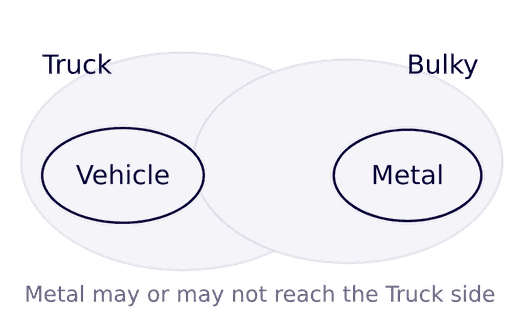 Metal is tied only to Bulky; nothing fixes whether Metal reaches the truck part of Bulky, so Metal has no definite link with Truck or with Vehicle.
Conclusion II can be made false: draw Metal entirely in the part of Bulky that contains no truck, and all three statements still hold, so 'Some Metal are Truck' is only a possibility.
Conclusion I can be made false in the mirror way: draw the whole of Vehicle inside Metal (and inside the bulky trucks), and again every statement holds, so 'Some Vehicle are not Metal' is only a possibility.
Metal is tied only to Bulky; nothing fixes whether Metal reaches the truck part of Bulky, so Metal has no definite link with Truck or with Vehicle.
Conclusion II can be made false: draw Metal entirely in the part of Bulky that contains no truck, and all three statements still hold, so 'Some Metal are Truck' is only a possibility.
Conclusion I can be made false in the mirror way: draw the whole of Vehicle inside Metal (and inside the bulky trucks), and again every statement holds, so 'Some Vehicle are not Metal' is only a possibility.
 A conclusion follows only when it is true in every arrangement, and each of these is true in some arrangements and false in others.
Hence neither conclusion follows — option (d).
A conclusion follows only when it is true in every arrangement, and each of these is true in some arrangements and false in others.
Hence neither conclusion follows — option (d).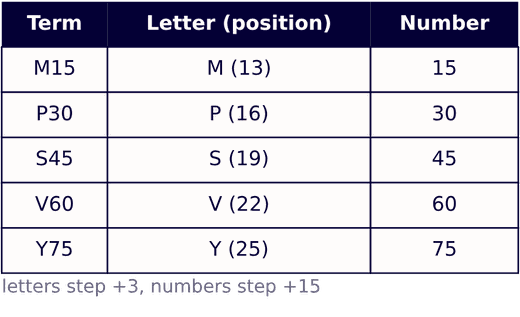 Joining the two parts gives P30, so option (a) is correct.
Option (c) keeps the number but takes the letter Q(17), which is only 4 places before S, and option (d) breaks both parts at once.
Joining the two parts gives P30, so option (a) is correct.
Option (c) keeps the number but takes the letter Q(17), which is only 4 places before S, and option (d) breaks both parts at once.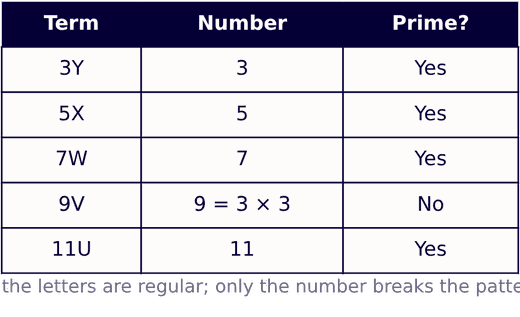 Test them for primeness instead: 3, 5, 7 and 11 are prime, but is composite.
The term carrying the composite number is 9V, so option (d) is correct.
Test them for primeness instead: 3, 5, 7 and 11 are prime, but is composite.
The term carrying the composite number is 9V, so option (d) is correct.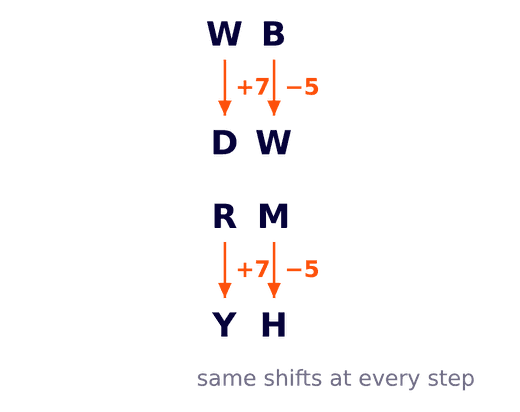 The missing cluster is therefore YH, so option (c) is correct.
 Next term , so option (a) is correct.
 The expression becomes .
Division and multiplication come first: and .
Now 40+3-2=41.
Hence option (c) is correct.
The expression becomes .
Division and multiplication come first: and .
Now 40+3-2=41.
Hence option (c) is correct.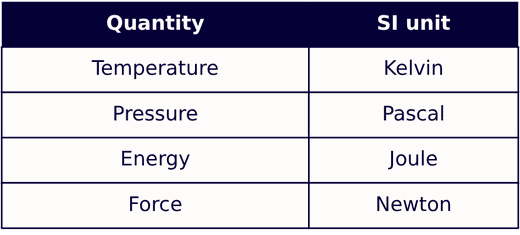 Joule measures energy, watt measures power and newton measures force, so option (a) is correct.
 A young goat is a kid, a young deer a fawn and a young sheep a lamb, so option (d) is correct.
 The number added rises by 1 each time, so next .
Hence option (c) is correct.
The number added rises by 1 each time, so next .
Hence option (c) is correct.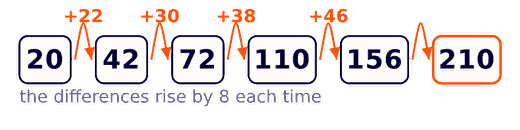 Next term =156+54=210.
The same terms can be read as , so the next is .
Hence option (a) is correct.
Next term =156+54=210.
The same terms can be read as , so the next is .
Hence option (a) is correct.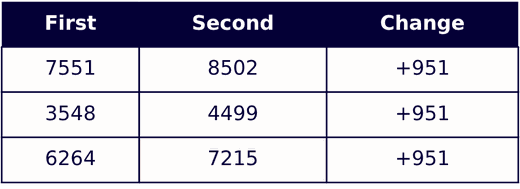 6264+951=7215, so option (a) is correct.
 Missing number =5239+990=6229, so option (a) is correct.
 In NA484 – PG726 the first letter moves N→P (+2), but the second moves A→G, which is +6 instead of +5.
That pair breaks the letter rule, so option (d) is the odd one out.
In NA484 – PG726 the first letter moves N→P (+2), but the second moves A→G, which is +6 instead of +5.
That pair breaks the letter rule, so option (d) is the odd one out.