SSC CHSL 30 November 2025 · Shift 1 · English Language — questions with answers · ShikshaSphere
Chapter 192 of 200
30 November 2025 · Shift 1
English Language
25 questions ~25 min readFree
25 questions
A
1
The sentence below has errors in two parts which are highlighted in bold. Identify the same.
Regal Theatre is to shut on January(A), it was declared last week. The owner of the property, Mr Sharma, will have leased it(B) to a group of developers(C), who are planning to construct several apartments on the .
A.AB
B.CD
C.BD
D.AC
Solution
Error spotting: two parts
Each marked part has to be tested against a rule; exactly two of them break one.
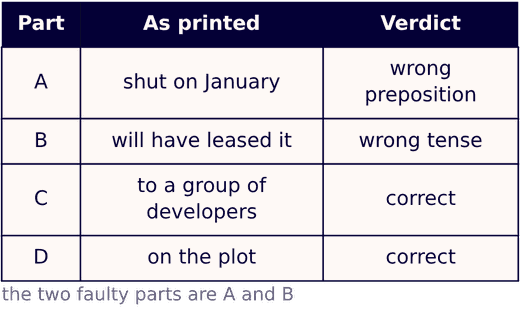
Part A: names of months, years and seasons take the preposition 'in', so 'is to shut on January' must read 'is to shut in January'.
Part B: the developers 'are planning' to build now, which shows the property has already been leased; the future perfect 'will have leased' pushes the leasing after the present and destroys the sense.
The present perfect 'has leased it' is what the sentence needs, so part B is faulty.
Parts C and D are sound, so the two errors lie in A and B.
2
Fill in the blank with the most appropriate preposition:
The spokesperson is not permitted to act
behalf of the company during external negotiations.
A.for
B.in
C.upon
D.on
Solution
Preposition in a phrase
The fixed phrase is 'on behalf of somebody', meaning 'as the representative of' that person or body.
The spokesperson speaks as the representative of the company, so 'on behalf of the company' is required.
'In behalf of' means 'for the benefit of' and does not suit a representative speaking; 'for behalf of' and 'upon behalf of' are not English phrases at all.
3
Select the most appropriate synonym of the word:
Insightful
A.Unaware
B.Sagacious
C.Naïve
D.Careless
Solution
Synonym
Insightful means showing a deep and accurate understanding of a matter.
Sagacious means having keen judgement and sound practical wisdom, which is the same quality of mind.
Unaware (not knowing), Naïve (lacking experience of life) and Careless (giving no proper attention) all point the opposite way, so option (b) is correct.
4
Choose the correctly spelt word:
A.Sergeant
B.Seargent
C.Sargant
D.Sergant
Solution
Correct spelling
The correct spelling is 'Sergeant' — S-e-r-g-e-a-n-t.
It names a rank in the army or the police and comes from Old French 'sergent'; note that the first syllable is 'ser-' and the ending is '-geant'.
'Seargent', 'Sargant' and 'Sergant' all disturb this order of vowels, so only option (a) is correctly spelt.
5
Which of the following sentences uses the word "found" in a meaning different from the others?
A.Scientists found a rare mineral during the expedition.
B.She found her wallet in the drawer.
C.The university was found in 1991.
D.He finally found the solution to the complex problem.
Solution
One word, two meanings
English has two different verbs spelt 'found'.
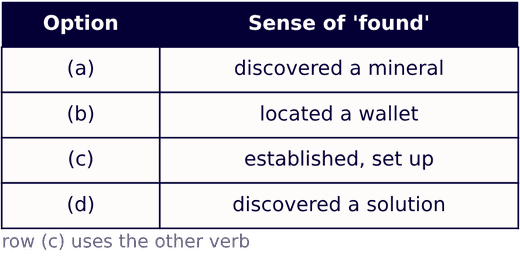
One is the past tense of 'find' — to discover or come upon something; the other is the verb 'found', meaning to establish an institution.
In (a) a mineral is discovered, in (b) a wallet is located and in (d) a solution is discovered, so all three use 'find'.
Only in (c) is a university set up in 1991, which is the sense of establishing, so option (c) stands apart.
6
Choose the correct meaning of the idiom:
After weeks of disagreement, the two leaders were clearly on a collision course.
A.Avoiding confrontation completely
B.Planning a joint strategy
C.Moving towards an unavoidable clash
D.Reaching a mutual agreement peacefully
Solution
Idiom meaning
'On a collision course' pictures two vehicles moving along paths that are bound to meet.
Used of people it means heading straight for a conflict that can no longer be avoided.
Weeks of disagreement lead exactly to such a clash, so 'moving towards an unavoidable clash' is the meaning; avoiding a confrontation, planning together and agreeing peacefully are all the opposite of it.
7
Choose the correct meaning of the idiom:
I got the news straight from the horse's mouth, so I know it's true.
A.From a written report
B.Through rumours
C.By guessing the facts
D.From a trustworthy source
Solution
Idiom meaning
'Straight from the horse's mouth' comes from horse-racing, where the surest tip about a horse would be one given by the horse itself.
It therefore means information taken directly from the person who really knows — a trustworthy source.
The speaker adds 'so I know it's true', which rules out rumours, guesswork and a mere written report, so option (d) is correct.
8
Choose the correct one-word substitute for:
A strong building used for defense, not training.
A.Barracks
B.Bunker
C.Fortress
D.Citadel
Solution
One-word substitution
A fortress is a large, strongly built place raised for defence against attack.
The definition deliberately adds 'not training', which throws out barracks, since barracks are the buildings where soldiers live and are trained.
A bunker is only a small, usually underground shelter, and a citadel is a fortress standing inside or above a city, so 'Fortress' is the exact word.
9
Select the most appropriate antonym of the word:
Pretty
A.Monstrous
B.Beautiful
C.Attractive
D.Lovely
Solution
Antonym
Pretty means pleasant and attractive to look at.
Its opposite must carry the idea of ugliness, and 'Monstrous' means hideous, frightful and repulsive in appearance.
Beautiful, Attractive and Lovely all repeat the sense of 'pretty' instead of reversing it, so option (a) is the antonym.
10
Select the most appropriate antonym of the word:
Vague
A.fuzzy
B.Elucidate
C.Obscure
D.foggy
Solution
Antonym
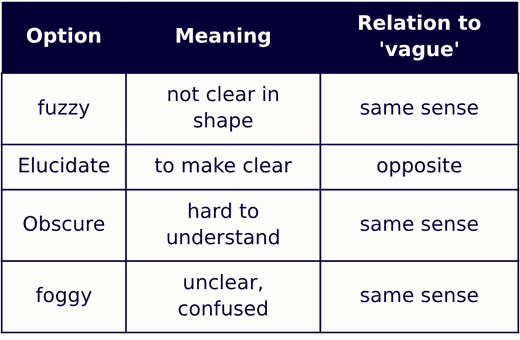
Vague means not clearly expressed or perceived — blurred and indefinite.
Fuzzy, Obscure and Foggy all repeat that very sense of unclearness, so none of them can be its opposite.
'Elucidate' means to make a thing clear and easy to understand, which reverses the idea of leaving something vague, so option (b) is correct.
11
Choose the option that is the most appropriate conversion of the following sentence into Direct Speech.
They asked whether the train was expected to arrive on time or be delayed further.
A.They asked, "Is the train expected to arrive on time or will it be delayed further?"
B.They asked, "Is the train expected to arrive shortly or be delayed more?"
C.They asked, "Will the train expected arrive on time or is it to be delayed further?"
D.They asked, "Was the train expected to arrive on time or be delayed further?*
Solution
Indirect to direct speech
In the reported form the past-tense reporting verb 'asked' has pushed the verb of the question one step back.
Turning it into Direct Speech, that back-shift must be undone, so 'was expected' returns to 'Is ... expected'.
The conjunction 'whether' disappears, the words are put inside inverted commas, and the alternative is stated as the second half of the question: 'or will it be delayed further?'
Option (b) changes the words themselves ('shortly', 'more'), option (c) disturbs the word order, and option (d) leaves the verb in the back-shifted past, so option (a) is correct.
12
Choose the misspelled word ?
The doctor explained that taking the medicine on time is cruicial because even a small delay could seriously affect the patient's recovery and overall health.
A.medicine
B.cruicial
C.serious
D.patient
Solution
Misspelt word
Reading the sentence word by word, 'cruicial' carries an extra 'i'.
The correct spelling is 'crucial' — c-r-u-c-i-a-l — meaning decisive or extremely important.
'Medicine' and 'patient' are spelt correctly in the sentence, and the sentence in fact uses 'seriously', not 'serious', so option (b) is the misspelt word.
13
Select the option that expresses the given sentence in indirect voice. "We will organize a trip next weekend," my colleagues told me.
A.My colleagues told me that they will organize a trip the next weekend.
B.My colleagues told me that we would organize a trip next weekend.
C.My colleagues told me that they would organize a trip the next weekend.
D.My colleagues told me that we will organize a trip next weekend.
Solution
Direct to indirect speech
Three changes are needed when this statement is reported.
Pronoun: 'we' stands for the colleagues who are speaking, and the reporter is a different person, so 'we' becomes 'they'.
Tense: the reporting verb 'told' is in the past, so 'will organize' becomes 'would organize'.
Time-word: 'next weekend' is counted from the moment of speaking and becomes 'the next weekend' in the report.
Option (c) alone makes all three changes, so it is correct.
14
Change the following sentence into the Active form.
Had the renovation work been being carried out on the old library for weeks before she arrived ?
A.Had they been carrying out the renovation work on the old library for weeks before she arrived?
B.They had been carrying out the renovation work on the old library for weeks before she arrived ?
C.Had the old library been carrying out the renovation work for weeks before she arrived?
D.Were they carrying out the renovation work on the old library for weeks before she arrived?
Solution
Passive to active voice
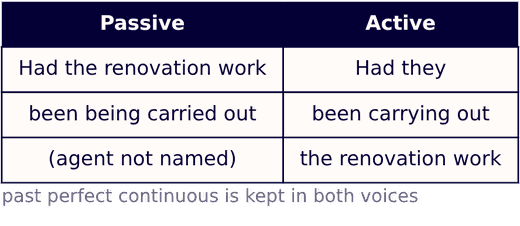
'Had been being carried out' is the past perfect continuous passive, so the active verb must also be past perfect continuous: 'had been carrying out'.
The doer is nowhere named, so the indefinite agent 'they' supplies the subject, and the passive subject 'the renovation work' becomes the object.
The sentence is a question, so the auxiliary 'Had' keeps its place before the subject: 'Had they been carrying out the renovation work ... ?'
Option (b) turns it into a statement, option (c) makes the library itself the doer, and option (d) shifts to the past continuous, so option (a) is correct.
15
Choose the most suitable option to replace the highlighted part of the sentence:
After climbing the steep hill, the man was out of breathe.
A.out of air
B.out of breathing
C.out of breath
D.out of breaths
Solution
Idiom and spelling
The idiom is 'out of breath', meaning panting and unable to breathe easily after exertion.
'Breath' is the noun and 'breathe' is the verb, and the preposition 'of' must be followed by a noun, so 'breathe' is out of place here.
Climbing a steep hill leaves the man panting, so 'out of breath' fits exactly; 'out of air', 'out of breathing' and 'out of breaths' are not English idioms.
16
Choose the correct passive voice transformation of the sentence:
Someone has misplaced the keys.
A.The keys were misplaced.
B.The keys have been misplaced.
C.The keys are misplaced.
D.The keys had been misplaced.
Solution
Active to passive voice
The active verb is 'has misplaced' — present perfect — and the object is 'the keys'.
The present perfect passive is formed as has/have + been + past participle, and the new subject 'The keys' is plural, so 'have been' is used.
The agent 'someone' is indefinite and is therefore dropped, giving 'The keys have been misplaced.'
Option (a) is simple past, (c) simple present and (d) past perfect, so none of them keeps the original tense.
17
Directions (Qs. 17-21): Read the following passage carefully and answer the questions that follow.
Uttarakhand, celebrated for its scenic landscapes and rich ecological heritage, is currently facing a severe phase of environmental deterioration. Unchecked deforestation, driven by rapid infrastructure development and increasing tourist inflow, exacerbates the fragile ecosystem's vulnerability, leading to a significant loss of biodiversity. Forests that once functioned as crucial carbon absorbers and shelters for diverse species are now increasingly fragmented, disturbing the natural equilibrium.
The excessive exploitation of natural resources, particularly minerals and freshwater, along with unpredictable climatic variations linked to global warming, further weakens the ecosystem. Rampant construction along riverbanks and mountainous terrains has resulted in soil degradation and a rising incidence of landslides, posing serious threats to local communities and wildlife. Moreover, careless disposal of waste, especially non-biodegradable materials, in environmentally sensitive areas amplifies pollution and endangers aquatic ecosystems.
A major contributor to this environmental decline is the lack of effective environmental regulations and their proper implementation. Despite public awareness initiatives, administrative bodies often prioritise economic development over ecological
preservation. This imbalance between progress and environmental responsibility jeopardises the region's ecological sanctity, calling for urgent corrective action.
In conclusion, Uttarakhand's environmental challenges stem from human activities combined with climatic changes. Coordinated efforts involving policy enhancement, public participation, and scientific solutions are essential to restore the state's ecological balance.
In the sentence,
"Unchecked deforestation, driven by rapid infrastructure development and increasing tourist inflow, exacerbates the fragile ecosystem's vulnerability," identify the type of noun "deforestation" is:
A.Proper noun
B.Abstract noun
C.Concrete noun
D.Collective noun
Solution
Kinds of noun
A concrete noun names something the senses can perceive, while an abstract noun names an idea, quality, state or action.
'Deforestation' names the process of clearing forests; it is an action, not a thing that can be touched or pointed at.
It is therefore an abstract noun — it is not the name of one particular person or place (proper), nor the name of a group taken as a single whole (collective).
18
Directions (Qs. 17-21): Read the following passage carefully and answer the questions that follow.
Uttarakhand, celebrated for its scenic landscapes and rich ecological heritage, is currently facing a severe phase of environmental deterioration. Unchecked deforestation, driven by rapid infrastructure development and increasing tourist inflow, exacerbates the fragile ecosystem's vulnerability, leading to a significant loss of biodiversity. Forests that once functioned as crucial carbon absorbers and shelters for diverse species are now increasingly fragmented, disturbing the natural equilibrium.
The excessive exploitation of natural resources, particularly minerals and freshwater, along with unpredictable climatic variations linked to global warming, further weakens the ecosystem. Rampant construction along riverbanks and mountainous terrains has resulted in soil degradation and a rising incidence of landslides, posing serious threats to local communities and wildlife. Moreover, careless disposal of waste, especially non-biodegradable materials, in environmentally sensitive areas amplifies pollution and endangers aquatic ecosystems.
A major contributor to this environmental decline is the lack of effective environmental regulations and their proper implementation. Despite public awareness initiatives, administrative bodies often prioritise economic development over ecological
preservation. This imbalance between progress and environmental responsibility jeopardises the region's ecological sanctity, calling for urgent corrective action.
In conclusion, Uttarakhand's environmental challenges stem from human activities combined with climatic changes. Coordinated efforts involving policy enhancement, public participation, and scientific solutions are essential to restore the state's ecological balance.
Identify the type of clause in the sentence:
"Forests, which once functioned as crucial carbon absorbers and shelters for diverse species, are now increasingly fragmented."
A.Adjective clause
B.Adverb clause
C.Noun clause
D.Relative clause
Solution
Type of clause
The group 'which once functioned as crucial carbon absorbers and shelters for diverse species' has its own subject and verb, yet it cannot stand alone, so it is a subordinate clause.
It is introduced by the relative pronoun 'which' and adds information about the noun 'Forests' that stands just before it.
A clause introduced in this way by who, whom, whose, which or that is called a relative clause, so option (d) is correct.
It is not a noun clause, since it works neither as subject nor as object of a verb, and not an adverb clause, since it answers no question of time, place, reason or manner.
19
Directions (Qs. 17-21): Read the following passage carefully and answer the questions that follow.
Uttarakhand, celebrated for its scenic landscapes and rich ecological heritage, is currently facing a severe phase of environmental deterioration. Unchecked deforestation, driven by rapid infrastructure development and increasing tourist inflow, exacerbates the fragile ecosystem's vulnerability, leading to a significant loss of biodiversity. Forests that once functioned as crucial carbon absorbers and shelters for diverse species are now increasingly fragmented, disturbing the natural equilibrium.
The excessive exploitation of natural resources, particularly minerals and freshwater, along with unpredictable climatic variations linked to global warming, further weakens the ecosystem. Rampant construction along riverbanks and mountainous terrains has resulted in soil degradation and a rising incidence of landslides, posing serious threats to local communities and wildlife. Moreover, careless disposal of waste, especially non-biodegradable materials, in environmentally sensitive areas amplifies pollution and endangers aquatic ecosystems.
A major contributor to this environmental decline is the lack of effective environmental regulations and their proper implementation. Despite public awareness initiatives, administrative bodies often prioritise economic development over ecological
preservation. This imbalance between progress and environmental responsibility jeopardises the region's ecological sanctity, calling for urgent corrective action.
In conclusion, Uttarakhand's environmental challenges stem from human activities combined with climatic changes. Coordinated efforts involving policy enhancement, public participation, and scientific solutions are essential to restore the state's ecological balance.
Which word from the passage means to worsen?
A.Alleviates
B.Exacerbates
C.Mitigates
D.Initiates
Solution
Word meaning from passage
'To worsen' means to make a bad situation still worse.
The first paragraph says that unchecked deforestation 'exacerbates the fragile ecosystem's vulnerability' — that is, it increases the danger already present.
Alleviates and Mitigates mean exactly the opposite, to lessen or soften, and Initiates means to begin, so only 'Exacerbates' carries the sense of worsening.
20
Directions (Qs. 17-21): Read the following passage carefully and answer the questions that follow.
Uttarakhand, celebrated for its scenic landscapes and rich ecological heritage, is currently facing a severe phase of environmental deterioration. Unchecked deforestation, driven by rapid infrastructure development and increasing tourist inflow, exacerbates the fragile ecosystem's vulnerability, leading to a significant loss of biodiversity. Forests that once functioned as crucial carbon absorbers and shelters for diverse species are now increasingly fragmented, disturbing the natural equilibrium.
The excessive exploitation of natural resources, particularly minerals and freshwater, along with unpredictable climatic variations linked to global warming, further weakens the ecosystem. Rampant construction along riverbanks and mountainous terrains has resulted in soil degradation and a rising incidence of landslides, posing serious threats to local communities and wildlife. Moreover, careless disposal of waste, especially non-biodegradable materials, in environmentally sensitive areas amplifies pollution and endangers aquatic ecosystems.
A major contributor to this environmental decline is the lack of effective environmental regulations and their proper implementation. Despite public awareness initiatives, administrative bodies often prioritise economic development over ecological
preservation. This imbalance between progress and environmental responsibility jeopardises the region's ecological sanctity, calling for urgent corrective action.
In conclusion, Uttarakhand's environmental challenges stem from human activities combined with climatic changes. Coordinated efforts involving policy enhancement, public participation, and scientific solutions are essential to restore the state's ecological balance.
Select the option that means 'the purity and inviolability of the natural environment'.
A.ecological sanctity
B.environmental challenges
C.mountainous terrains
D.local communities
Solution
Phrase meaning from passage
'Sanctity' means holiness or a purity that must not be violated, and 'ecological' relates to the natural environment.
The fourth paragraph says that the imbalance between progress and responsibility 'jeopardises the region's ecological sanctity', that is, it endangers the untouched purity of the natural environment.
'Environmental challenges' names problems, 'mountainous terrains' names landforms and 'local communities' names people, so none of them carries the idea of purity; option (a) is correct.
21
Directions (Qs. 17-21): Read the following passage carefully and answer the questions that follow.
Uttarakhand, celebrated for its scenic landscapes and rich ecological heritage, is currently facing a severe phase of environmental deterioration. Unchecked deforestation, driven by rapid infrastructure development and increasing tourist inflow, exacerbates the fragile ecosystem's vulnerability, leading to a significant loss of biodiversity. Forests that once functioned as crucial carbon absorbers and shelters for diverse species are now increasingly fragmented, disturbing the natural equilibrium.
The excessive exploitation of natural resources, particularly minerals and freshwater, along with unpredictable climatic variations linked to global warming, further weakens the ecosystem. Rampant construction along riverbanks and mountainous terrains has resulted in soil degradation and a rising incidence of landslides, posing serious threats to local communities and wildlife. Moreover, careless disposal of waste, especially non-biodegradable materials, in environmentally sensitive areas amplifies pollution and endangers aquatic ecosystems.
A major contributor to this environmental decline is the lack of effective environmental regulations and their proper implementation. Despite public awareness initiatives, administrative bodies often prioritise economic development over ecological
preservation. This imbalance between progress and environmental responsibility jeopardises the region's ecological sanctity, calling for urgent corrective action.
In conclusion, Uttarakhand's environmental challenges stem from human activities combined with climatic changes. Coordinated efforts involving policy enhancement, public participation, and scientific solutions are essential to restore the state's ecological balance.
According to the passage, which factor does NOT contribute to environmental degradation?
A.Unchecked deforestation
B.Careless disposal of waste
C.Excessive construction activities
D.Strict implementation of environmental regulations
Solution
Reading comprehension
The question asks for the one option that the passage does NOT list as a cause of environmental damage, so each option has to be traced back to the text.
Paragraph 1 names 'unchecked deforestation', and paragraph 2 names 'rampant construction along riverbanks and mountainous terrains' and 'careless disposal of waste' — so (a), (b) and (c) are all stated causes.
About regulations the passage says the opposite: a major contributor to the decline is 'the lack of effective environmental regulations and their proper implementation'.
Strict implementation would therefore repair the damage rather than cause it, so option (d) is the factor that does not contribute.
22
Rearrange the following sentences to form a meaningful and grammatically correct paragraph:
P. The coffee machine hissed, its steam a fragrant cloud in the morning air.
Q. He placed a filter in the dripper, pouring the hot water over the dark grounds.
R. A swirl of cream clouded the liquid, turning it a rich hazelnut colour.
S. With the first bold sip, the day felt a little easier to manage.
A.P, Q, R, S
B.S, Q, R, P
C.Q, S, P, R
D.R, Q, P, S
Solution
Sentence rearrangement
The four sentences describe one continuous action — making and drinking a cup of coffee — so they must follow the natural order of that process.
P sets the scene with the machine hissing in the morning air; it is the only sentence that fixes the time and place, so it opens the paragraph.
Q is the next stage of brewing: the filter goes into the dripper and hot water is poured over the grounds.
R comes after the coffee exists, because cream can be swirled in only once the liquid is there.
S is the natural close — the first sip makes the day easier to manage.
The sequence is P, Q, R, S, so option (a) is correct.
23
Rearrange the following sentence parts to form a meaningful and grammatically correct paragraph:
P. The medical team enrolled a large group of eligible patients for the clinical trial.
Q. At the end of the study, they evaluated the findings to determine the new medicine's safety and effectiveness.
R. The doctors closely monitored the health and recovery of all the patients for several weeks.
S. Half the patients were given the new medicine, while the remaining half received the old one.
A.R, S, Q, P
B.P, S, R, Q
C.Q, S, R, P
D.R, S, P, Q
Solution
Sentence rearrangement
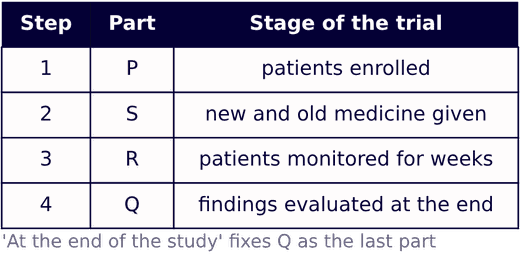
The parts narrate one clinical trial from beginning to end, so they must be placed in the order in which a trial actually runs.
P must open, because it introduces 'a large group of eligible patients'; the other parts speak of 'the patients' as people already known to the reader.
S follows P, since the patients can be split into two halves only after they have been enrolled.
R follows S: once the two medicines have been given, the doctors watch the patients for several weeks.
Q closes the paragraph — its own words 'At the end of the study' mark it as the last stage.
The sequence is P, S, R, Q, so option (b) is correct.
24
Which word is nearest in meaning to attentively ?
The guards were carefully watching the entrance throughout the night.
A.Carelessly
B.Intently
C.Casually
D.Negligently
Solution
Synonym
'Attentively' means doing something with close attention and full concentration.
In the sentence the guards watch the entrance all night long, so the word must keep that sense of steady, concentrated watching.
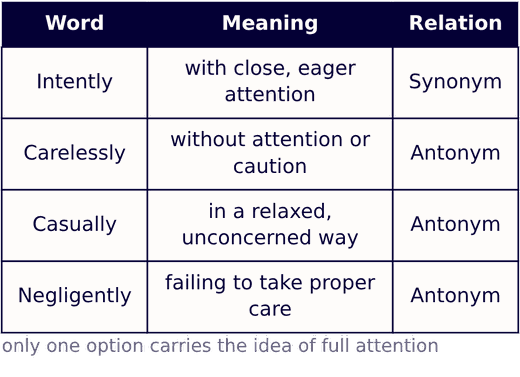
'Intently' means 'with earnest and eager attention', which is exactly that sense — 'watching intently' and 'watching attentively' say the same thing.
'Carelessly' and 'negligently' both mean 'without proper care', and 'casually' means 'in a relaxed, unconcerned way'; all three are opposites of attentively.
Hence option (b) is correct.
25
Which term refers to a form of government with elected representatives.
A.Theocracy
B.Democracy
C.Republic
D.Utopia
Solution
One-word substitution
The term asked for names a form of government in which the head of state and the law-makers are chosen by the people instead of inheriting their office.
That term is 'republic' — India is a republic because its President is elected and is not a hereditary monarch.
'Democracy' answers a different question: it says where power lies (with the people) and can survive under a crowned head, as in the United Kingdom, so it is not defined by elected representatives alone.
'Theocracy' is rule by religious leaders or religious law, and a 'utopia' is an imagined perfect society, not a form of government at all.
Hence option (c) is correct.
Finished reading? Now test yourself.
The same 25 questions, but with a timer and the answers hidden — 15 minutes.

 Parts C and D are sound, so the two errors lie in A and B.
 In (a) a mineral is discovered, in (b) a wallet is located and in (d) a solution is discovered, so all three use 'find'.
Only in (c) is a university set up in 1991, which is the sense of establishing, so option (c) stands apart.
In (a) a mineral is discovered, in (b) a wallet is located and in (d) a solution is discovered, so all three use 'find'.
Only in (c) is a university set up in 1991, which is the sense of establishing, so option (c) stands apart.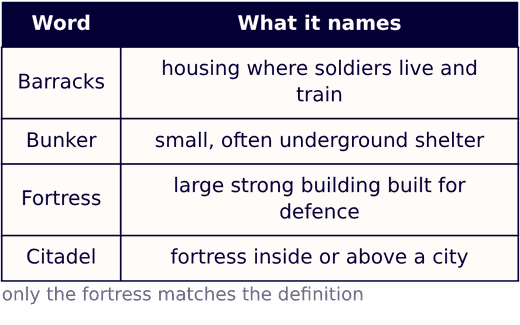 A bunker is only a small, usually underground shelter, and a citadel is a fortress standing inside or above a city, so 'Fortress' is the exact word.
 Fuzzy, Obscure and Foggy all repeat that very sense of unclearness, so none of them can be its opposite.
'Elucidate' means to make a thing clear and easy to understand, which reverses the idea of leaving something vague, so option (b) is correct.
Fuzzy, Obscure and Foggy all repeat that very sense of unclearness, so none of them can be its opposite.
'Elucidate' means to make a thing clear and easy to understand, which reverses the idea of leaving something vague, so option (b) is correct.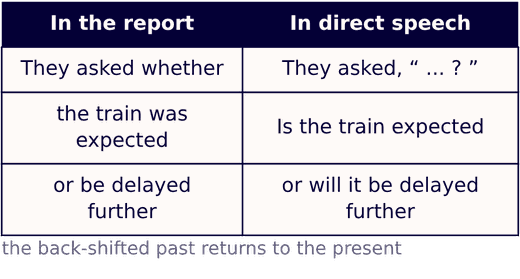 The conjunction 'whether' disappears, the words are put inside inverted commas, and the alternative is stated as the second half of the question: 'or will it be delayed further?'
Option (b) changes the words themselves ('shortly', 'more'), option (c) disturbs the word order, and option (d) leaves the verb in the back-shifted past, so option (a) is correct.
The conjunction 'whether' disappears, the words are put inside inverted commas, and the alternative is stated as the second half of the question: 'or will it be delayed further?'
Option (b) changes the words themselves ('shortly', 'more'), option (c) disturbs the word order, and option (d) leaves the verb in the back-shifted past, so option (a) is correct.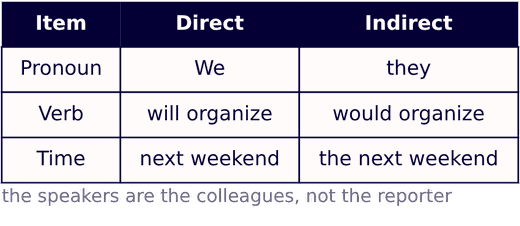 Option (c) alone makes all three changes, so it is correct.
 The sentence is a question, so the auxiliary 'Had' keeps its place before the subject: 'Had they been carrying out the renovation work ... ?'
Option (b) turns it into a statement, option (c) makes the library itself the doer, and option (d) shifts to the past continuous, so option (a) is correct.
The sentence is a question, so the auxiliary 'Had' keeps its place before the subject: 'Had they been carrying out the renovation work ... ?'
Option (b) turns it into a statement, option (c) makes the library itself the doer, and option (d) shifts to the past continuous, so option (a) is correct.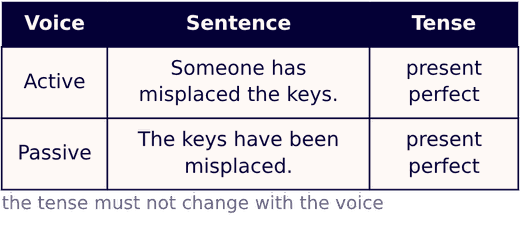 The agent 'someone' is indefinite and is therefore dropped, giving 'The keys have been misplaced.'
Option (a) is simple past, (c) simple present and (d) past perfect, so none of them keeps the original tense.
The agent 'someone' is indefinite and is therefore dropped, giving 'The keys have been misplaced.'
Option (a) is simple past, (c) simple present and (d) past perfect, so none of them keeps the original tense.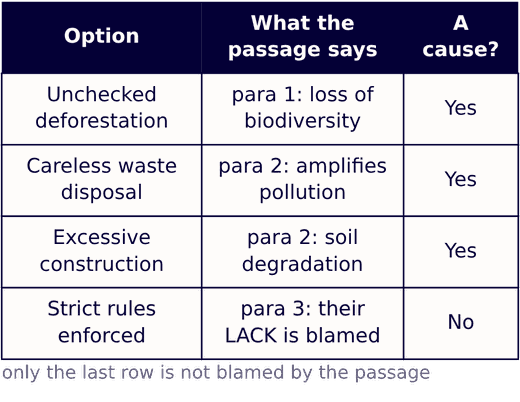 Paragraph 1 names 'unchecked deforestation', and paragraph 2 names 'rampant construction along riverbanks and mountainous terrains' and 'careless disposal of waste' — so (a), (b) and (c) are all stated causes.
About regulations the passage says the opposite: a major contributor to the decline is 'the lack of effective environmental regulations and their proper implementation'.
Strict implementation would therefore repair the damage rather than cause it, so option (d) is the factor that does not contribute.
Paragraph 1 names 'unchecked deforestation', and paragraph 2 names 'rampant construction along riverbanks and mountainous terrains' and 'careless disposal of waste' — so (a), (b) and (c) are all stated causes.
About regulations the passage says the opposite: a major contributor to the decline is 'the lack of effective environmental regulations and their proper implementation'.
Strict implementation would therefore repair the damage rather than cause it, so option (d) is the factor that does not contribute.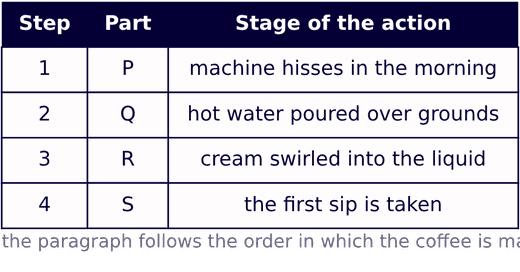 The sequence is P, Q, R, S, so option (a) is correct.
 The sequence is P, S, R, Q, so option (b) is correct.
 'Carelessly' and 'negligently' both mean 'without proper care', and 'casually' means 'in a relaxed, unconcerned way'; all three are opposites of attentively.
Hence option (b) is correct.
'Carelessly' and 'negligently' both mean 'without proper care', and 'casually' means 'in a relaxed, unconcerned way'; all three are opposites of attentively.
Hence option (b) is correct.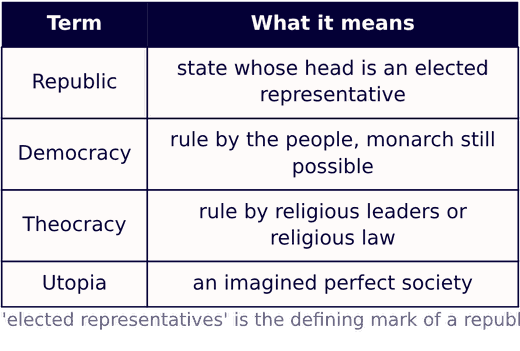 'Democracy' answers a different question: it says where power lies (with the people) and can survive under a crowned head, as in the United Kingdom, so it is not defined by elected representatives alone.
'Theocracy' is rule by religious leaders or religious law, and a 'utopia' is an imagined perfect society, not a form of government at all.
Hence option (c) is correct.
'Democracy' answers a different question: it says where power lies (with the people) and can survive under a crowned head, as in the United Kingdom, so it is not defined by elected representatives alone.
'Theocracy' is rule by religious leaders or religious law, and a 'utopia' is an imagined perfect society, not a form of government at all.
Hence option (c) is correct.