SSC CHSL 30 November 2025 · Shift 2 · General Intelligence — questions with answers · ShikshaSphere
Chapter 193 of 200
30 November 2025 · Shift 2
General Intelligence
25 questions ~25 min readFree
25 questions
A
26
You are organizing an educational seminar. You have two options-either conduct the seminar with a high registration fee and limited participants, or organize it with a low registration fee and a larger number of participants. Your objective is to maximize the total revenue collected.
Which of the following decisions is the most appropriate?
A.High registration fee, fewer Participants.
B.Low registration fee, more participants.
C.Carefully analyze the registration fee versus the expected number of participants and make a balanced decision.
D.Conduct the seminar free of charge and rely on sponsorships.
Solution
Decision making
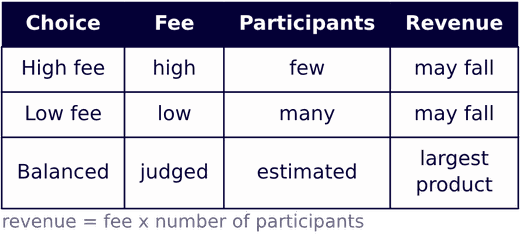
Total revenue = registration fee number of participants, so it is the product, not either factor alone, that has to be made as large as possible.
A high fee raises the amount per head but shrinks the audience; a low fee fills the hall but earns little from each participant. Either extreme can end with the smaller product.
The sound managerial step is therefore to estimate how many participants each fee level would actually attract and then choose the combination whose product is the largest.
Option (d) removes the fee altogether and leaves the income to uncertain sponsorship, which does not serve the stated objective.
Hence option (c) is correct.
27
Read the following statement carefully and identify the inference that follows.Statement: A study shows that people who regularly eat breakfast tend to have lower rates of obesity and other health problems.
Inference:
I. Skipping breakfast causes obesity and other health problems.
II. Eating breakfast regularly can prevent obesity and other health problems.
III. People who are obese should stop eating breakfast.
A.If only I follows
B.If only II follows
C.If both I and II follow
D.If both II and III follow
Solution
Statement and inference
The statement reports only what a study observed: regular breakfast-eaters show lower rates of obesity and other health problems. That is an association between two things.
Inference II says regular breakfast 'can prevent' those problems. The hedged word 'can' claims no more than the observed association supports, so II follows.
Inference I converts the association into a definite cause — that skipping breakfast causes obesity. A study of this kind shows correlation, not proof of cause, so I does not follow.
Inference III advises obese people to stop eating breakfast, which runs against the very finding reported, so it does not follow.
Hence only II follows; option (b) is correct.
28
Read the following statement carefully and identify the inference that follows.Statement: The government has announced a significant increase in import duty on imported foreign fruits and premium chocolates.
Assumptions:
I. The government wants people to completely stop consuming foreign food items.
II. The government aims to generate additional revenue for the government treasury through this tax hike.
III. The government is trying to reduce dependency on imports, promote domestic products, and improve trade balance.
A.If only I follows
B.If only II follows
C.If both I and II follow
D.If both II and III follow
Solution
Statement and assumptions
An assumption is what the government must already be taking for granted when it raises the duty.
II follows: a higher duty on goods that continue to be imported adds directly to the treasury's collections, which is a standard purpose of raising a duty.
III follows: costlier imports push buyers towards Indian fruits and chocolates, so the import bill falls and the trade balance improves — the usual protective purpose of a duty hike.
I does not follow: a duty makes such items dearer, not unavailable. Wanting people to 'completely stop' consuming foreign food is far stronger than anything the announcement implies.
Hence both II and III follow; option (d) is correct.
29
Few of the letters are given followed by a question mark (?) these letters are following a specific pattern you have to give the correct option which can replace question mark.
What is next: W, U, S, Q, ?
A.N
B.O
C.P
D.Q
Solution
Letter series
Write each letter by its place in the alphabet: W =23, U =21, S =19, Q =17.
Every term is 2 less than the one before it, that is, one letter is skipped each time.
Next place =17-2=15, and the 15th letter of the alphabet is O.
Hence option (b) is correct.
Find the next element that replace the ? Logically.55, 70, 87, 106, ?
A.127
B.125
C.129
D.135
Solution
Number series
Take the differences of consecutive terms: 70-55=15, 87-70=17, 106-87=19.
The differences 15, 17, 19 themselves increase by 2 each time, so the next difference is 19+2=21.
Required term =106+21=127.
Hence option (a) is correct.
32
Find the next element that replace the ? Logically.
7, 13, 25, 49, ?
A.110
B.97
C.89
D.98
Solution
Number series
Each term is one less than twice the term before it.
Check: , , .
So the required term .
The same pattern shows in the differences 6, 12, 24, which double every step; the next difference is 48 and 49+48=97.
Hence option (b) is correct.
33
Find the next element that replace the ? Logically.
6, 24, 114, 564, ?
A.2884
B.2870
C.2856
D.2814
Solution
Number series
The terms grow roughly five times each step, so try 'multiply by 5 and then adjust'.
Check: , , .
The rule holds throughout, so the required term .
, and 2820-6=2814.
Hence option (d) is correct.
34
Among four given words, three are alike in some way, but one stands out. Determine the odd one.
A.Hovercraft
B.Motorboat
C.Ferry
D.Submersible
Solution
Odd one out
A hovercraft, a motorboat and a ferry all travel on the surface of the water — the hovercraft on a cushion of air just above it, the other two floating on it.
A submersible is built to go below the surface and to work under water, which is exactly what the other three never do.
So the submersible is the odd one out; hence option (d) is correct.
35
Pick the odd one out from the given options.
A.Anthracite
B.Bituminous
C.Lignite
D.Graphite
Solution
Odd one out
Anthracite, bituminous and lignite are the ranks of coal, graded by carbon content — lignite the lowest and softest, bituminous in the middle, anthracite the hardest with the highest carbon.
Graphite is not a coal at all; it is a crystalline allotrope of carbon, used in pencil leads, as a lubricant and as a moderator in nuclear reactors.
So graphite is the odd one out; hence option (d) is correct.
36
Select the correct options from the given alternatives 59, 49, 58, 48, 57, ?
A.48
B.47
C.46
D.52
Solution
Alternating number series
The series moves alternately: first subtract 10, then add 9.
Check: 59-10=49, 49+9=58, 58-10=48, 48+9=57.
The next step is again -10, so the required term =57-10=47.
The same thing is seen in the two interlaced series 59, 58, 57, ... and 49, 48, 47, ..., each falling by 1; the missing term belongs to the second one.
Hence option (b) is correct.
37
In the question below there are three statements followed by two conclusions I and II. You have to take the three given statements to be true even if they seem to be at variance from commonly known facts and then decide which of the given conclusions logically follows from the three statements disregarding commonly known facts.Statements:
40% of Hit are Hop
Some Hop are Pop
Some Pop are Rock
Conclusions:
I. Some Hit are Rock
II. No Hop is Rock
A.Only conclusion I follows
B.Only conclusion II follows
C.Both conclusions I and II follow
D.Neither conclusion I nor conclusion II follows
Solution
Syllogism
'40% of Hit are Hop' is a particular statement and means no more than 'some Hit are Hop'. So all three links are of the 'some' type.
A chain made only of 'some' statements never carries a definite conclusion from the first class to the last, because the overlapping parts need not be the same parts.
Conclusion I, 'Some Hit are Rock', is therefore only a possibility, not a certainty — it does not follow.
Conclusion II, 'No Hop is Rock', is equally uncertain, since Hop and Rock are free to overlap through the common Pop portion.
I and II are not a complementary pair either (that would need 'Some Hop are Rock' against 'No Hop is Rock' on the same two classes), so no either-or case arises.
Hence neither conclusion follows; option (d) is correct.
38
Complete the following series from the given options.
xy_zxyy__yy_
A.xzyz
B.yzxz
C.yxxz
D.yyxz
Solution
Missing letters series
Count the string with its blanks: it is 12 letters long, and 12 divides neatly into three blocks of 4.
The letters that are already there — x y _ z at the start — suggest the block x y y z.
Testing xyyz / xyyz / xyyz against the given string fits every letter that is printed.
The gaps are the 3rd, 8th, 9th and 12th places, which the pattern fills with y, z, x and z.
So the missing letters in order are y z x z; hence option (b) is correct.
39
What should come next in the following series?
Y8, W64, U216, S512, ?
A.R729
B.Q729
C.Q1000
D.T729
Solution
Alpha-numeric series
Each term has a letter and a number, so handle the two parts separately.
Letters: Y =25, W =23, U =21, S =19 — each falls by 2, so the next place is 19-2=17, which is Q.
Numbers: , , , — cubes of consecutive even numbers, so the next is .
Putting the two together, the missing term is Q1000.
Hence option (c) is correct.
40
Select the combination of letters that, when placed sequentially in the blanks of the given series, will complete the series.
F K J RO TFR JT
A.O, R, T, F, K, J, O, K
B.R, O, T, K, F, J, O, K
C.R, O, T, F, K, J, O, K
D.R, O, K, F, T, J, O, K
Solution
Letter series completion
Ten letters are printed and each option supplies eight, so the completed string has 18 letters — three repetitions of a six-letter block.
The printed letters F _ _ K J _ _ R O _ _ T F R _ _ J T match the block F R O K J T repeated three times.
Reading off the four gaps, two letters at a time: R O, then T F, then K J, then O K.
So the required sequence is R, O, T, F, K, J, O, K.
Hence option (c) is correct.
41
Identify the next number.
3, 8, 15, 24, 35, ?
A.46
B.48
C.52
D.50
Solution
Number series
Instead of the terms themselves, look at the gaps between two consecutive terms.
8-3=5, 15-8=7, 24-15=9, 35-24=11 — the gaps are consecutive odd numbers.
So the next gap must be 13, giving the missing term =35+13=48.
The same series can be read as , whose next term is .
Hence option (b) is correct.
42
Select the option that is related to the second number in the same way as the third number is related to the fourth number and fifth number is related to sixth number.
(NOTE: Operations should be performed on the whole numbers, without breaking down the numbers into its constituent digits. E.g. 13 - Operations on 13 such as adding /subtracting /multiplying etc. to 13 can be performed. Breaking down 13 into 1 and 3 and then performing mathematical operations on 1 and 3 is not allowed)
? : 10889 :: 6802 : 7756 :: 6355 : 7309
A.9977
B.9968
C.9925
D.9935
Solution
Number analogy
Two complete pairs are given, so first find the rule from them.
7756-6802=954 and 7309-6355=954, so the second number is always 954 more than the first.
Applying the rule backwards, the missing first number =10889-954=9935.
Check: 9935+954=10889, exactly as required.
Hence option (d) is correct.
43
Select the option that is related to the fifth number in the same way as the second number is related to the first number and fourth number is related to third number.
(NOTE: Operations should be performed on the whole numbers, without breaking down the numbers into its constituent digits. E.g. 13 - Operations on 13 such as adding /subtracting /multiplying etc. to 13 can be performed. Breaking down 13 into 1 and 3 and then performing mathematical operations on 1 and 3 is not allowed)
927 : 6486 :: 691 : 4834 :: 514 :?
A.3592
B.3594
C.3600
D.3595
Solution
Number analogy
The second number is about seven times the first, so test (first number ) with a small adjustment.
and 6489-3=6486.
and 4837-3=4834, so the rule is (first number ) -3.
For 514: , and 3598-3=3595.
Hence option (d), 3595, is correct.
44
Select the option that is related to the second number in the same way as the third number is related to the fourth number and fifth number is related to sixth number.
(NOTE: Operations should be performed on the whole numbers, without breaking down the numbers into its constituent digits. E.g. 13 - Operations on 13 such as adding /subtracting /multiplying etc. to 13 can be performed. Breaking down 13 into 1 and 3 and then performing mathematical operations on 1 and 3 is not allowed)
410 : 5748 :: ? : 1898 :: 373 : 5230
A.136
B.135
C.143
D.125
Solution
Number analogy
The second number is roughly fourteen times the first, so try (first number ) with a small addition.
and 5740+8=5748.
and 5222+8=5230, so the rule is (first number ) +8.
Reversing it for 1898: 1898-8=1890 and .
Hence option (b), 135, is correct.
45
In the following question, four letter-number pairs are given. The letter-number on the left side of is related to the letter-number on the right side of (-) with some Logic/Rule/Relation. Three pairs are similar on the basis of same Logic/Rule/Relation. Select the odd one out from the given alternatives.
(NOTE: Operations should be performed on the whole numbers, without breaking down the number into its constituent digits. E.g. 13 - Operations on 13 such as adding /subtracting /multiplying etc. to 13 can be performed. Breaking down 13 into 1 and 3 and then performing mathematical operations on 1 and 3 is not allowed)
A.DT244 - EW488
B.MR196 - NU392
C.NO148 - OR296
D.BY256 - CB502
Solution
Odd letter-number pair
Treat the letters and the number separately.
The letters behave alike in all four pairs: the first letter moves 1 step forward and the second letter 3 steps forward — D→E, T→W; M→N, R→U; N→O, O→R; B→C, Y→B (counting on past Z).
So the number must decide the odd one; here the number is simply doubled.
, and — three pairs obey the rule.
But , whereas the pair shows 502.
Hence option (d) is correct.
46
In the following question, four letter-number pairs are given. The letter-number on the left side of is related to the letter-number on the right side of (-) with some Logic/Rule/Relation. Three pairs are similar on the basis of same Logic/Rule/Relation. Select the odd one out from the given alternatives.
(NOTE: Operations should be performed on the whole numbers, without breaking down the number into its constituent digits. E.g. 13 - Operations on 13 such as adding /subtracting /multiplying etc. to 13 can be performed. Breaking down 13 into 1 and 3 and then performing mathematical operations on 1 and 3 is not allowed)
A.VF440 - BL630
B.OY280 - UE460
C.HG360 - NM550
D.TK520 - ZQ710
Solution
Odd letter-number pair
Check the letters first: in every pair both letters move 6 steps forward — V→B, F→L; O→U, Y→E; H→N, G→M; T→Z, K→Q.
Since the letters are alike everywhere, compare the rise in the numbers.
630-440=190, 550-360=190 and 710-520=190 — three pairs rise by the same 190.
But 460-280=180, which breaks the pattern.
Hence option (b) is correct.
47
In the following question, four number pairs are given. In each pair the number on left side of (-) is related to the number of the right side of (-) with some
Logic/Rule/Relation. Three pairs are similar on the basis of same Logic/Rule/Relation. Select the odd one out from the given alternatives.
(NOTE: Operations should be performed on the whole numbers, without breaking down the number into its constituent digits. E.g. 13 - Operations on 13 such as adding /subtracting /multiplying etc. to 13 can be performed. Breaking down 13 into 1 and 3 and then performing mathematical operations on 1 and 3 is not allowed)
A.14-196
B.16-256
C.15-225
D.17-279
Solution
Odd number pair
The second number of each pair is much larger than the first, so test whether it is the square of the first.
, and — three pairs match exactly.
But , while the fourth pair shows 279, which is 10 short.
Hence option (d) is correct.
48
Select the option that is related to the fifth letter-number cluster in the same way as the second letter-number cluster is related to the first letter-number cluster and fourth letter-number cluster is related to third letter-number cluster.
(NOTE: Operations should be performed on the whole numbers, without breaking down the numbers into its constituent digits. E.g. 13 - Operations on 13 such as adding /subtracting /multiplying etc. to 13 can be performed. Breaking down 13 into 1 and 3 and then performing mathematical operations on 1 and 3 is not allowed)
TC760 : QZ530 :: BS1040 : YP810 :: GL840 : ?
A.DH590
B.DI590
C.DI610
D.CH630
Solution
Letter-number cluster analogy
Deal with the letters and the number one at a time.
In TC760 : QZ530 both letters go 3 steps back — T→Q and C→Z — and the number falls by 760-530=230.
BS1040 : YP810 confirms it — B→Y, S→P, and 1040-810=230.
For GL840: G→D, L→I, and 840-230=610.
So the required cluster is DI610.
Hence option (c) is correct.
49
Select the option that is related to the fifth letter-number cluster in the same way as the second letter-number cluster is related to the first letter-number cluster and fourth letter-number cluster is related to third letter-number cluster.
(NOTE: Operations should be performed on the whole numbers, without breaking down the numbers into its constituent digits. E.g. 13 - Operations on 13 such as adding /subtracting /multiplying etc. to 13 can be performed. Breaking down 13 into 1 and 3 and then performing mathematical operations on 1 and 3 is not allowed)
KV72 : TI215 :: BZ93 : XZ278 :: EW103 : ?
A.TC308
B.UC308
C.UC309
D.VC309
Solution
Letter-number cluster analogy
The letters do not shift in place — they are first interchanged and each is then moved 2 steps back.
KV72 → TI215: V goes back 2 to T and takes the first position, K goes back 2 to I and takes the second position.
BZ93 → XZ278 agrees: Z goes back 2 to X, and B goes back 2 to Z (counting back past A).
The number is multiplied by 3 and 1 is subtracted: , 216-1=215; , 279-1=278.
For EW103: W goes back 2 to U, E goes back 2 to C, and , 309-1=308.
So the required cluster is UC308.
Hence option (b) is correct.
50
Select the option that is related to the fifth letter-number cluster in the same way as the second letter-number cluster is related to the first letter-number cluster and fourth letter-number cluster is related to third letter-number cluster.
(NOTE: Operations should be performed on the whole numbers, without breaking down the numbers into its constituent digits. E.g. 13 - Operations on 13 such as adding /subtracting /multiplying etc, to 13 can be performed. Breaking down 13 into 1 and 3 and then performing mathematical operations on 1 and 3 is not allowed)
Q0112 : HJ392 :: GC84 : VZ294 :: BS56 : ?
A.LU204
B.LU196
C.MT204
D.MT196
Solution
Letter-number cluster analogy
The first cluster is QO112, the two letters being Q and O.
The letters are interchanged and each is then moved 7 steps back: O→H takes the first place and Q→J takes the second, giving HJ.
GC84 → VZ294 confirms it: C→V and G→Z, counting back past A.
The number is multiplied by : and .
For BS56: S→L takes the first place, B→U takes the second, and .
So the required cluster is LU196.
Hence option (b) is correct.
Finished reading? Now test yourself.
The same 25 questions, but with a timer and the answers hidden — 15 minutes.

 A high fee raises the amount per head but shrinks the audience; a low fee fills the hall but earns little from each participant. Either extreme can end with the smaller product.
The sound managerial step is therefore to estimate how many participants each fee level would actually attract and then choose the combination whose product is the largest.
Option (d) removes the fee altogether and leaves the income to uncertain sponsorship, which does not serve the stated objective.
Hence option (c) is correct.
A high fee raises the amount per head but shrinks the audience; a low fee fills the hall but earns little from each participant. Either extreme can end with the smaller product.
The sound managerial step is therefore to estimate how many participants each fee level would actually attract and then choose the combination whose product is the largest.
Option (d) removes the fee altogether and leaves the income to uncertain sponsorship, which does not serve the stated objective.
Hence option (c) is correct.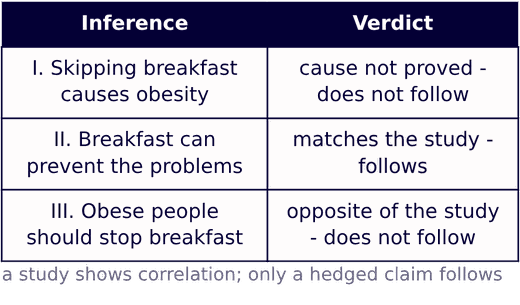 Inference II says regular breakfast 'can prevent' those problems. The hedged word 'can' claims no more than the observed association supports, so II follows.
Inference I converts the association into a definite cause — that skipping breakfast causes obesity. A study of this kind shows correlation, not proof of cause, so I does not follow.
Inference III advises obese people to stop eating breakfast, which runs against the very finding reported, so it does not follow.
Hence only II follows; option (b) is correct.
Inference II says regular breakfast 'can prevent' those problems. The hedged word 'can' claims no more than the observed association supports, so II follows.
Inference I converts the association into a definite cause — that skipping breakfast causes obesity. A study of this kind shows correlation, not proof of cause, so I does not follow.
Inference III advises obese people to stop eating breakfast, which runs against the very finding reported, so it does not follow.
Hence only II follows; option (b) is correct.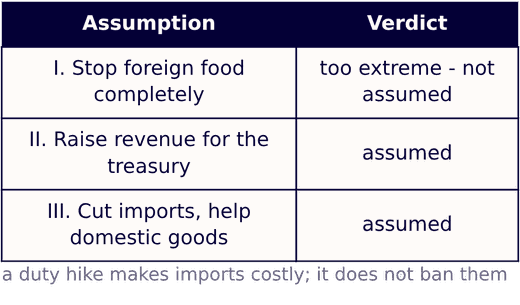 II follows: a higher duty on goods that continue to be imported adds directly to the treasury's collections, which is a standard purpose of raising a duty.
III follows: costlier imports push buyers towards Indian fruits and chocolates, so the import bill falls and the trade balance improves — the usual protective purpose of a duty hike.
I does not follow: a duty makes such items dearer, not unavailable. Wanting people to 'completely stop' consuming foreign food is far stronger than anything the announcement implies.
Hence both II and III follow; option (d) is correct.
II follows: a higher duty on goods that continue to be imported adds directly to the treasury's collections, which is a standard purpose of raising a duty.
III follows: costlier imports push buyers towards Indian fruits and chocolates, so the import bill falls and the trade balance improves — the usual protective purpose of a duty hike.
I does not follow: a duty makes such items dearer, not unavailable. Wanting people to 'completely stop' consuming foreign food is far stronger than anything the announcement implies.
Hence both II and III follow; option (d) is correct.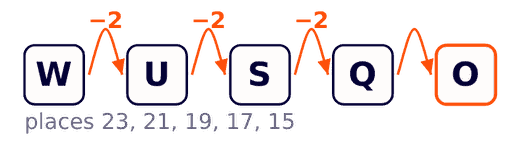 Every term is 2 less than the one before it, that is, one letter is skipped each time.
Next place =17-2=15, and the 15th letter of the alphabet is O.
Hence option (b) is correct.
Every term is 2 less than the one before it, that is, one letter is skipped each time.
Next place =17-2=15, and the 15th letter of the alphabet is O.
Hence option (b) is correct.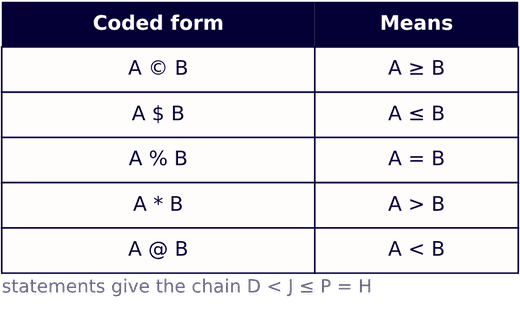 The three statements therefore read D<J, and P=H.
Joining them into one chain: .
Conclusion I, H © J, asks for . The chain gives , so I is true.
Conclusion II, P * D, asks for P>D. The chain gives , hence D<P, so II is true.
Both conclusions are true; hence option (d) is correct.
The three statements therefore read D<J, and P=H.
Joining them into one chain: .
Conclusion I, H © J, asks for . The chain gives , so I is true.
Conclusion II, P * D, asks for P>D. The chain gives , hence D<P, so II is true.
Both conclusions are true; hence option (d) is correct.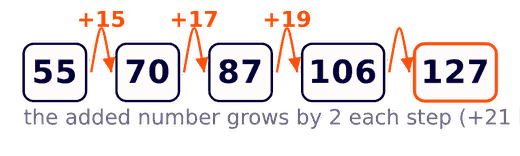 The differences 15, 17, 19 themselves increase by 2 each time, so the next difference is 19+2=21.
Required term =106+21=127.
Hence option (a) is correct.
The differences 15, 17, 19 themselves increase by 2 each time, so the next difference is 19+2=21.
Required term =106+21=127.
Hence option (a) is correct.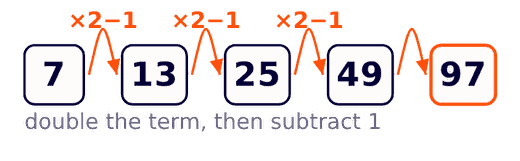 Check: , , .
So the required term .
The same pattern shows in the differences 6, 12, 24, which double every step; the next difference is 48 and 49+48=97.
Hence option (b) is correct.
Check: , , .
So the required term .
The same pattern shows in the differences 6, 12, 24, which double every step; the next difference is 48 and 49+48=97.
Hence option (b) is correct.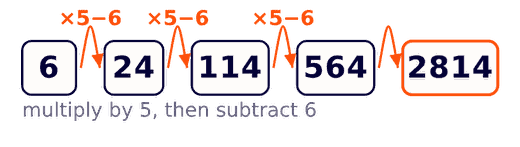 Check: , , .
The rule holds throughout, so the required term .
, and 2820-6=2814.
Hence option (d) is correct.
Check: , , .
The rule holds throughout, so the required term .
, and 2820-6=2814.
Hence option (d) is correct.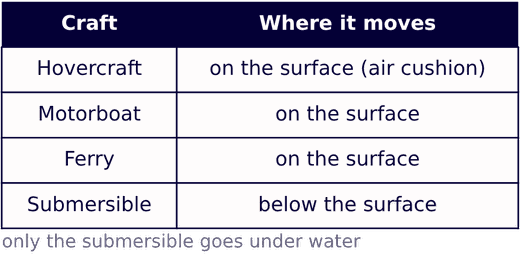 A submersible is built to go below the surface and to work under water, which is exactly what the other three never do.
So the submersible is the odd one out; hence option (d) is correct.
A submersible is built to go below the surface and to work under water, which is exactly what the other three never do.
So the submersible is the odd one out; hence option (d) is correct.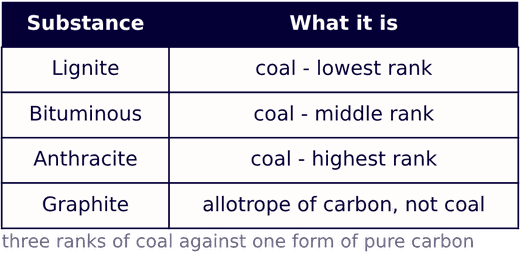 Graphite is not a coal at all; it is a crystalline allotrope of carbon, used in pencil leads, as a lubricant and as a moderator in nuclear reactors.
So graphite is the odd one out; hence option (d) is correct.
Graphite is not a coal at all; it is a crystalline allotrope of carbon, used in pencil leads, as a lubricant and as a moderator in nuclear reactors.
So graphite is the odd one out; hence option (d) is correct.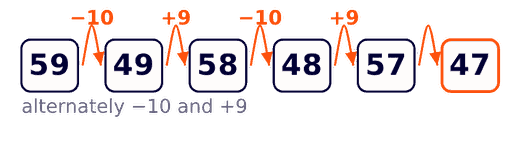 Check: 59-10=49, 49+9=58, 58-10=48, 48+9=57.
The next step is again -10, so the required term =57-10=47.
The same thing is seen in the two interlaced series 59, 58, 57, ... and 49, 48, 47, ..., each falling by 1; the missing term belongs to the second one.
Hence option (b) is correct.
Check: 59-10=49, 49+9=58, 58-10=48, 48+9=57.
The next step is again -10, so the required term =57-10=47.
The same thing is seen in the two interlaced series 59, 58, 57, ... and 49, 48, 47, ..., each falling by 1; the missing term belongs to the second one.
Hence option (b) is correct.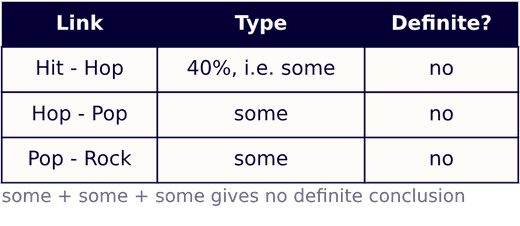 A chain made only of 'some' statements never carries a definite conclusion from the first class to the last, because the overlapping parts need not be the same parts.
Conclusion I, 'Some Hit are Rock', is therefore only a possibility, not a certainty — it does not follow.
Conclusion II, 'No Hop is Rock', is equally uncertain, since Hop and Rock are free to overlap through the common Pop portion.
I and II are not a complementary pair either (that would need 'Some Hop are Rock' against 'No Hop is Rock' on the same two classes), so no either-or case arises.
Hence neither conclusion follows; option (d) is correct.
A chain made only of 'some' statements never carries a definite conclusion from the first class to the last, because the overlapping parts need not be the same parts.
Conclusion I, 'Some Hit are Rock', is therefore only a possibility, not a certainty — it does not follow.
Conclusion II, 'No Hop is Rock', is equally uncertain, since Hop and Rock are free to overlap through the common Pop portion.
I and II are not a complementary pair either (that would need 'Some Hop are Rock' against 'No Hop is Rock' on the same two classes), so no either-or case arises.
Hence neither conclusion follows; option (d) is correct.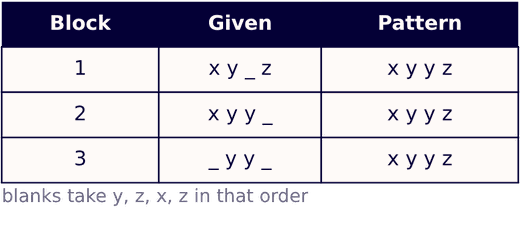 Testing xyyz / xyyz / xyyz against the given string fits every letter that is printed.
The gaps are the 3rd, 8th, 9th and 12th places, which the pattern fills with y, z, x and z.
So the missing letters in order are y z x z; hence option (b) is correct.
Testing xyyz / xyyz / xyyz against the given string fits every letter that is printed.
The gaps are the 3rd, 8th, 9th and 12th places, which the pattern fills with y, z, x and z.
So the missing letters in order are y z x z; hence option (b) is correct.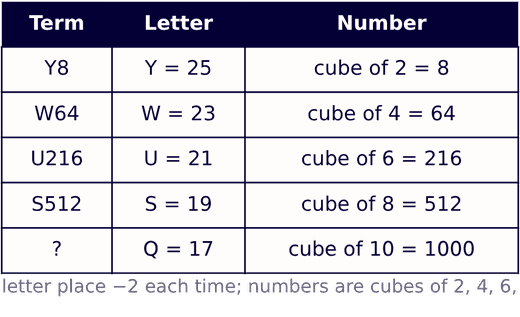 Letters: Y =25, W =23, U =21, S =19 — each falls by 2, so the next place is 19-2=17, which is Q.
Numbers: , , , — cubes of consecutive even numbers, so the next is .
Putting the two together, the missing term is Q1000.
Hence option (c) is correct.
Letters: Y =25, W =23, U =21, S =19 — each falls by 2, so the next place is 19-2=17, which is Q.
Numbers: , , , — cubes of consecutive even numbers, so the next is .
Putting the two together, the missing term is Q1000.
Hence option (c) is correct.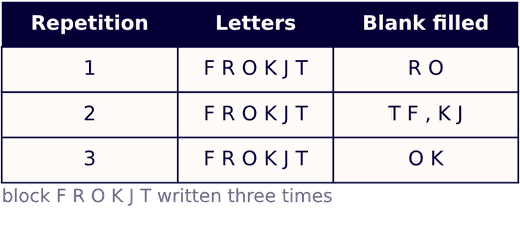 The printed letters F _ _ K J _ _ R O _ _ T F R _ _ J T match the block F R O K J T repeated three times.
Reading off the four gaps, two letters at a time: R O, then T F, then K J, then O K.
So the required sequence is R, O, T, F, K, J, O, K.
Hence option (c) is correct.
The printed letters F _ _ K J _ _ R O _ _ T F R _ _ J T match the block F R O K J T repeated three times.
Reading off the four gaps, two letters at a time: R O, then T F, then K J, then O K.
So the required sequence is R, O, T, F, K, J, O, K.
Hence option (c) is correct.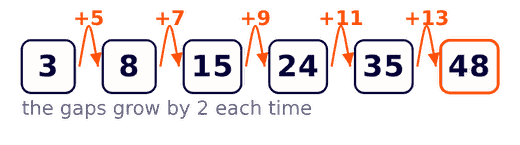 So the next gap must be 13, giving the missing term =35+13=48.
The same series can be read as , whose next term is .
Hence option (b) is correct.
So the next gap must be 13, giving the missing term =35+13=48.
The same series can be read as , whose next term is .
Hence option (b) is correct.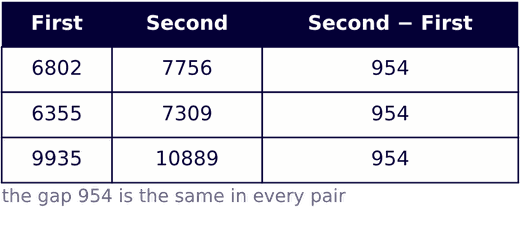 Applying the rule backwards, the missing first number =10889-954=9935.
Check: 9935+954=10889, exactly as required.
Hence option (d) is correct.
Applying the rule backwards, the missing first number =10889-954=9935.
Check: 9935+954=10889, exactly as required.
Hence option (d) is correct.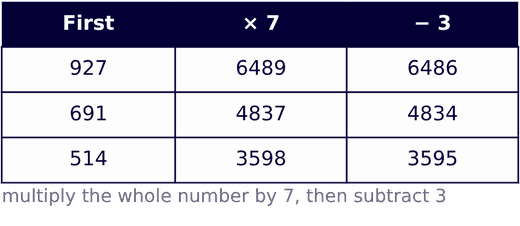 For 514: , and 3598-3=3595.
Hence option (d), 3595, is correct.
For 514: , and 3598-3=3595.
Hence option (d), 3595, is correct.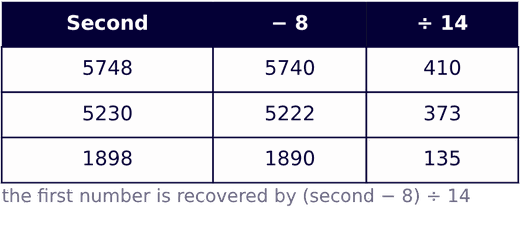 Reversing it for 1898: 1898-8=1890 and .
Hence option (b), 135, is correct.
Reversing it for 1898: 1898-8=1890 and .
Hence option (b), 135, is correct.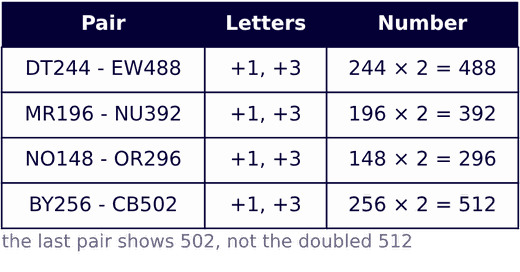 , and — three pairs obey the rule.
But , whereas the pair shows 502.
Hence option (d) is correct.
, and — three pairs obey the rule.
But , whereas the pair shows 502.
Hence option (d) is correct.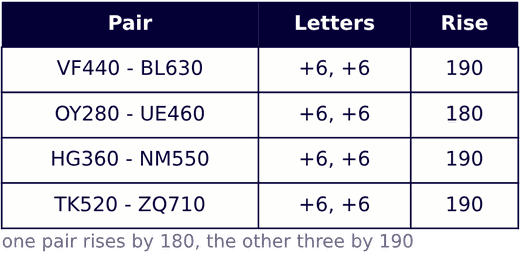 630-440=190, 550-360=190 and 710-520=190 — three pairs rise by the same 190.
But 460-280=180, which breaks the pattern.
Hence option (b) is correct.
630-440=190, 550-360=190 and 710-520=190 — three pairs rise by the same 190.
But 460-280=180, which breaks the pattern.
Hence option (b) is correct.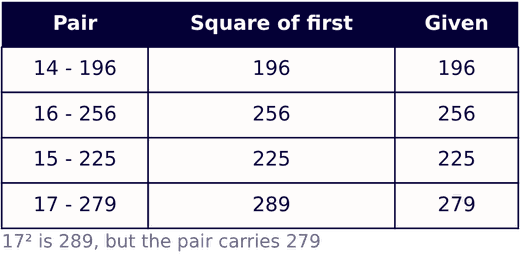 , and — three pairs match exactly.
But , while the fourth pair shows 279, which is 10 short.
Hence option (d) is correct.
, and — three pairs match exactly.
But , while the fourth pair shows 279, which is 10 short.
Hence option (d) is correct.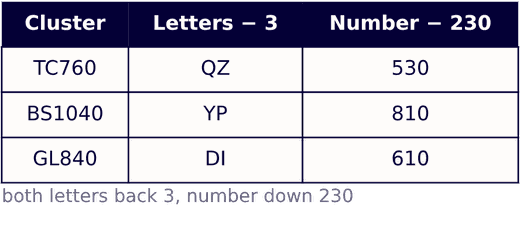 For GL840: G→D, L→I, and 840-230=610.
So the required cluster is DI610.
Hence option (c) is correct.
For GL840: G→D, L→I, and 840-230=610.
So the required cluster is DI610.
Hence option (c) is correct.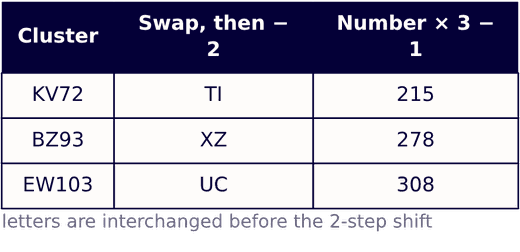 For EW103: W goes back 2 to U, E goes back 2 to C, and , 309-1=308.
So the required cluster is UC308.
Hence option (b) is correct.
For EW103: W goes back 2 to U, E goes back 2 to C, and , 309-1=308.
So the required cluster is UC308.
Hence option (b) is correct.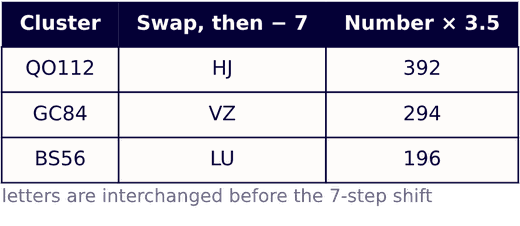 For BS56: S→L takes the first place, B→U takes the second, and .
So the required cluster is LU196.
Hence option (b) is correct.
For BS56: S→L takes the first place, B→U takes the second, and .
So the required cluster is LU196.
Hence option (b) is correct.