
1
Choose the correct option to specify the meaning of the highlighted idiom. You've prepared well for the performance. Now break a leg.
- A.Say Good Luck to someone
- B.Ask someone not to go for a task
- C.Say Bad Luck to someone
- D.Not saying anything to someone
Solution
Idiom meaning
'Break a leg' is an idiom used to wish somebody good luck, especially just before a performance on stage.
The speaker has already said 'You've prepared well for the performance', so the natural next remark is a wish for success.
The idiom never conveys bad luck, nor does it ask anyone to stay away from a task, so (b), (c) and (d) are ruled out.
Hence option (a) is correct.
 Option (b) has 'Either of the solutions seem', where the plural verb 'seem' breaks this rule; it should be 'seems'.
Option (c) follows the same rule correctly with 'One of the houses ... is', and options (a) and (d) are grammatically sound.
Hence the incorrect sentence is option (b).
Option (b) has 'Either of the solutions seem', where the plural verb 'seem' breaks this rule; it should be 'seems'.
Option (c) follows the same rule correctly with 'One of the houses ... is', and options (a) and (d) are grammatically sound.
Hence the incorrect sentence is option (b).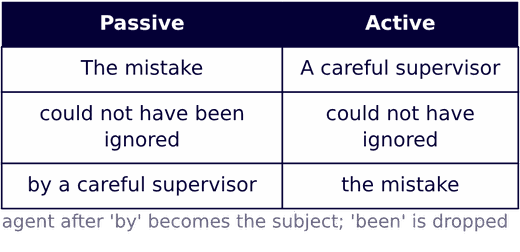 The verb 'could not have been ignored' simply drops 'been' and becomes 'could not have ignored', so the modal-perfect form is preserved.
The active sentence is therefore 'A careful supervisor could not have ignored the mistake', and the trailing clause 'a point that was later highlighted' is left untouched.
Option (c) drops 'have' and so changes the tense, (a) interchanges subject and object wrongly, and (d) is still in the passive voice.
Hence option (b) is correct.
The verb 'could not have been ignored' simply drops 'been' and becomes 'could not have ignored', so the modal-perfect form is preserved.
The active sentence is therefore 'A careful supervisor could not have ignored the mistake', and the trailing clause 'a point that was later highlighted' is left untouched.
Option (c) drops 'have' and so changes the tense, (a) interchanges subject and object wrongly, and (d) is still in the passive voice.
Hence option (b) is correct.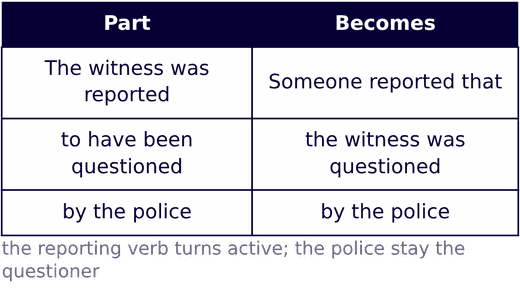 Since the reporter is not named, the outer passive 'The witness was reported' becomes 'Someone reported that ...'.
The infinitive 'to have been questioned by the police' is then expanded into a finite clause about the witness, keeping the police as the questioner.
Options (b) and (d) replace the police with a vague 'someone', which changes the meaning, and (c) merely reshuffles the words while staying passive throughout.
Hence option (a) is correct.
Since the reporter is not named, the outer passive 'The witness was reported' becomes 'Someone reported that ...'.
The infinitive 'to have been questioned by the police' is then expanded into a finite clause about the witness, keeping the police as the questioner.
Options (b) and (d) replace the police with a vague 'someone', which changes the meaning, and (c) merely reshuffles the words while staying passive throughout.
Hence option (a) is correct.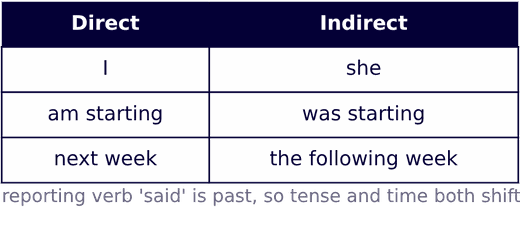 'I am starting' therefore becomes 'she was starting', and 'next week' becomes 'the following week'.
Option (a) keeps 'next week', option (b) keeps the present form 'is starting', and option (c) wrongly turns the verb into 'would have been starting'.
Hence option (d) is correct.
'I am starting' therefore becomes 'she was starting', and 'next week' becomes 'the following week'.
Option (a) keeps 'next week', option (b) keeps the present form 'is starting', and option (c) wrongly turns the verb into 'would have been starting'.
Hence option (d) is correct.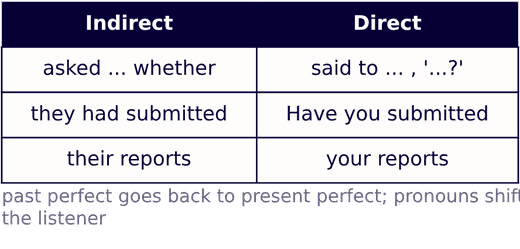 The reported clause 'they had submitted' is in the past perfect; moving one tense forward for direct speech turns it into the present perfect, 'Have you submitted'.
The pronouns 'they/their' stand for the persons being addressed, so they change to 'you/your'.
This gives: The manager said to the employees, 'Have you submitted your reports?' — option (a).
Options (b) and (d) use the wrong tense (simple past and past perfect) and (c) keeps the wrong pronoun 'their'.
The reported clause 'they had submitted' is in the past perfect; moving one tense forward for direct speech turns it into the present perfect, 'Have you submitted'.
The pronouns 'they/their' stand for the persons being addressed, so they change to 'you/your'.
This gives: The manager said to the employees, 'Have you submitted your reports?' — option (a).
Options (b) and (d) use the wrong tense (simple past and past perfect) and (c) keeps the wrong pronoun 'their'.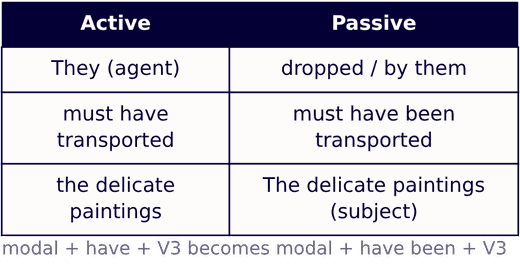 Here the active verb group is 'must have transported', so the passive group is 'must have been transported'.
The object 'the delicate paintings' becomes the subject, and the adverbial parts stay with the verb: The delicate paintings must have been transported very carefully from the gallery's storage room.
Option (a) replaces 'must' by 'had to' and (d) by 'should', both of which change the meaning from strong inference to obligation or advice; (c) is a cleft sentence, not a passive transformation.
Hence option (b) is correct.
Here the active verb group is 'must have transported', so the passive group is 'must have been transported'.
The object 'the delicate paintings' becomes the subject, and the adverbial parts stay with the verb: The delicate paintings must have been transported very carefully from the gallery's storage room.
Option (a) replaces 'must' by 'had to' and (d) by 'should', both of which change the meaning from strong inference to obligation or advice; (c) is a cleft sentence, not a passive transformation.
Hence option (b) is correct.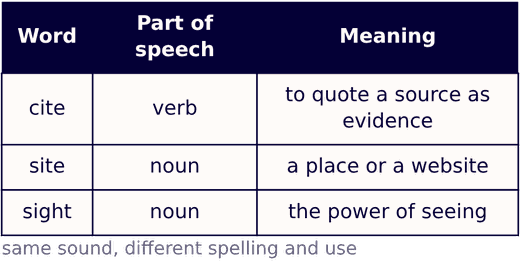 So the sentence reads: The researcher made sure to cite credible studies and visit the official site for additional information.
In (a) 'council' and 'counsel' are both wrong here (a body and advice), in (c) 'principal/principle' means chief or a rule, and in (d) 'aural/oral' relate to hearing and speech — none of them fits a researcher checking sources.
Hence option (b) is correct.
So the sentence reads: The researcher made sure to cite credible studies and visit the official site for additional information.
In (a) 'council' and 'counsel' are both wrong here (a body and advice), in (c) 'principal/principle' means chief or a rule, and in (d) 'aural/oral' relate to hearing and speech — none of them fits a researcher checking sources.
Hence option (b) is correct.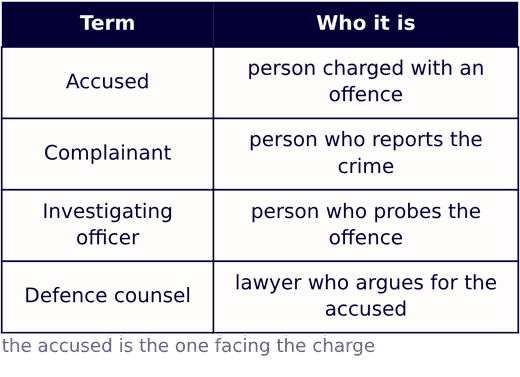 The person who reports the crime is the complainant or informant (a), the officer who looks into it is the investigator (c), and the one who argues for innocence is the defence counsel (d).
Hence option (b) is correct.
The person who reports the crime is the complainant or informant (a), the officer who looks into it is the investigator (c), and the one who argues for innocence is the defence counsel (d).
Hence option (b) is correct.