SSC CHSL 30 November 2025 · Shift 3 · General Intelligence — questions with answers · ShikshaSphere
Chapter 197 of 200
30 November 2025 · Shift 3
General Intelligence
25 questions ~25 min readFree
25 questions
A
26
You notice a statistical error in your report, but correcting it will require reworking some charts and analysis, and may cause a slight delay in your presentation. What is the most professional course of action?
A.Leave the error in the report and hope no one notices.
B.Cancel the entire report.
C.Briefly acknowledge the error and present the correct data, even if it causes a slight delay.
D.Blame the data source for the error.
Solution
Professional integrity
The question weighs a small delay against the accuracy of what is placed before the audience.
A report known to carry a statistical error must not be presented as it stands, because every conclusion drawn from it becomes unreliable.
The professional course is to acknowledge the slip briefly, rework the affected charts and analysis, and present the correct data even if the presentation slips a little.
Hiding the error (a) is plain dishonesty, scrapping the whole report (b) is a needless over-reaction to a fixable fault, and blaming the data source (d) shifts responsibility without correcting anything.
Hence option (c) is correct.
27
A person walks 6 km north, then 3 km east, and finally 6 km south. In which direction is he from his starting point?
A.North
B.South
C.East
D.West
Solution
Direction sense
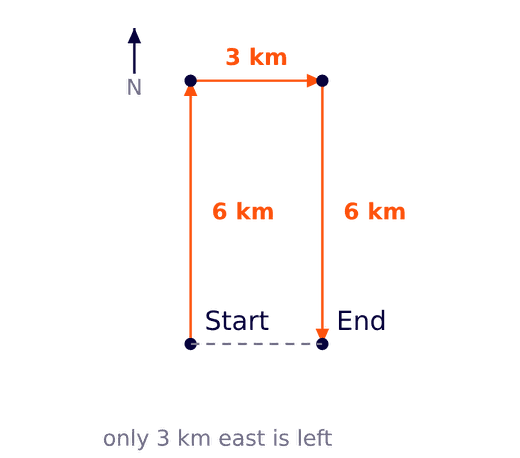
Take the starting point as the origin and mark each move one after the other.
The 6 km walked north is exactly cancelled by the 6 km walked south, so the north-south displacement is 6-6=0.
Only the 3 km walked east remains, so the final position lies 3 km due east of the start.
Hence the person is to the east of his starting point, and option (c) is correct.
28
Read the following statement carefully and identify the inference that follows.Statement: The municipal corporation has announced a complete ban on smoking at all public places in the city.
Assumptions:
I. People will have to avoid smoking at public places.
II. The sale of all tobacco products will be completely banned.
III. This ban will have no effect on people's health.
A.If only I follows
B.If only II follows
C.If both I and II follow
D.If both I and III follow
Solution
Statement and inference
An inference may use only what the statement actually says, together with what must necessarily be true if the statement is true.
The statement gives one fact: a complete ban on smoking at all public places in the city.
I is that same ban stated from the citizen's side - if smoking is banned there, people must avoid smoking there - so I follows directly.
II speaks of the sale of tobacco products; banning where a person may smoke says nothing about where tobacco may be sold, so II does not follow.
III claims the ban will have no effect on health, which the statement neither states nor implies - such a ban is in fact aimed at protecting health - so III does not follow.
Only inference I follows, so option (a) is correct.
29
In the following questions some issues are provided to you. You have to mark the appropriate answer logically that can be taken in such circumstances. If your colleague becomes very stressed at the workplace due to a mistake, what would be the emotionally intelligent response?
A.Ignore what they are saying
B.Criticize them in front of everyone
C.Immediately blame them
D.Calmly listen to them and assure your support
Solution
Emotional intelligence
Emotional intelligence means recognising another person's feelings and responding in a way that steadies them.
A colleague under stress after a mistake first needs to be heard; only a calm listener can then help him repair the error.
So listening patiently and assuring him of your support is the emotionally intelligent response.
Ignoring him (a) leaves him isolated, criticising him publicly (b) humiliates him, and blaming him at once (c) adds to the pressure - none of these helps solve the problem.
Hence option (d) is correct.
D.If neither conclusion I nor conclusion II is true
Solution
Coded inequalities
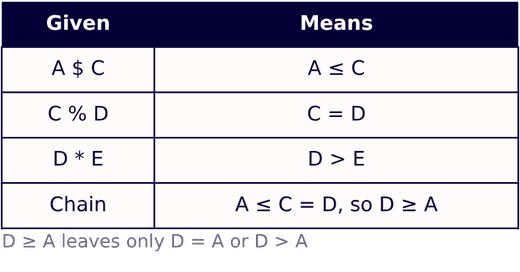
First replace each symbol by the inequality sign it stands for, then join the statements into a single chain.
The statements give , C = D and D > E.
Combining the first two, , which means .
Conclusion I claims D = A and conclusion II claims D > A; neither is certain by itself, because permits both.
But also guarantees that one of the two must hold - there is no third possibility left.
So conclusions I and II form an either-or pair, and option (c) is correct.
31
Find the next element that replace the ? Logically
2, 20, 110, 560, ?
A.2815
B.2810
C.2805
D.2905
Solution
Number series
Look for a single rule that takes each term to the next one.
Test 'multiply by 5 and add 10': , , .
The rule holds for every step given, so apply it once more.
The missing term is .
The same pattern shows in the gaps: - each five times the one before - so the next gap is and 560+2250=2810.
Hence option (b) is correct.
32
Which one of the following numbers is divisible by both 11 and 19 ?
A.418
B.361
C.419
D.425
Solution
Divisibility
11 and 19 are both prime, so a number divisible by both must be divisible by their product .
So the answer must be a multiple of 209.
, so 418 is divisible by 209 and therefore by 11 as well as by 19.
Checking the rest: is divisible by 19 but not by 11, 419 is a prime number, and .
Hence option (a) is correct.
33
Out of four words, three have something in common and one is different. Identify the different one.
A.Mixer
B.Printer
C.Scanner
D.Copy Machine
Solution
Odd one out
Group the four items by where they are used and what they work on.
A printer, a scanner and a copy machine are all office machines that handle documents and are normally used with a computer.
A mixer is a kitchen appliance used to grind and blend food, so it belongs to a different family altogether.
Hence the mixer is the odd one out, and option (a) is correct.
34
Select the correct options from the given alternatives 9284766
A.86
B.81
C.84
D.85
Solution
Number series
The digits given form the series
Take the difference of consecutive terms: 28-9=19, 47-28=19, 66-47=19.
The difference is the same throughout, so this is an arithmetic progression with common difference 19.
Therefore the next term is 66+19=85.
Hence option (d) is correct.
35
Pick the correct options from below.
10.5, 18, 27.5, 39, 52.5
A.70
B.68
C.66
D.72.5
Solution
Number series
Take the differences of consecutive terms: 18-10.5=7.5, 27.5-18=9.5, 39-27.5=11.5, 52.5-39=13.5.
These differences themselves rise by 2 each time, so the next difference is 13.5+2=15.5.
Therefore the next term is 52.5+15.5=68.
Hence option (b) is correct.
36
In the questions given below, there are three statements followed by three conclusions I, II and III. You have to take the three given statements to be true even if they seem to be at variance from commonly known facts. Read all the conclusions and then decide which of the given conclusions logically follows from the three statements disregarding commonly known facts.Statements:
All mangoes are fruits.
All fruits are sweet.
Some mangoes are red.
Conclusion:
I. Some red are sweet.
II. Some sweet are mangoes.
III. All mangoes are sweet.
A.Only conclusions II and III follow
B.Only conclusion I follows
C.Only conclusion III follows
D.All the conclusions follow
Solution
Syllogism
Draw the three statements: the mango circle lies wholly inside fruits, the fruit circle lies wholly inside sweet, and the red circle cuts the mango circle.
Every mango is a fruit and every fruit is sweet, so every mango is sweet - conclusion III follows.
Since all mangoes are sweet, those mangoes are themselves sweet things, so some sweet things are mangoes - conclusion II follows as the converse of III.
Some mangoes are red, and those very mangoes are sweet, so at least those red things are sweet - conclusion I follows.
All three conclusions follow, so option (d) is correct.
37
What comes next in the following series?
P1, Q1, R8, S27, T125, U512, ?
A.V125
B.T1728
C.V729
D.V2197
Solution
Alphanumeric series
Handle the letters and the numbers separately.
The letters run P, Q, R, S, T, U in alphabetical order, so the next letter is V.
The numbers are all perfect cubes: .
The cube roots form a Fibonacci sequence, in which each term is the sum of the two before it, so the next root is 5+8=13.
Therefore the next number is and the term is V2197.
Hence option (d) is correct.
38
What comes next in the series?
E, J, Q, Z, K, ?
A.X
B.
C.Z
D.A
Solution
Letter series
Write the alphabetical position of each letter: E = 5, J = 10, Q = 17, Z = 26.
The jumps are , growing by 2 each time, so the next jump is +11, giving 26+11=37.
The alphabet has only 26 letters, so continue counting cyclically: 37-26=11, and the 11th letter is K - exactly the fifth term given.
The following jump must be +13, so from 37 we reach 37+13=50, and 50-26=24.
The 24th letter is X, so option (a) is correct.
39
An officer reports violations of rules in your organization but does not fully follow some internal guidelines while reporting. What should you do?
A.Take strict action against him for not following the rules
B.Praise him without any verification
C.Protect his identity and conduct a fair and impartial investigation
D.Remove him from the post without giving any warning
Solution
Administrative ethics
Separate the two issues: the substance of the report - a violation of rules - and the form in which it was made.
A procedural lapse in the manner of reporting must not be allowed to bury a genuine complaint, and the person who reports must be protected from retaliation.
So the correct step is to keep his identity confidential and have the allegation examined by a fair and impartial enquiry, which will also test whether it is true.
Taking strict action against him (a) or removing him (d) punishes honest reporting and discourages others, while praising him without verification (b) accepts an unproven charge.
Hence option (c) is correct.
40
If @ means "first × second + first", and # means "first + second × second", then what is 5 @ 2 # 3 ?
A.18
B.20
C.22
D.24
Solution
Symbol operations
The two defined operations are applied one after the other, working from left to right.
The rule for @ is 'first × second + first', so 5 @ 2 gives .
This 15 now becomes the 'first' number for the next operation.
The rule for # is 'first + second × second', so 15 # 3 gives .
Hence the value of 5 @ 2 # 3 is 24, and option (d) is correct.
41
If: Then find the result of: ?
A.247
B.235
C.241
D.253
Solution
Symbol substitution
In such questions every sign of the expression is first replaced by the sign the code gives it, and only after that is the BODMAS order applied.
So becomes .
Division and multiplication are done first, from left to right: and .
Now 240-5+6=241.
Hence the required value is 241.
42
A company implements flexible working hours in the office to increase employee productivity. Which of the following is the most logical assumption behind this decision?
A.Employees do not like working at a fixed time in the office.
B.Flexible working hours improve employee productivity and satisfaction.
C.The company wants to reduce electricity and resource costs.
D.Employees are more productive in the evening.
Solution
Statement and assumption
An assumption is the unstated belief that the decision-maker must already hold for the action to make sense.
Here the action is the introduction of flexible working hours and the stated purpose is a rise in employee productivity.
The company can expect that rise only if it takes for granted that flexible hours really do raise productivity and satisfaction, which is exactly what option (b) states.
Options (a) and (d) add fresh claims about what employees like or when they work best, and option (c) speaks of saving cost, a purpose the statement never mentions.
43
Choose the related word from the given alternatives Glaucoma : ? : : Nephritis : Kidney
A.Eye
B.Liber
C.Ear
D.Heart
Solution
Disease and organ
Each pair joins a disease with the organ of the body that the disease attacks.
Nephritis is the inflammation of the kidney, so the second term of the pair names the affected organ.
Glaucoma is caused by a rise of fluid pressure inside the eyeball, which damages the optic nerve, so the organ affected is the eye.
The liver is attacked by hepatitis and the ear by otitis, so options (b), (c) and (d) do not go with glaucoma.
44
Choose the related word from the given alternatives ? : Measure :: Weighing scale : Weigh
A.Thermometer
B.Clock
C.Camera
D.Microphone
Solution
Instrument and function
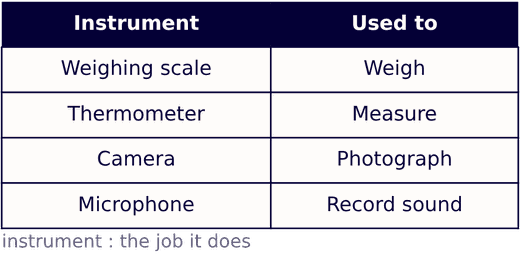
Each pair joins an instrument with the work that the instrument is used to do.
A weighing scale is the instrument used to weigh a body, so the first term must be an instrument and the second the action it performs.
The instrument used to measure temperature is the thermometer, so 'Thermometer : Measure' repeats the same relation.
A clock shows the time, a camera takes photographs and a microphone picks up sound, so none of them is described by the word 'measure'.
45
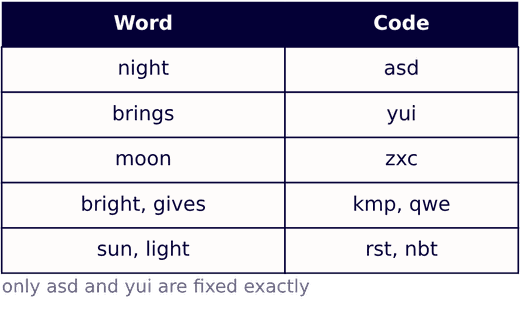
In a certain coding system, 'bright sun gives light' is coded as 'kmp, rst, qwe, nbt. 'moon gives bright night' is coded as 'zxc, qwe, kmp, asd' and 'sun brings light night' is coded as 'rst, yui, nbt, asd'. How will 'bright sun night brings' be coded in this coding system?
A.kmp, rst, asd, yui
B.rst, kmp, yui, nbt
C.kmp, qwe, asd, rst
D.yui, asd, kmp, qwe
Solution
Coded sentences
Take the sentences two at a time: a word common to two sentences must carry the code common to their two code groups.
Sentences 2 and 3 have only 'night' in common and only asd in common, so night = asd.
Sentences 1 and 3 share 'sun' and 'light' against the codes rst and nbt, so the word left in sentence 3, 'brings', must take the code left over, yui.
Sentences 1 and 2 share 'gives' and 'bright' against the codes qwe and kmp, so bright is one of kmp and qwe; the code left in sentence 2, zxc, stands for moon.
So 'bright sun night brings' needs one code out of kmp and qwe, one out of rst and nbt, and then asd and yui.
Only option (a) — kmp, rst, asd, yui — satisfies all four requirements together.
46
Identify the pattern in the following sequence.
4, 18, 48, 100, 180
What is the next number in the sequence?
A.294
B.288
C.292
D.298
Solution
Number series
Write each term as a counting number multiplied by the square of the next counting number.
, , , , .
So the nth term is .
For n=6 the next term is .
The differences confirm it: their own differences rise by 6, so the next difference is 80+34=114 and 180+114=294.
47
Select the option that is related to the fifth number in the same way as the second number is related to the first number and fourth number is related to third number.
(NOTE: Operations should be performed on the whole numbers, without breaking down the numbers into its constituent digits. E.g. 13 - Operations on 13 such as adding /subtracting /multiplying etc. to 13 can be performed. Breaking down 13 into 1 and 3 and then performing mathematical operations on 1 and 3 is not allowed)
421 : 2521 :: 272 : 1627 :: 763 : ?
A.4569
B.4573
C.4575
D.4582
Solution
Number analogy
Compare the two complete pairs and look for one operation that turns the first number into the second.
and 2526-5=2521.
and 1632-5=1627.
So the rule is: second number =(first number.
Applying it to 763: and 4578-5=4573.
48
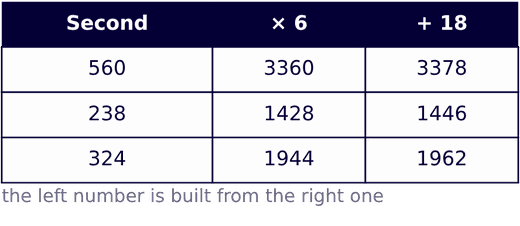
Select the option that is related to the sixth number in the same way as the first number is related to the second number and third number is related to fourth number. (NOTE: Operations should be performed on the whole numbers, without breaking down the numbers into its constituent digits. E.g. 13 - Operations on 13 such as adding /subtracting /multiplying etc. to 13 can be performed. Breaking down 13 into 1 and 3 and then performing mathematical operations on 1 and 3 is not allowed) 3378 : 560 :: 1446 : 238 :: ? : 324
A.1962
B.1960
C.1964
D.1969
Solution
Number analogy
Here the smaller number written on the right has to be turned into the larger number written on the left.
and 3360+18=3378.
and 1428+18=1446.
So the rule is: first number =(second number.
Hence the missing number .
49
In the following question, four letter-number pairs are given. The letter-number on the left side of (-) is related to the letter-number on the right side of (-) with some Logic/Rule/Relation. Select the odd one out from the given alternatives.
(NOTE: Operations should be performed on the whole numbers, without breaking down the numbers into its constituent digits. E.g. 13 - Operations on 13 such as adding /subtracting /multiplying etc. to 13 can be performed. Breaking down 13 into 1 and 3 and then performing mathematical operations on 1 and 3 is not allowed)
A.PK 11 - ME120
B.QY13 - NS170
C.GN17 - DH288
D.OI 15-LC224
Solution
Odd letter-number pair
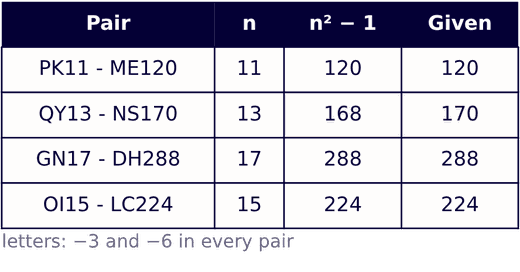
In every pair the first letter moves 3 places back, the second letter moves 6 places back, and the number is changed by one fixed rule.
P M, K E; Q N, Y S; G D, N H; O L, I C — so the letters obey the same rule in all four options.
The number rule is : , and , all of which match.
For QY13 the rule gives , but the pair shows 170.
Hence QY13 - NS170 is the odd one out.
50
A word has been given in the question. This word CAN be formed by using the letters of the word given in one of the alternatives only. Select that alternative.
PLANE
A.PANELT
B.LEAN
C.APPLE
D.NAPKIN
Solution
Word formation
PLANE needs the five letters P, L, A, N and E, one of each.
PANELT is made of P, A, N, E, L and T, so every letter of PLANE is available in it and the extra T is simply not used.
LEAN has no P, APPLE has no N, and NAPKIN has neither L nor E, so PLANE cannot be formed from them.
Finished reading? Now test yourself.
The same 25 questions, but with a timer and the answers hidden — 15 minutes.

 The 6 km walked north is exactly cancelled by the 6 km walked south, so the north-south displacement is 6-6=0.
Only the 3 km walked east remains, so the final position lies 3 km due east of the start.
Hence the person is to the east of his starting point, and option (c) is correct.
The 6 km walked north is exactly cancelled by the 6 km walked south, so the north-south displacement is 6-6=0.
Only the 3 km walked east remains, so the final position lies 3 km due east of the start.
Hence the person is to the east of his starting point, and option (c) is correct.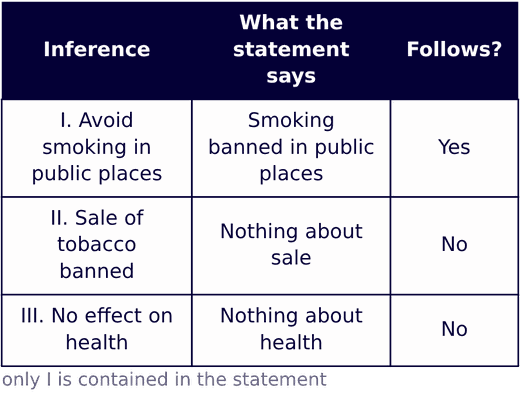 Only inference I follows, so option (a) is correct.
 The statements give , C = D and D > E.
Combining the first two, , which means .
Conclusion I claims D = A and conclusion II claims D > A; neither is certain by itself, because permits both.
But also guarantees that one of the two must hold - there is no third possibility left.
So conclusions I and II form an either-or pair, and option (c) is correct.
The statements give , C = D and D > E.
Combining the first two, , which means .
Conclusion I claims D = A and conclusion II claims D > A; neither is certain by itself, because permits both.
But also guarantees that one of the two must hold - there is no third possibility left.
So conclusions I and II form an either-or pair, and option (c) is correct.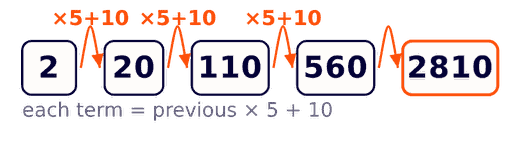 The missing term is .
The same pattern shows in the gaps: - each five times the one before - so the next gap is and 560+2250=2810.
Hence option (b) is correct.
The missing term is .
The same pattern shows in the gaps: - each five times the one before - so the next gap is and 560+2250=2810.
Hence option (b) is correct.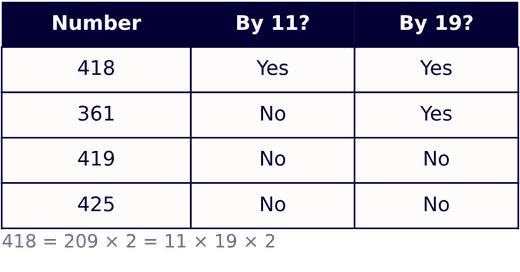 Checking the rest: is divisible by 19 but not by 11, 419 is a prime number, and .
Hence option (a) is correct.
Checking the rest: is divisible by 19 but not by 11, 419 is a prime number, and .
Hence option (a) is correct.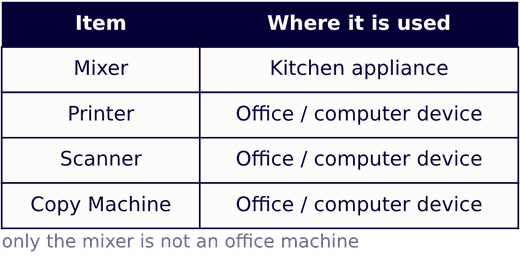 A mixer is a kitchen appliance used to grind and blend food, so it belongs to a different family altogether.
Hence the mixer is the odd one out, and option (a) is correct.
A mixer is a kitchen appliance used to grind and blend food, so it belongs to a different family altogether.
Hence the mixer is the odd one out, and option (a) is correct.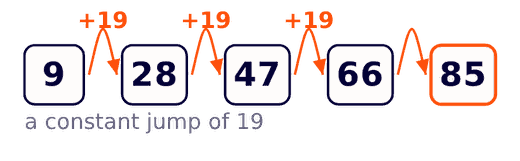 The difference is the same throughout, so this is an arithmetic progression with common difference 19.
Therefore the next term is 66+19=85.
Hence option (d) is correct.
The difference is the same throughout, so this is an arithmetic progression with common difference 19.
Therefore the next term is 66+19=85.
Hence option (d) is correct.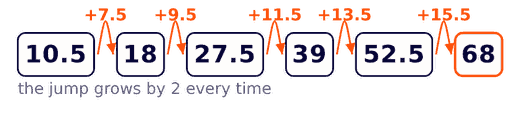 Therefore the next term is 52.5+15.5=68.
Hence option (b) is correct.
Therefore the next term is 52.5+15.5=68.
Hence option (b) is correct.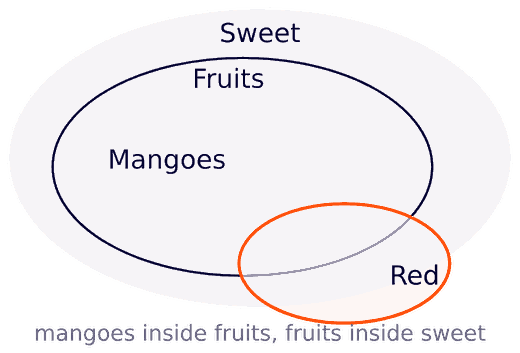 Every mango is a fruit and every fruit is sweet, so every mango is sweet - conclusion III follows.
Since all mangoes are sweet, those mangoes are themselves sweet things, so some sweet things are mangoes - conclusion II follows as the converse of III.
Some mangoes are red, and those very mangoes are sweet, so at least those red things are sweet - conclusion I follows.
All three conclusions follow, so option (d) is correct.
Every mango is a fruit and every fruit is sweet, so every mango is sweet - conclusion III follows.
Since all mangoes are sweet, those mangoes are themselves sweet things, so some sweet things are mangoes - conclusion II follows as the converse of III.
Some mangoes are red, and those very mangoes are sweet, so at least those red things are sweet - conclusion I follows.
All three conclusions follow, so option (d) is correct.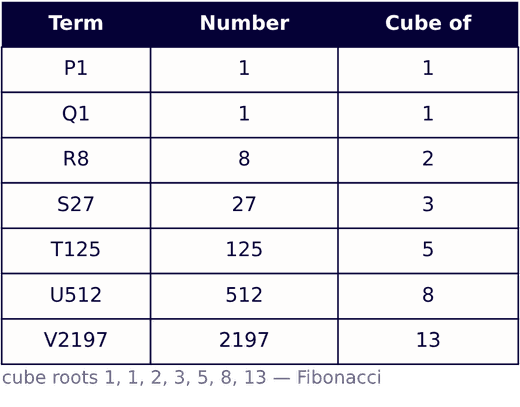 The cube roots form a Fibonacci sequence, in which each term is the sum of the two before it, so the next root is 5+8=13.
Therefore the next number is and the term is V2197.
Hence option (d) is correct.
The cube roots form a Fibonacci sequence, in which each term is the sum of the two before it, so the next root is 5+8=13.
Therefore the next number is and the term is V2197.
Hence option (d) is correct.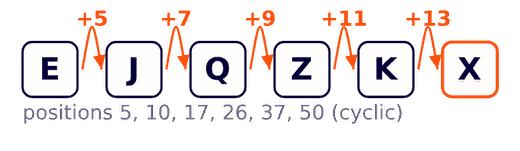 The following jump must be +13, so from 37 we reach 37+13=50, and 50-26=24.
The 24th letter is X, so option (a) is correct.
The following jump must be +13, so from 37 we reach 37+13=50, and 50-26=24.
The 24th letter is X, so option (a) is correct.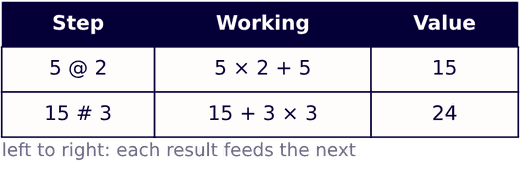 Hence the value of 5 @ 2 # 3 is 24, and option (d) is correct.
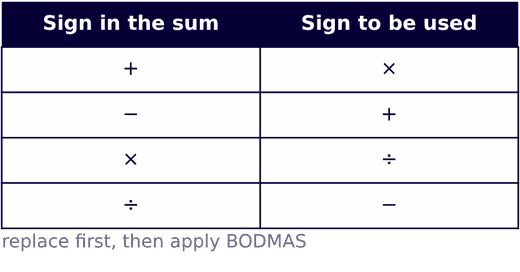 So becomes .
Division and multiplication are done first, from left to right: and .
Now 240-5+6=241.
Hence the required value is 241.
So becomes .
Division and multiplication are done first, from left to right: and .
Now 240-5+6=241.
Hence the required value is 241.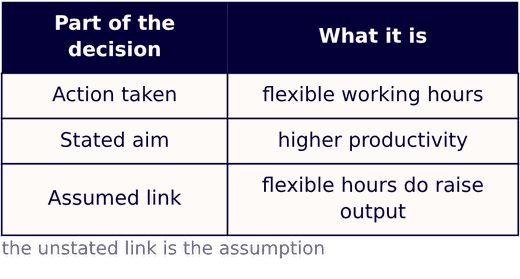 The company can expect that rise only if it takes for granted that flexible hours really do raise productivity and satisfaction, which is exactly what option (b) states.
Options (a) and (d) add fresh claims about what employees like or when they work best, and option (c) speaks of saving cost, a purpose the statement never mentions.
The company can expect that rise only if it takes for granted that flexible hours really do raise productivity and satisfaction, which is exactly what option (b) states.
Options (a) and (d) add fresh claims about what employees like or when they work best, and option (c) speaks of saving cost, a purpose the statement never mentions.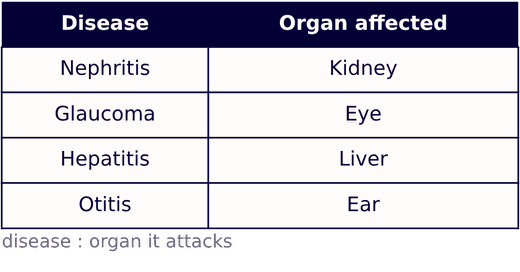 The liver is attacked by hepatitis and the ear by otitis, so options (b), (c) and (d) do not go with glaucoma.
 A clock shows the time, a camera takes photographs and a microphone picks up sound, so none of them is described by the word 'measure'.
 So 'bright sun night brings' needs one code out of kmp and qwe, one out of rst and nbt, and then asd and yui.
Only option (a) — kmp, rst, asd, yui — satisfies all four requirements together.
So 'bright sun night brings' needs one code out of kmp and qwe, one out of rst and nbt, and then asd and yui.
Only option (a) — kmp, rst, asd, yui — satisfies all four requirements together.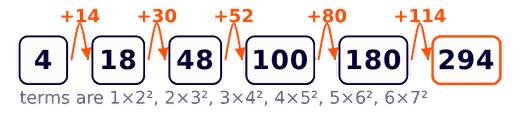 For n=6 the next term is .
The differences confirm it: their own differences rise by 6, so the next difference is 80+34=114 and 180+114=294.
For n=6 the next term is .
The differences confirm it: their own differences rise by 6, so the next difference is 80+34=114 and 180+114=294.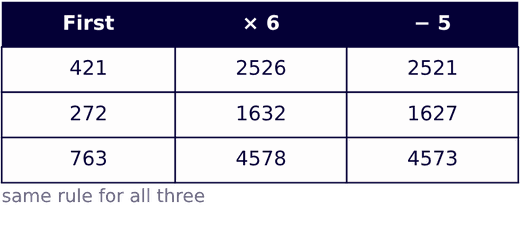 Applying it to 763: and 4578-5=4573.
 Hence the missing number .
 For QY13 the rule gives , but the pair shows 170.
Hence QY13 - NS170 is the odd one out.
For QY13 the rule gives , but the pair shows 170.
Hence QY13 - NS170 is the odd one out.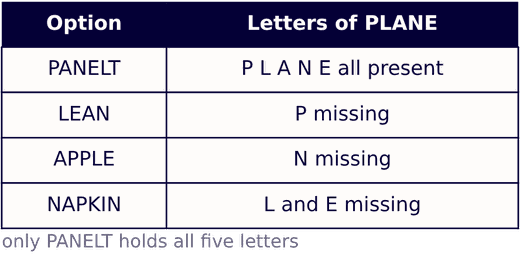 LEAN has no P, APPLE has no N, and NAPKIN has neither L nor E, so PLANE cannot be formed from them.