
21
The first three digits of the Magnetic Ink Character Recognition number on your cheque specifies the ____ code in which you have the bank account.
- A.bank
- B.branch
- C.city
- D.country
Solution
MICR code structure
The MICR band printed along the foot of a cheque carries a 9-digit code that is read in three blocks of three digits.
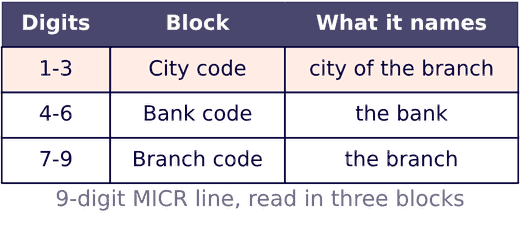 The first block is the city code, so the first three digits name the city in which the branch holding your account is located.
The code is printed in magnetic ink so a sorting machine can still read the cheque after it has been stamped, folded or signed across.
Bank (a) and branch (b) are tempting because both do appear in the code - but they are the second and third blocks, not the first.
Hence the correct option is (c).
The first block is the city code, so the first three digits name the city in which the branch holding your account is located.
The code is printed in magnetic ink so a sorting machine can still read the cheque after it has been stamped, folded or signed across.
Bank (a) and branch (b) are tempting because both do appear in the code - but they are the second and third blocks, not the first.
Hence the correct option is (c).
The first block is the city code, so the first three digits name the city in which the branch holding your account is located.
The code is printed in magnetic ink so a sorting machine can still read the cheque after it has been stamped, folded or signed across.
Bank (a) and branch (b) are tempting because both do appear in the code - but they are the second and third blocks, not the first.
Hence the correct option is (c).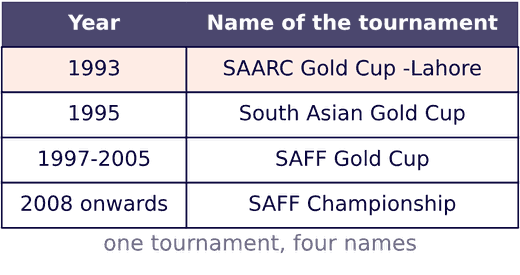 That tournament is the ancestor of today's SAFF Championship - the same competition was renamed twice before settling on its present name in 2008.
Colombo (a) is the trap: Sri Lanka were the runners-up of that very edition, but the matches were played in Lahore, not in Colombo.
Hence the correct option is (b).
That tournament is the ancestor of today's SAFF Championship - the same competition was renamed twice before settling on its present name in 2008.
Colombo (a) is the trap: Sri Lanka were the runners-up of that very edition, but the matches were played in Lahore, not in Colombo.
Hence the correct option is (b).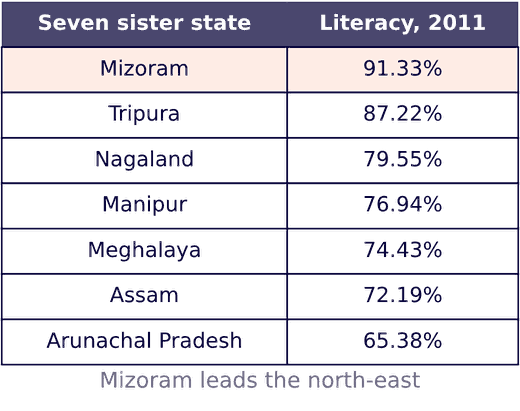 In the all-India ranking Mizoram stood second only to Kerala (93.91 per cent), and its female literacy of 89.27 per cent is the real reason its overall figure is so high.
Nagaland (d) is the nearest of the given options at 79.55 per cent - a full twelve points behind, so the gap is not a close call.
Hence the correct option is (b).
In the all-India ranking Mizoram stood second only to Kerala (93.91 per cent), and its female literacy of 89.27 per cent is the real reason its overall figure is so high.
Nagaland (d) is the nearest of the given options at 79.55 per cent - a full twelve points behind, so the gap is not a close call.
Hence the correct option is (b).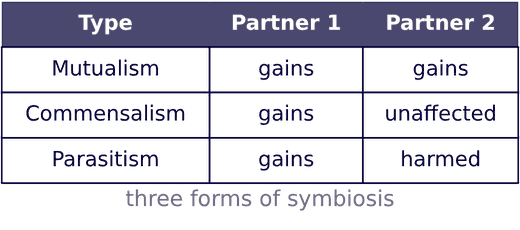 A lichen is the standard example - a fungus supplies shelter and minerals while an alga supplies food, and neither survives alone.
Competition (c) is also an interaction between species, but it is short-term rivalry for a resource, not a sustained partnership, so it fails the definition.
Photosynthesis (a) happens inside a single organism and random movement (d) needs no second species at all.
Hence the correct option is (b).
A lichen is the standard example - a fungus supplies shelter and minerals while an alga supplies food, and neither survives alone.
Competition (c) is also an interaction between species, but it is short-term rivalry for a resource, not a sustained partnership, so it fails the definition.
Photosynthesis (a) happens inside a single organism and random movement (d) needs no second species at all.
Hence the correct option is (b).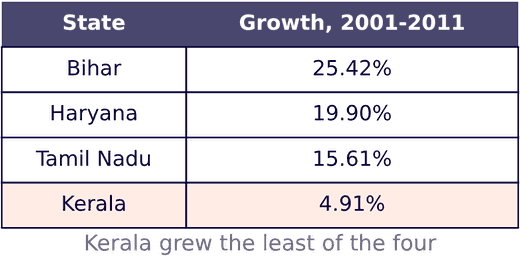 High female literacy, a dense network of health centres and an early family-planning success pushed Kerala's fertility below the replacement level long before the rest of the country.
Bihar (a) is the opposite extreme at 25.42 per cent, and it is the option a student picks by misreading 'least' as 'highest'.
Hence the correct option is (d).
High female literacy, a dense network of health centres and an early family-planning success pushed Kerala's fertility below the replacement level long before the rest of the country.
Bihar (a) is the opposite extreme at 25.42 per cent, and it is the option a student picks by misreading 'least' as 'highest'.
Hence the correct option is (d).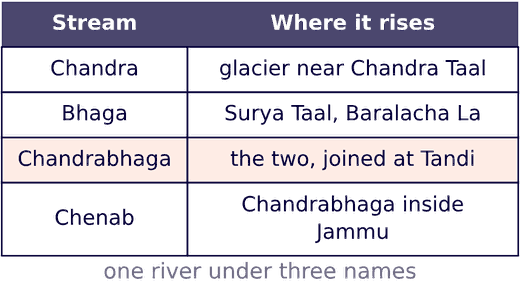 Below Tandi the united stream is called the Chandrabhaga, and once it enters Jammu it is known as the Chenab, one of the five rivers of Punjab.
Penuganga and Warda (d) and Panzara and Waghur (a) are Deccan streams of Maharashtra, so they cannot meet in a Himalayan valley.
Hence the correct option is (c).
Below Tandi the united stream is called the Chandrabhaga, and once it enters Jammu it is known as the Chenab, one of the five rivers of Punjab.
Penuganga and Warda (d) and Panzara and Waghur (a) are Deccan streams of Maharashtra, so they cannot meet in a Himalayan valley.
Hence the correct option is (c).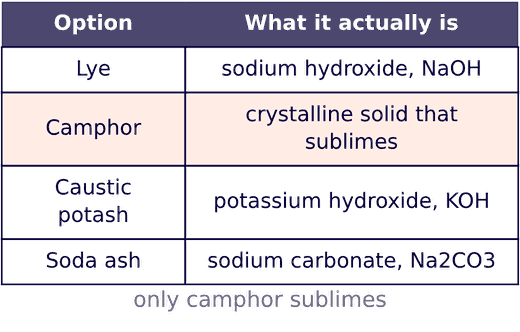 That is why camphor is purified by sublimation: heat it in a china dish under an inverted funnel and the pure solid re-forms on the cold glass, leaving the impurities behind.
Naphthalene, iodine, ammonium chloride and dry ice behave the same way.
Lye (a) and caustic potash (c) are strong alkalis that melt and dissolve rather than sublime, so they can never be purified this way.
Hence the correct option is (b).
That is why camphor is purified by sublimation: heat it in a china dish under an inverted funnel and the pure solid re-forms on the cold glass, leaving the impurities behind.
Naphthalene, iodine, ammonium chloride and dry ice behave the same way.
Lye (a) and caustic potash (c) are strong alkalis that melt and dissolve rather than sublime, so they can never be purified this way.
Hence the correct option is (b).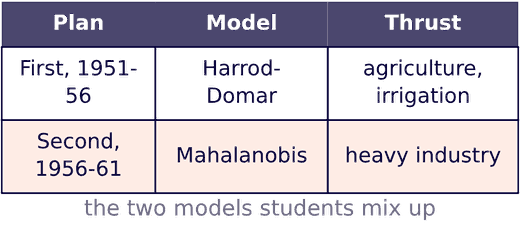 His model put investment into heavy and basic industry first, on the argument that machines which make machines will pay for consumer goods later - the plan is therefore remembered as the industrial plan.
It was carried out alongside the Industrial Policy Resolution of 1956, which reserved the commanding heights of the economy for the public sector.
CD Deshmukh (a) is the trap: he was the Finance Minister who presented the plan's budgets, but the design behind it was Mahalanobis's.
Hence the correct option is (d).
His model put investment into heavy and basic industry first, on the argument that machines which make machines will pay for consumer goods later - the plan is therefore remembered as the industrial plan.
It was carried out alongside the Industrial Policy Resolution of 1956, which reserved the commanding heights of the economy for the public sector.
CD Deshmukh (a) is the trap: he was the Finance Minister who presented the plan's budgets, but the design behind it was Mahalanobis's.
Hence the correct option is (d).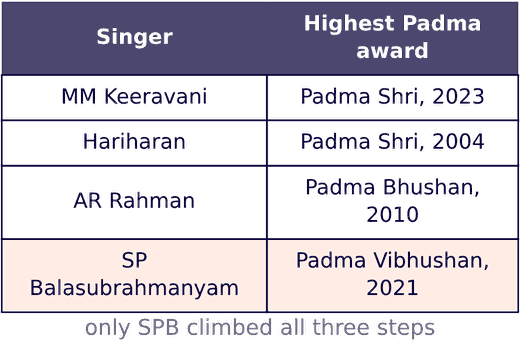 He sang more than forty thousand songs in sixteen languages and also worked as an actor, dubbing artist and music director, which is why the honours kept climbing.
AR Rahman (c) is the tempting answer because he is the most decorated name on the list internationally - but his Padma awards stop at the Padma Bhushan of 2010.
Hence the correct option is (d).
He sang more than forty thousand songs in sixteen languages and also worked as an actor, dubbing artist and music director, which is why the honours kept climbing.
AR Rahman (c) is the tempting answer because he is the most decorated name on the list internationally - but his Padma awards stop at the Padma Bhushan of 2010.
Hence the correct option is (d).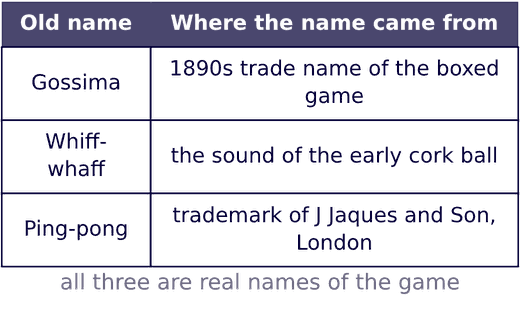 The game began as after-dinner table tennis in 1880s England, with books for a net and a champagne cork for a ball, and each maker gave it a name of its own.
'Ping-pong' survived because J Jaques and Son registered it as a trademark, which is why the sport's world body had to adopt the neutral name table tennis in 1926.
Options (b), (c) and (d) each drop at least one real name, so only the all-inclusive choice can be right.
Hence the correct option is (a).
The game began as after-dinner table tennis in 1880s England, with books for a net and a champagne cork for a ball, and each maker gave it a name of its own.
'Ping-pong' survived because J Jaques and Son registered it as a trademark, which is why the sport's world body had to adopt the neutral name table tennis in 1926.
Options (b), (c) and (d) each drop at least one real name, so only the all-inclusive choice can be right.
Hence the correct option is (a).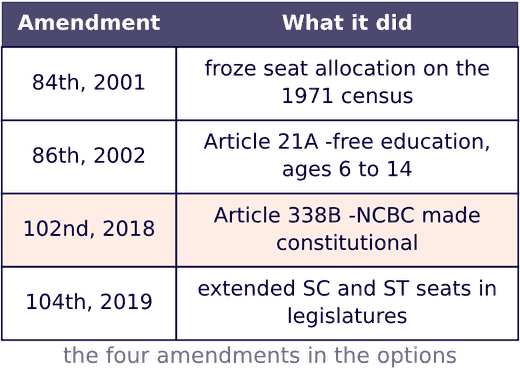 Until then the NCBC was only a statutory body set up under an Act of 1993; the same amendment also added Article 342A, under which the President notifies the socially and educationally backward classes of a state.
The Commission has a Chairperson, a Vice-Chairperson and three other Members, all appointed by the President.
The 104th Amendment (b) is the near miss - it belongs to reservation as well, but it extended reserved seats for SCs and STs in the legislatures and ended the nomination of Anglo-Indians.
Hence the correct option is (c).
Until then the NCBC was only a statutory body set up under an Act of 1993; the same amendment also added Article 342A, under which the President notifies the socially and educationally backward classes of a state.
The Commission has a Chairperson, a Vice-Chairperson and three other Members, all appointed by the President.
The 104th Amendment (b) is the near miss - it belongs to reservation as well, but it extended reserved seats for SCs and STs in the legislatures and ended the nomination of Anglo-Indians.
Hence the correct option is (c).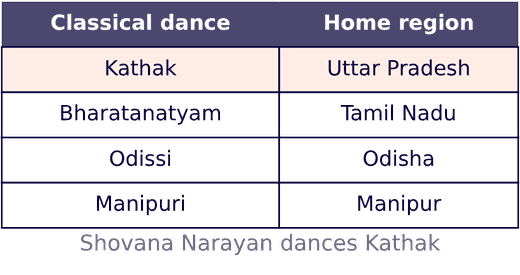 She is unusual in having danced at the top level while serving as an officer of the Indian Audit and Accounts Service, and she holds the Padma Shri and the Sangeet Natak Akademi Award.
Kathak is the only one of the four that grew in the north, moving from temple story-telling to the Mughal court, which is the clue the question leaves.
Bharatanatyam (a) is the usual guess for any celebrated woman dancer, but that form belongs to the Tamil temple tradition.
Hence the correct option is (d).
She is unusual in having danced at the top level while serving as an officer of the Indian Audit and Accounts Service, and she holds the Padma Shri and the Sangeet Natak Akademi Award.
Kathak is the only one of the four that grew in the north, moving from temple story-telling to the Mughal court, which is the clue the question leaves.
Bharatanatyam (a) is the usual guess for any celebrated woman dancer, but that form belongs to the Tamil temple tradition.
Hence the correct option is (d).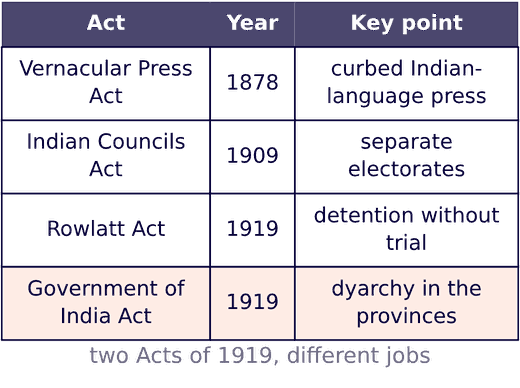 Dyarchy split the provincial subjects in two: transferred subjects such as education and health went to ministers answerable to the legislature, while reserved subjects such as police and finance stayed with the Governor.
The same Act made the central legislature bicameral and extended separate electorates to Sikhs, Indian Christians, Anglo-Indians and Europeans.
The Rowlatt Act (c) is the trap because it too was passed in 1919 - but it dealt with detention without trial, not with the machinery of provincial government.
Hence the correct option is (b).
Dyarchy split the provincial subjects in two: transferred subjects such as education and health went to ministers answerable to the legislature, while reserved subjects such as police and finance stayed with the Governor.
The same Act made the central legislature bicameral and extended separate electorates to Sikhs, Indian Christians, Anglo-Indians and Europeans.
The Rowlatt Act (c) is the trap because it too was passed in 1919 - but it dealt with detention without trial, not with the machinery of provincial government.
Hence the correct option is (b).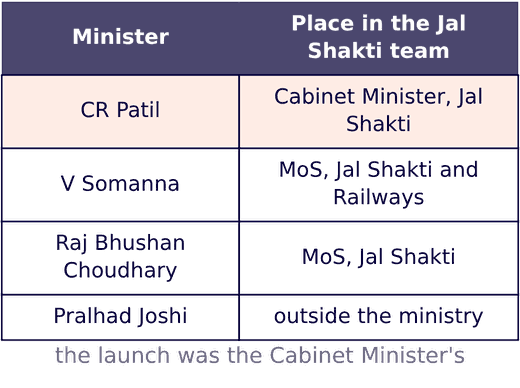 Bhu-Neer is a single window for no-objection certificates to draw ground water; it was built by the Central Ground Water Authority with the National Informatics Centre and links each permit to a PAN so that withdrawals can be tracked.
V Somanna (b) and Raj Bhushan Choudhary (d) are the near misses - both are Ministers of State in the same Jal Shakti ministry, but the launch was made by the Cabinet Minister.
Hence the correct option is (a).
Bhu-Neer is a single window for no-objection certificates to draw ground water; it was built by the Central Ground Water Authority with the National Informatics Centre and links each permit to a PAN so that withdrawals can be tracked.
V Somanna (b) and Raj Bhushan Choudhary (d) are the near misses - both are Ministers of State in the same Jal Shakti ministry, but the launch was made by the Cabinet Minister.
Hence the correct option is (a).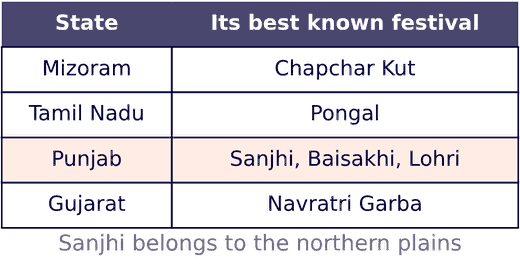 Girls shape an image of the goddess Sanjhi, a form of Durga, in clay or cow dung on a wall, decorate it through the nine nights of Navratri and float it in a river or pond on the last day.
The custom also runs through Haryana, western Uttar Pradesh, Delhi and Rajasthan, and in some districts it is kept during Pitru Paksha instead.
Gujarat (d) tempts because Navratri is its biggest festival, but there the nine nights are marked by Garba and Dandiya, not by Sanjhi.
Hence the correct option is (c).
Girls shape an image of the goddess Sanjhi, a form of Durga, in clay or cow dung on a wall, decorate it through the nine nights of Navratri and float it in a river or pond on the last day.
The custom also runs through Haryana, western Uttar Pradesh, Delhi and Rajasthan, and in some districts it is kept during Pitru Paksha instead.
Gujarat (d) tempts because Navratri is its biggest festival, but there the nine nights are marked by Garba and Dandiya, not by Sanjhi.
Hence the correct option is (c).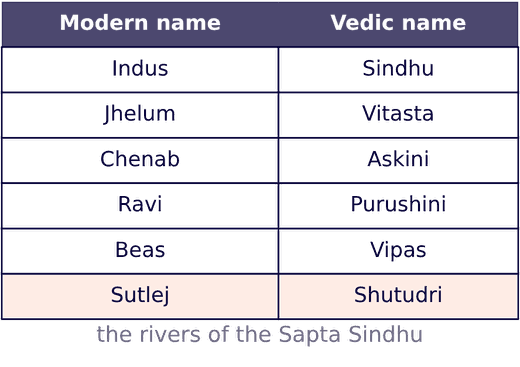 Sapta Sindhu means the land of seven rivers - the Sindhu with its five tributaries and the Saraswati - and the hymns name each of them separately.
Vitasta (c) is the standard distractor because it is also a Sapta Sindhu name, but it belongs to the Jhelum, and Askini (a) and Purushini (d) are the Chenab and the Ravi.
Hence the correct option is (b).
Sapta Sindhu means the land of seven rivers - the Sindhu with its five tributaries and the Saraswati - and the hymns name each of them separately.
Vitasta (c) is the standard distractor because it is also a Sapta Sindhu name, but it belongs to the Jhelum, and Askini (a) and Purushini (d) are the Chenab and the Ravi.
Hence the correct option is (b).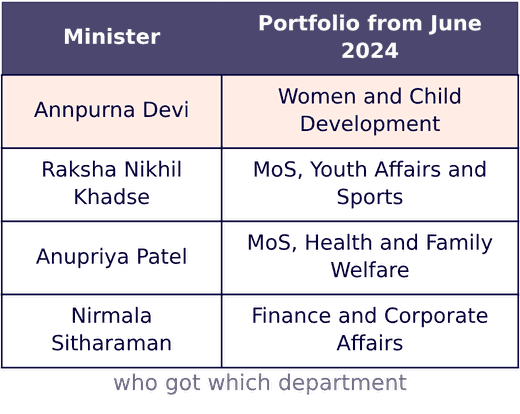 She is a Lok Sabha member from Koderma in Jharkhand and had been Minister of State for Education from 2021 to 2024; in this post she succeeded Smriti Irani.
Raksha Nikhil Khadse (b) and Anupriya Patel (c) also entered the same ministry list in June 2024, but as Ministers of State for Youth Affairs and Sports and for Health respectively.
Hence the correct option is (a).
She is a Lok Sabha member from Koderma in Jharkhand and had been Minister of State for Education from 2021 to 2024; in this post she succeeded Smriti Irani.
Raksha Nikhil Khadse (b) and Anupriya Patel (c) also entered the same ministry list in June 2024, but as Ministers of State for Youth Affairs and Sports and for Health respectively.
Hence the correct option is (a).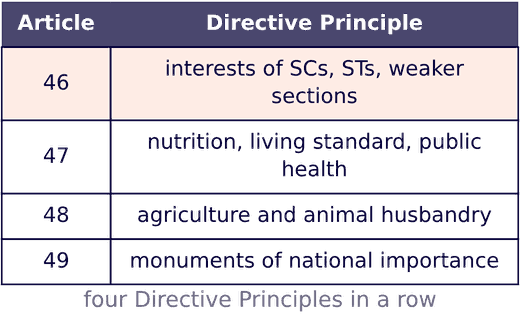 It sits in Part IV among the Directive Principles, so it is not enforceable in a court, yet it is the constitutional peg on which reservation and welfare schemes are hung.
Article 47 (b) is the closest rival because it too speaks of raising living standards - but its subject is nutrition and public health for everyone, not the weaker sections in particular.
Hence the correct option is (a).
It sits in Part IV among the Directive Principles, so it is not enforceable in a court, yet it is the constitutional peg on which reservation and welfare schemes are hung.
Article 47 (b) is the closest rival because it too speaks of raising living standards - but its subject is nutrition and public health for everyone, not the weaker sections in particular.
Hence the correct option is (a).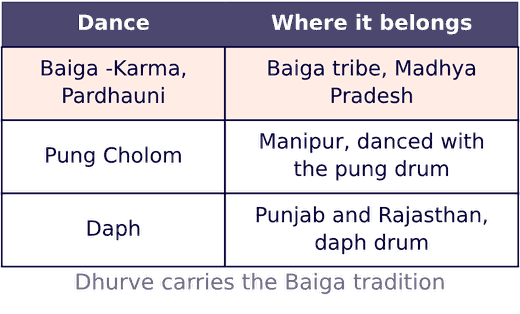 A retired teacher from Dindori district in Madhya Pradesh, he has spent decades performing and teaching Baiga forms such as the Karma and the Pardhauni, danced by men and women together in beaded ornaments.
Pung Cholom (a) is the tempting choice for anyone who recalls a tribal drum dance - but that is a Manipuri form performed with the pung drum, and it has no link to Madhya Pradesh.
Hence the correct option is (b).
A retired teacher from Dindori district in Madhya Pradesh, he has spent decades performing and teaching Baiga forms such as the Karma and the Pardhauni, danced by men and women together in beaded ornaments.
Pung Cholom (a) is the tempting choice for anyone who recalls a tribal drum dance - but that is a Manipuri form performed with the pung drum, and it has no link to Madhya Pradesh.
Hence the correct option is (b).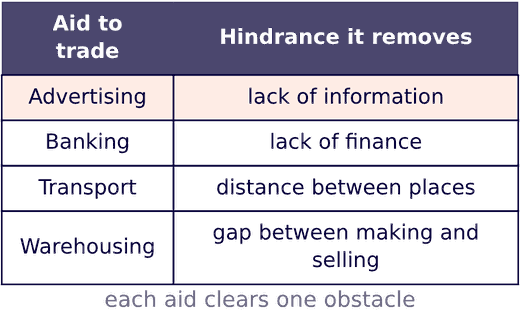 It removes the hindrance of information: a producer in one town can reach a customer in another only if the customer knows what is on offer and at what price.
The other three options are the jobs of the remaining auxiliaries - banking finances, industry produces and transport carries - so each names a different link in the chain.
Hence the correct option is (b).
It removes the hindrance of information: a producer in one town can reach a customer in another only if the customer knows what is on offer and at what price.
The other three options are the jobs of the remaining auxiliaries - banking finances, industry produces and transport carries - so each names a different link in the chain.
Hence the correct option is (b).