SSC GD Constable 10 February 2025 · Shift 3 · Elementary Mathematics — questions with answers · ShikshaSphere
Chapter 73 of 210
10 February 2025 · Shift 3
Elementary Mathematics
20 questions ~20 min readFree
20 questions
A
41
Nitin has ₹1224 with him. He divided it amongst his sons Pravin and Rishi and asked them to invest it at 4% rate of interest compounded annually. It was seen that Pravin and Rishi got same amount after 14 and 15 years respectively. How much (in ₹) did Nitin give to Rishi?
A.624
B.600
C.724
D.450
Solution
Compound interest, equal amounts
Let Pravin get P and Rishi get R, so P+R=1224.
The two amounts are equal, but Rishi's money grows for one year longer:
Cancelling from both sides:
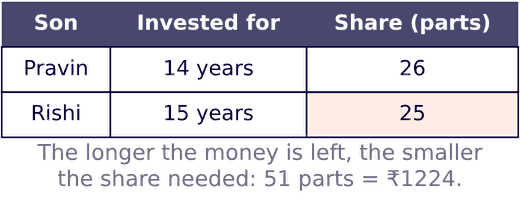
So P:R=26:25, that is 26+25=51 equal parts in all.
1 part , so one part is ₹24.
Rishi's share ₹600
So the correct option is (b).
42
Evaluate:
A.15
B.11
C.14
D.12
Solution
BODMAS simplification
BODMAS: do division and multiplication first, then addition and subtraction from the left.
=16+4-8
=20-8=12
So the correct option is (d).
43
400 chickooes were bought at ₹1250 per hundred and were sold at a profit of ₹800. Find the selling price (in ₹) per dozen of chickooes.
A.174
B.189
C.184
D.164
Solution
Profit and unit selling price
400 chickoos are 4 hundreds, and one hundred costs ₹1250.
Cost price ₹5,000
Selling price of all 400 =5000+800= ₹5,800
Selling price of one chickoo ₹14.50
Selling price per dozen ₹174
So the correct option is (a).
44
A shopkeeper bought an article for ₹500. At what price (in ₹) should he sell the article to make 30% profit ?
A.650
B.350
C.638
D.662
Solution
Selling price from profit percent
Profit percent is always reckoned on the cost price:
SP= ₹650
So the correct option is (a).
45
Mohan invests a sum of ₹5400 and Varun invests a sum of ₹9400 at the same rate of simple interest per annum. If, at the end of 6 years, Varun gets ₹480 more interest than Mohan, then find the rate of interest per annum (in percentage).
A.4
B.2.5
C.3
D.2
Solution
Simple interest, equal rate and time
, and here R and T are the same for both men.
So the extra interest comes only from the extra principal.
Extra principal =9400-5400= ₹4,000
240R=480
per annum
So the correct option is (d).
46
A man goes to Jaipur from Surat at a speed of and returns to Surat at speed of 15 km/hr, through same route. What is his average speed (in km/hr) of the entire journey ?
A.5
B.8
C.6
D.1
Solution
Average speed, equal distances
The two legs cover the same distance, so use the harmonic mean .
=5 km/hr
The ordinary average is the trap: far more time is spent on the slow leg.
So the correct option is (a).
47
The smallest natural number which is divisible by and 9 is:
A.921
B.990
C.1054
D.1032
Solution
LCM by prime factorisation
The smallest number divisible by all of them is their LCM.
11=11, , ,
Take the highest power of each prime: LCM
So the correct option is (b).
48
The population of a district is 384000, out of which 192000 are males. 69% of the population is literate. If 53% males are literate, then what percentage of females are literate?
A.84%
B.87%
C.85%
D.82%
Solution
Percentage, literacy split
Females =384000-192000=192000, so the district is half male and half female.
Total literates
Literate males
Literate females =264960-101760=163200
Required percentage
So the correct option is (c).
49
A cyclist rides for 2 hours at 15 and then for 3 hours at . What is the average speed (in km/hr) of the cyclist for the entire trip ?
A.18
B.16
C.20
D.19
Solution
Average speed, unequal times
Average speed - never the average of the two speeds.
Total distance km
Total time =2+3=5 hours
Average speed km/hr
So the correct option is (a).
50
What is the volume of a sphere of radius ?
A.
B.
C.
D.
Solution
Volume of a sphere
Volume of a sphere
Here cm, so
So the correct option is (d).
51
If and are in continued proportion, then what is the value of ?
A.
B.
C.
D.
Solution
Continued proportion
In continued proportion every term bears the same ratio to the next:
The common ratio is , i.e. each term is twice the one before it.
b=24
So the correct option is (b).
52
The average weight of Kiran, Mahesh and Ram is 46 kg . If the average weight of Kiran and Mahesh be 40 kg and that of Mahesh and Ram be 47 kg, then the weight of Mahesh (in kg) is:
A.56
B.51
C.36
D.46
Solution
Averages of overlapping groups
Turn every average back into a total before combining them.
Adding the last two counts Mahesh twice: K+2M+R=80+94=174
Subtracting the first total: M=174-138
M=36 kg
So the correct option is (c).
53
If at the same rate of interest, in 2 years, the simple interest is ₹40 and compound interest is ₹56, then what is the principal (in ₹) ?
A.25
B.18
C.29
D.20
Solution
Difference of CI and SI
For 2 years the whole difference between CI and SI is the interest earned on the first year's interest.
First year's interest ₹20
CI-SI=56-40= ₹16
So
per annum
P= ₹25
So the correct option is (a).
54
The speed of a stream is 6 km/h. A boat can go 56 km downstream and 39 km upstream in 7 hours. What is the speed (in km/h) of the boat in still water?
A.22
B.15
C.7
D.13
Solution
Boat and stream
Let the speed of the boat in still water be x km/h.
Downstream speed =x+6 km/h and upstream speed =x-6 km/h.
x=15 km/h, the negative root being rejected.
So the correct option is (b).
55
Find the value of [(14 ÷ 2) × {14/7 + 40/3 × (7 − 4)}]
A.310
B.274
C.277
D.294
Solution
BODMAS with nested brackets
Clear the innermost brackets first, then the curly bracket, then the square bracket.
and (7-4)=3
Inside the curly bracket:
So the correct option is (d).
56
Evaluate:
A.- 47
B.- 48
C.-44
D.-45
Solution
BODMAS with negative numbers
Division and multiplication come before addition and subtraction; a negative divided by a negative is positive.
and
(-9)-4+(-32)
=-13-32
=-45
So the correct option is (d).
57
A shopkeeper offers 3 schemes of discounts to his customers. Which of the following schemes will fetch the minimum discount percentage?
A. Two successive discounts of 25% and 32%.
B. Buy 8 get two free.
C. Buy 8 and get 10.
A.B only
B.A only
C.Both B and C
D.C only
Solution
Comparing discount schemes
(A) Successive discounts multiply: the customer pays of the marked price.
Discount
(B) Buy 8 get 2 free: 10 articles are taken away but only 8 are paid for, so the discount is .
(C) Buy 8 and get 10 is exactly the same bargain - pay for 8, carry away 10 - so it too is .
The smallest discount is , and B and C give it equally.
So the correct option is (c).
58
P and Q can complete a piece of work in 28 days and 35 days, respectively. P begins to do the work and they work alternatively one at a time for one day each. In how many days will the whole work be completed ?
A.31
B.27
C.18
D.21
Solution
Alternate-day work
Take the total work as LCM(28,35)=140 units.
P does units a day and Q does units a day.
Working alternately from P, one 2-day cycle finishes 5+4=9 units.
, so 15 full cycles (30 days) finish 135 units.
Day 31 is P's turn, and P's 5 units exactly clear the remaining 5 units.
Total time =30+1=31 days
So the correct option is (a).
59
The power consumption of an electrical device varies directly with the square of the voltage applied. If a device consumes 150 watts when the voltage is 120 volts, how much power (in watts) will it consume at 240 volts ?
A.550
B.650
C.500
D.600
Solution
Direct variation with a square
, so .
watts
Doubling the voltage does not double the power - it multiplies it by four.
So the correct option is (d).
60
If the price of petrol increases from ₹90/L to ₹110/L, by what percentage does a person have to decrease his consumption so that his expenditure on petrol remains the same (approximate to two decimals) ?
A.78.78%
B.25.25%
C.18.18%
D.81.81%
Solution
Price rise and consumption cut
Expenditure = price × consumption, and it has to stay unchanged.
Required reduction
Dividing by the old price would give - the cut has to be measured on the new price.
So the correct option is (c).
Finished reading? Now test yourself.
The same 20 questions, but with a timer and the answers hidden — 15 minutes.

 1 part , so one part is ₹24.
Rishi's share ₹600
So the correct option is (b).
1 part , so one part is ₹24.
Rishi's share ₹600
So the correct option is (b).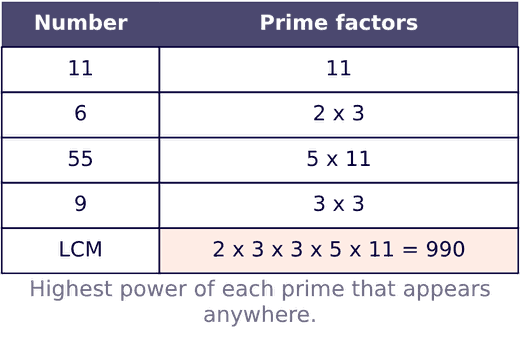 Take the highest power of each prime: LCM
So the correct option is (b).
Take the highest power of each prime: LCM
So the correct option is (b).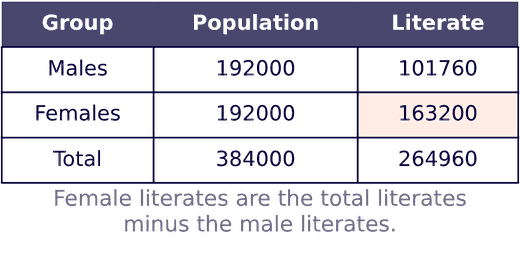 Required percentage
So the correct option is (c).
Required percentage
So the correct option is (c).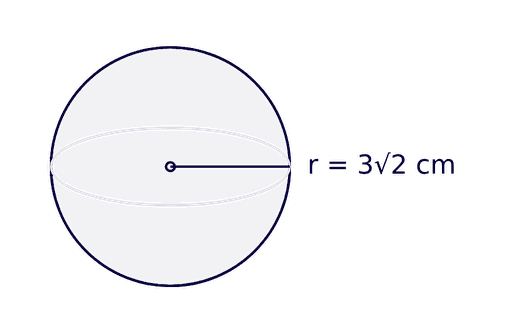 Here cm, so
So the correct option is (d).
Here cm, so
So the correct option is (d).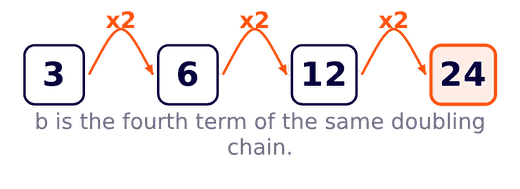 The common ratio is , i.e. each term is twice the one before it.
b=24
So the correct option is (b).
The common ratio is , i.e. each term is twice the one before it.
b=24
So the correct option is (b).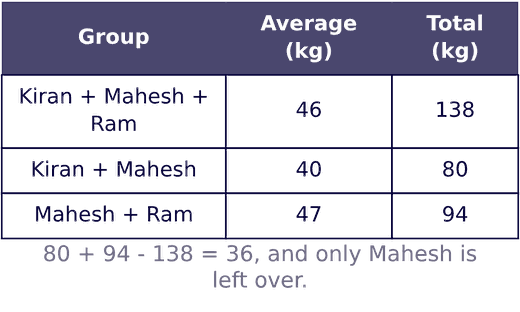 Adding the last two counts Mahesh twice: K+2M+R=80+94=174
Subtracting the first total: M=174-138
M=36 kg
So the correct option is (c).
Adding the last two counts Mahesh twice: K+2M+R=80+94=174
Subtracting the first total: M=174-138
M=36 kg
So the correct option is (c).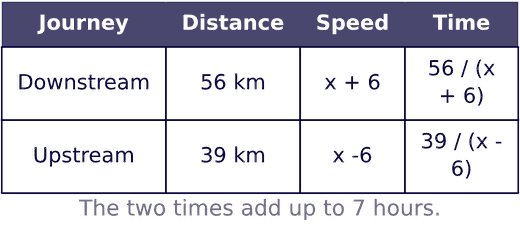 x=15 km/h, the negative root being rejected.
So the correct option is (b).
x=15 km/h, the negative root being rejected.
So the correct option is (b).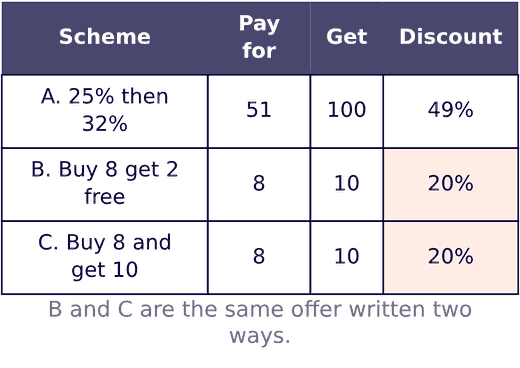 The smallest discount is , and B and C give it equally.
So the correct option is (c).
The smallest discount is , and B and C give it equally.
So the correct option is (c).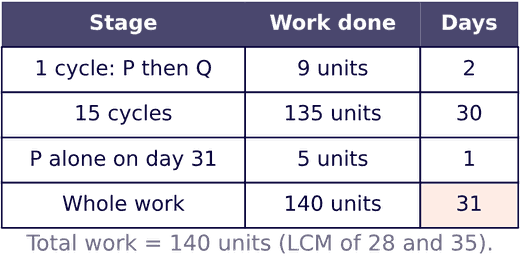 Day 31 is P's turn, and P's 5 units exactly clear the remaining 5 units.
Total time =30+1=31 days
So the correct option is (a).
Day 31 is P's turn, and P's 5 units exactly clear the remaining 5 units.
Total time =30+1=31 days
So the correct option is (a).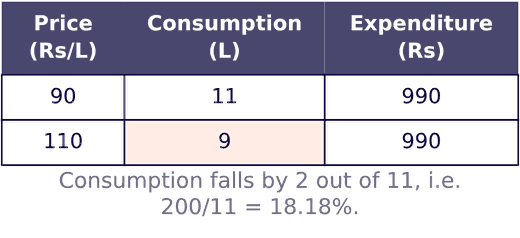 Dividing by the old price would give - the cut has to be measured on the new price.
So the correct option is (c).
Dividing by the old price would give - the cut has to be measured on the new price.
So the correct option is (c).