
21
Article 49 of the Constitution of India deals with which of the following Directive Principles of State Policy?
- A.To defend the country and render national service when called upon to do so
- B.To organise village Panchayats as units of self-government
- C.To secure just and humane conditions of work and maternity relief
- D.To protect all monuments of historic interest and national importance
Solution
Directive Principles - Article 49
Correct option: (d) To protect all monuments of historic interest and national importance.
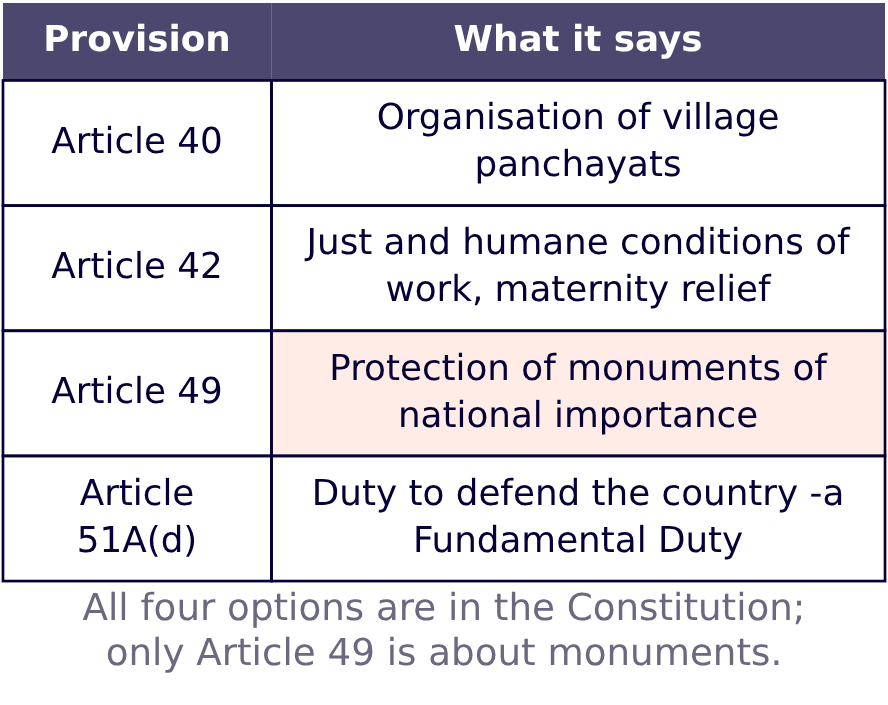
Article 49 places an obligation on the State to protect every monument, place or object of artistic or historic interest that Parliament has declared to be of national importance, from spoliation, disfigurement, destruction, removal, disposal or export.
 It lies in Part IV (Articles 36-51) of the Constitution and is the Directive Principle that pairs with Article 51A(f), the Fundamental Duty to value and preserve our composite culture.
The other three are genuine constitutional provisions put in the wrong slot: defending the country is a Fundamental Duty under Article 51A(d), organising village panchayats is Article 40, and just and humane conditions of work with maternity relief is Article 42.
It lies in Part IV (Articles 36-51) of the Constitution and is the Directive Principle that pairs with Article 51A(f), the Fundamental Duty to value and preserve our composite culture.
The other three are genuine constitutional provisions put in the wrong slot: defending the country is a Fundamental Duty under Article 51A(d), organising village panchayats is Article 40, and just and humane conditions of work with maternity relief is Article 42.
It lies in Part IV (Articles 36-51) of the Constitution and is the Directive Principle that pairs with Article 51A(f), the Fundamental Duty to value and preserve our composite culture.
The other three are genuine constitutional provisions put in the wrong slot: defending the country is a Fundamental Duty under Article 51A(d), organising village panchayats is Article 40, and just and humane conditions of work with maternity relief is Article 42.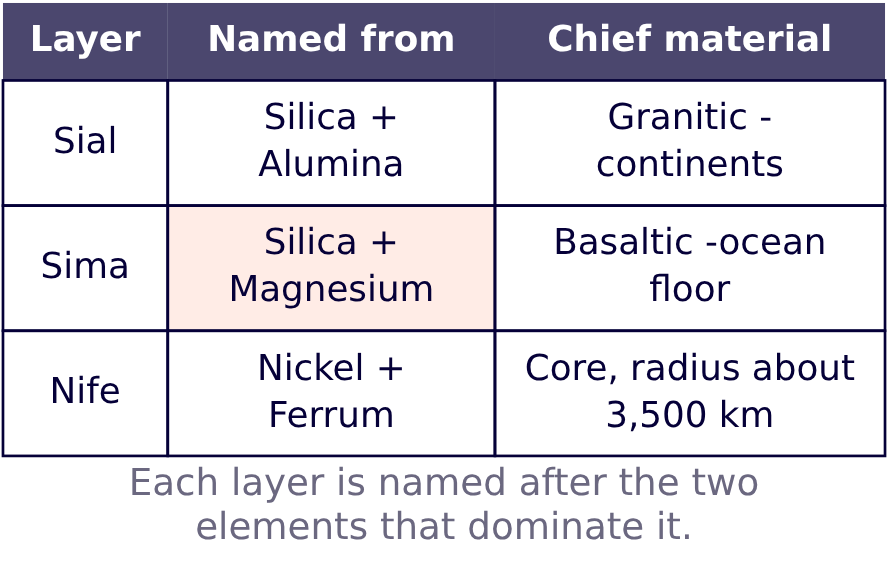 This layer is basaltic and forms the floor of the oceans; above it lies 'Sial' (silica + alumina), the lighter granitic layer that makes up the continents, and far below the crust the innermost core is called 'Nife' (nickel + ferrum), with a radius of about 3,500 km.
Sillimanite, sigloite and silinaite are all real minerals, but each is a single rare mineral species, not the broad rock-forming group that the term 'Sima' stands for.
This layer is basaltic and forms the floor of the oceans; above it lies 'Sial' (silica + alumina), the lighter granitic layer that makes up the continents, and far below the crust the innermost core is called 'Nife' (nickel + ferrum), with a radius of about 3,500 km.
Sillimanite, sigloite and silinaite are all real minerals, but each is a single rare mineral species, not the broad rock-forming group that the term 'Sima' stands for.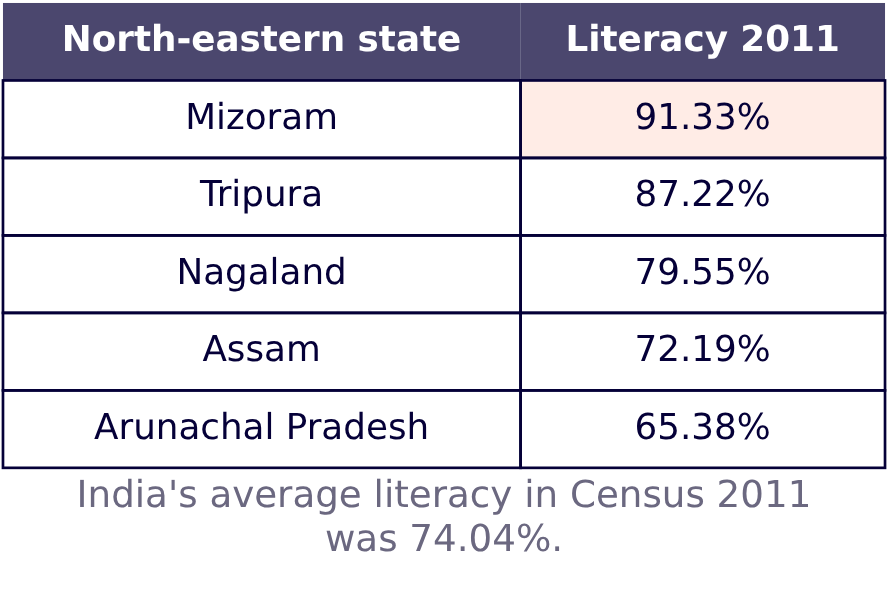 Mizoram's figure is also unusually even between the sexes: 93.35% for males against 89.27% for females, a gap of about 4 points, whereas India's male-female gap is nearly 17 points.
Tripura, at 87.22%, is the closest north-eastern rival; Assam (72.19%) and Arunachal Pradesh (65.38%) are far behind, the latter being the lowest in the region.
Mizoram's figure is also unusually even between the sexes: 93.35% for males against 89.27% for females, a gap of about 4 points, whereas India's male-female gap is nearly 17 points.
Tripura, at 87.22%, is the closest north-eastern rival; Assam (72.19%) and Arunachal Pradesh (65.38%) are far behind, the latter being the lowest in the region.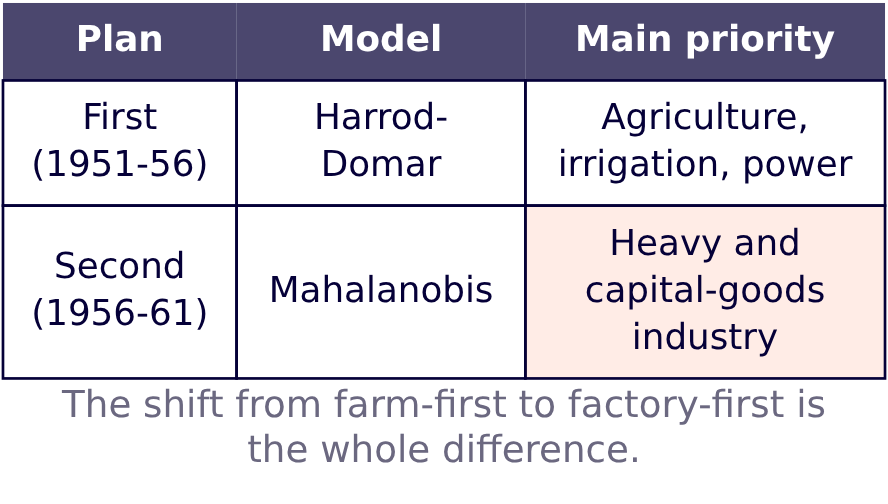 Its visible results were the steel plants at Bhilai (with the USSR), Rourkela (West Germany) and Durgapur (UK), and it rested on the Industrial Policy Resolution of 1956, which reserved the commanding heights of the economy for the public sector - which is exactly why option (c) is wrong.
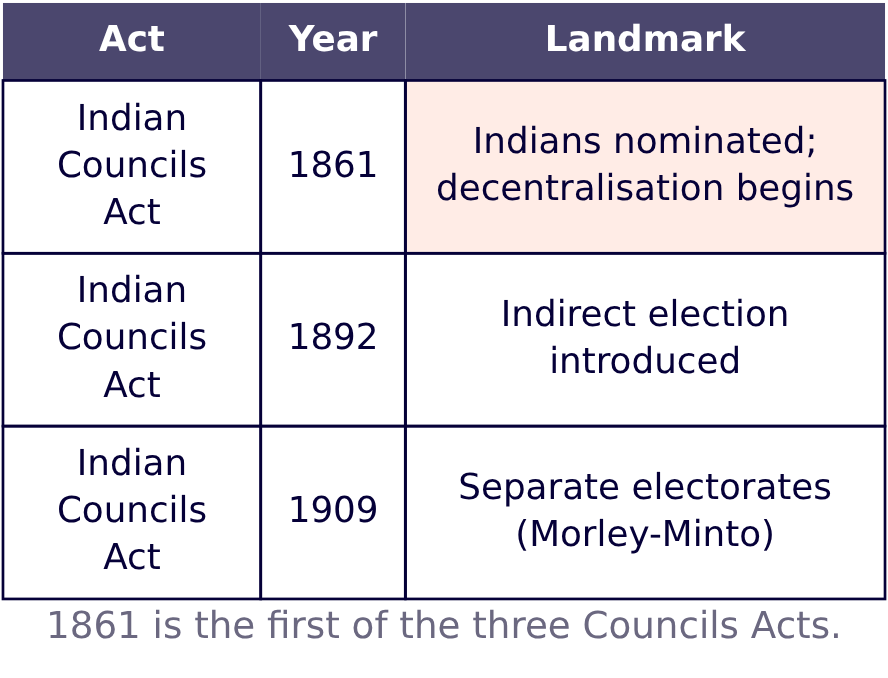 The distractors belong to other years: the Government of India Acts are of 1858, 1919 and 1935, the Rowlatt Act is of 1919, and the Indian Independence Act is of 1947.
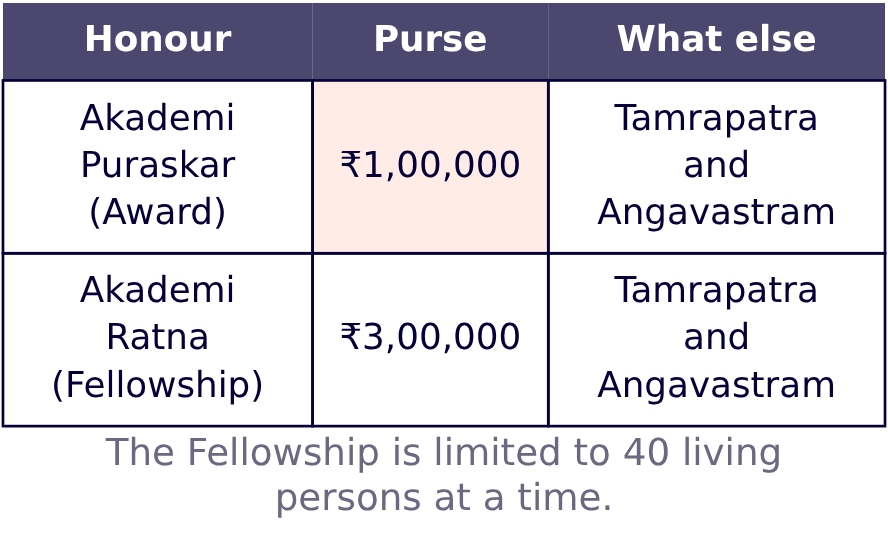 The Akademi's higher honour, the Fellowship or Akademi Ratna, is restricted to 40 living persons at any time and carries ₹3,00,000 - which is exactly why option (a) is placed here as the trap.
The Sangeet Natak Akademi, set up in 1952-53, is India's national academy for music, dance and drama; the honours are conferred by the President of India, and the Presidential Awards of 1952 and 1953 were later merged into its own list of awardees.
The Akademi's higher honour, the Fellowship or Akademi Ratna, is restricted to 40 living persons at any time and carries ₹3,00,000 - which is exactly why option (a) is placed here as the trap.
The Sangeet Natak Akademi, set up in 1952-53, is India's national academy for music, dance and drama; the honours are conferred by the President of India, and the Presidential Awards of 1952 and 1953 were later merged into its own list of awardees.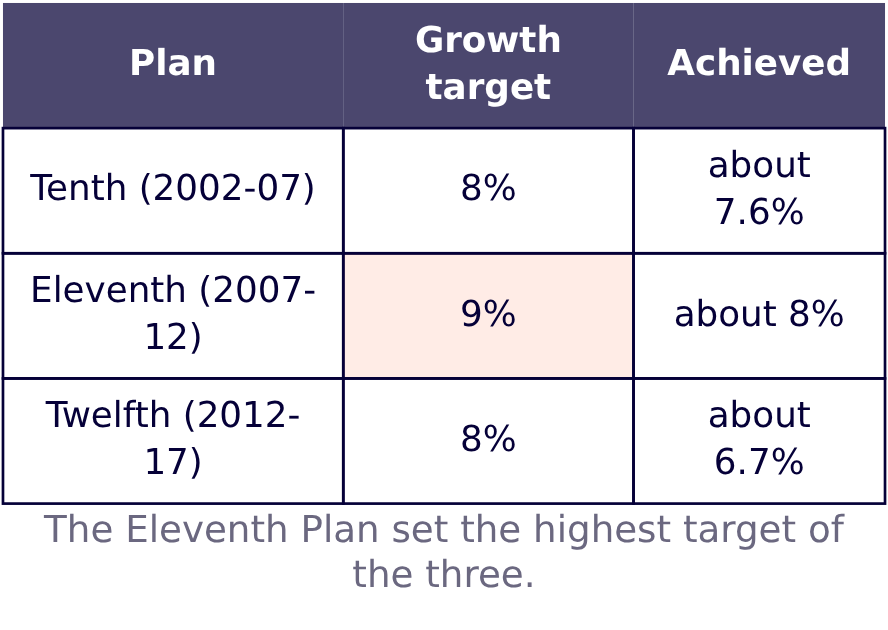 Inside that 9% the sectoral targets were 4% for agriculture, about 10% for industry and 9-11% for services, and the plan had an outlay of roughly ₹36.4 lakh crore.
The Planning Commission that drew it up was chaired ex officio by Prime Minister Manmohan Singh, with Montek Singh Ahluwalia as Deputy Chairman, and the National Development Council approved the plan in December 2007.
Inside that 9% the sectoral targets were 4% for agriculture, about 10% for industry and 9-11% for services, and the plan had an outlay of roughly ₹36.4 lakh crore.
The Planning Commission that drew it up was chaired ex officio by Prime Minister Manmohan Singh, with Montek Singh Ahluwalia as Deputy Chairman, and the National Development Council approved the plan in December 2007.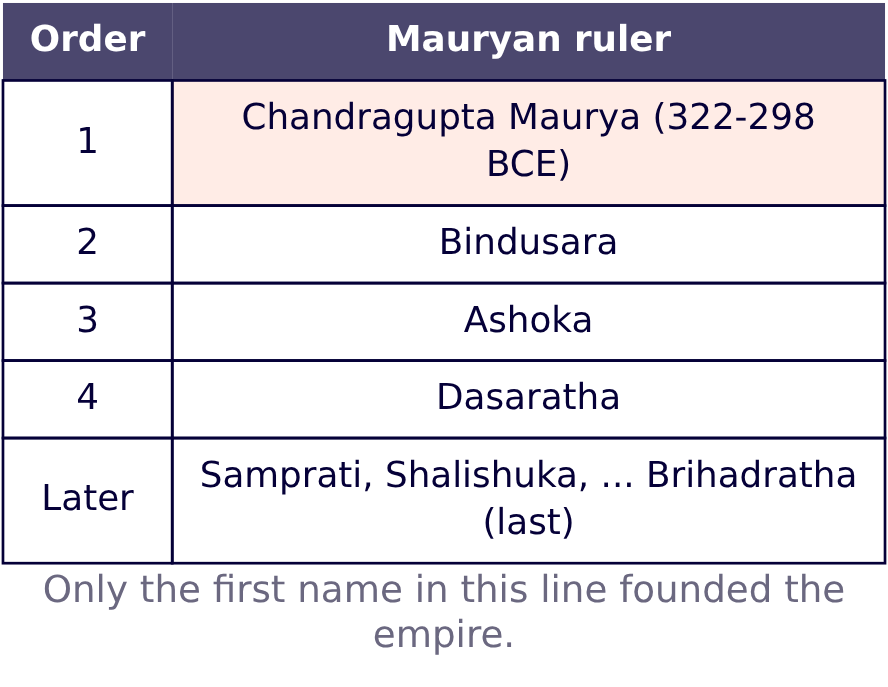 The other three - Dasaratha, Samprati and Shalishuka - were also Mauryas, but all of them ruled after Ashoka, during the decline of the empire.
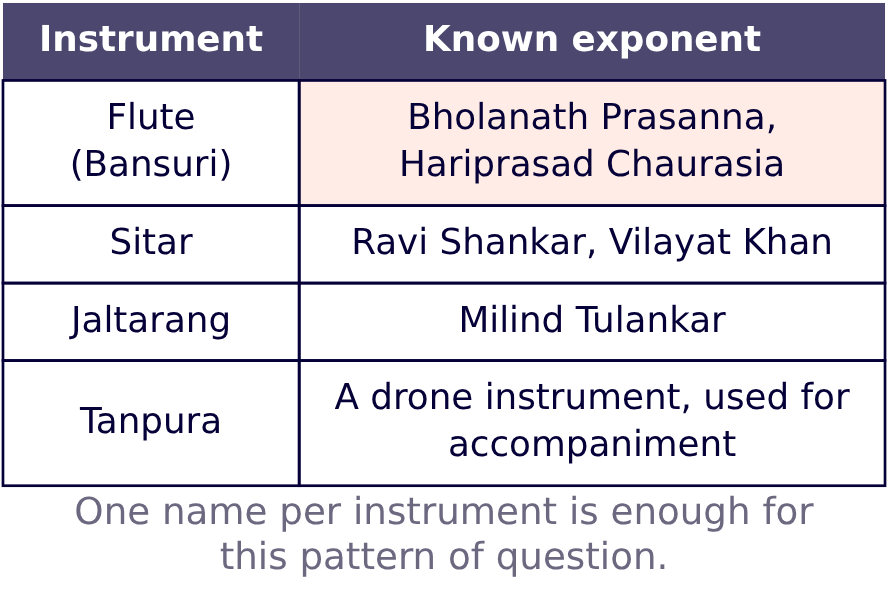 For questions of this kind the safest preparation is to hold one famous name against each instrument: flute - Hariprasad Chaurasia, sitar - Ravi Shankar, jaltarang - Milind Tulankar.
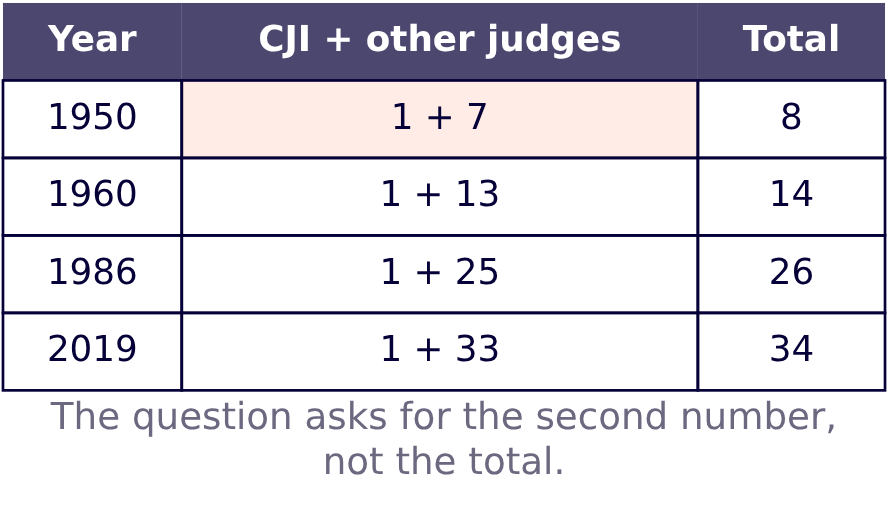 Article 124(1) leaves the number to Parliament, and as the pendency of cases grew the strength was raised again and again, reaching 34 (the CJI plus 33 judges) in 2019.
Option (a), 'Eight', is the trap: eight is the total including the Chief Justice, whereas the question asks only for the number of other judges. The first Chief Justice was H. J. Kania, and Articles 124 to 147 deal with the Supreme Court.
Article 124(1) leaves the number to Parliament, and as the pendency of cases grew the strength was raised again and again, reaching 34 (the CJI plus 33 judges) in 2019.
Option (a), 'Eight', is the trap: eight is the total including the Chief Justice, whereas the question asks only for the number of other judges. The first Chief Justice was H. J. Kania, and Articles 124 to 147 deal with the Supreme Court.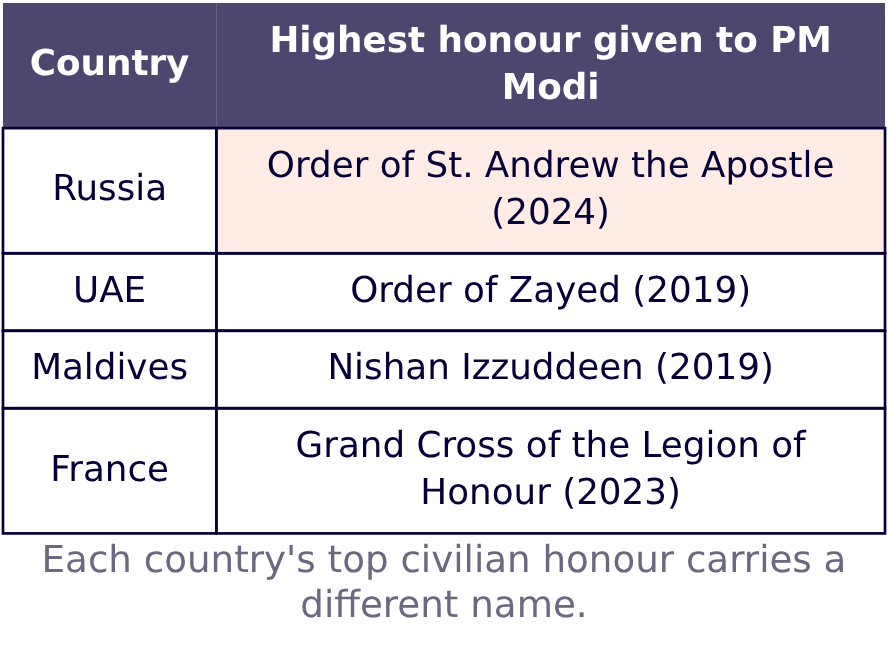 The other three names are not Russian state honours at all, which is enough to eliminate them.
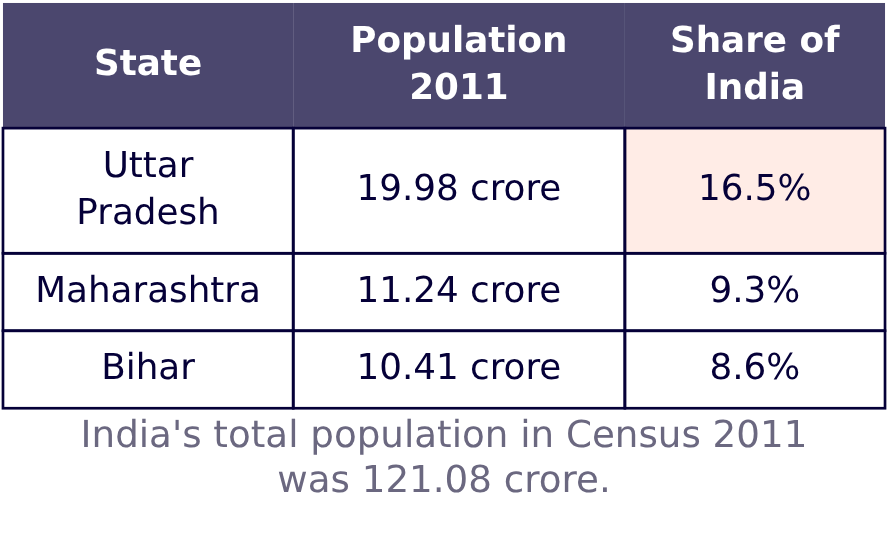 So roughly one Indian in six lives in Uttar Pradesh - it is the most populous state in the country, with more people than Pakistan had at the time, and it would rank about fifth in the world if it were a separate country.
Other Census 2011 figures for the state that are worth carrying: density 829 persons per sq km, literacy 67.68% and sex ratio 912, against the national sex ratio of 943.
So roughly one Indian in six lives in Uttar Pradesh - it is the most populous state in the country, with more people than Pakistan had at the time, and it would rank about fifth in the world if it were a separate country.
Other Census 2011 figures for the state that are worth carrying: density 829 persons per sq km, literacy 67.68% and sex ratio 912, against the national sex ratio of 943.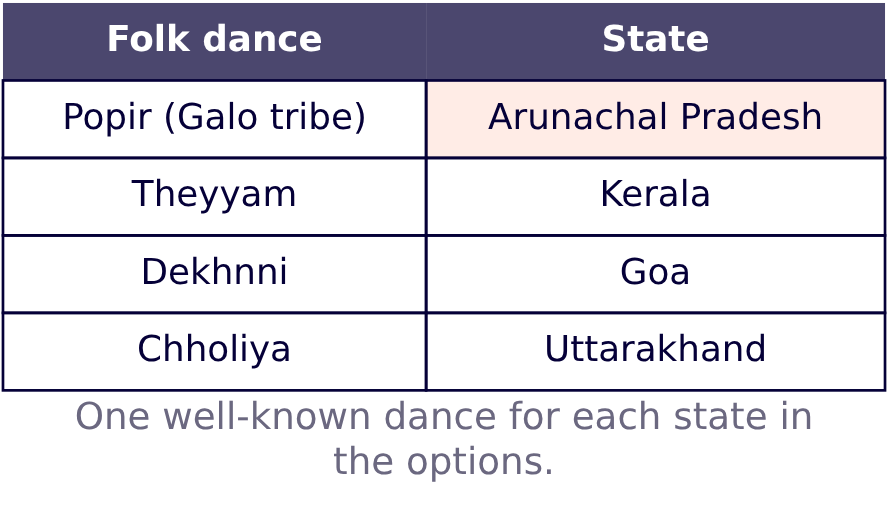 The state's other well-known dances are the Ponung of the Adi tribe and the Bardo Chham of the Sherdukpens, so a dance named along with a tribe of the north-east usually points to Arunachal Pradesh.
The dances typical of the other options are quite different: Theyyam in Kerala, Dekhnni in Goa and Chholiya in Uttarakhand.
The state's other well-known dances are the Ponung of the Adi tribe and the Bardo Chham of the Sherdukpens, so a dance named along with a tribe of the north-east usually points to Arunachal Pradesh.
The dances typical of the other options are quite different: Theyyam in Kerala, Dekhnni in Goa and Chholiya in Uttarakhand.