
21
Which of the following Greek ambassadors visited the Mauryan capital Pataliputra and whose account is a key source for the Mauryan period?
- A.Pliny
- B.Megasthenes
- C.Herodotus
- D.Arrian
Solution
Mauryan sources
Correct option: (b) Megasthenes.
Megasthenes was sent by Seleucus Nicator (Seleucus I) as his ambassador to the court of Chandragupta Maurya at Pataliputra, roughly between 302 and 298 BCE.
His book Indica survives only as quotations in later Greek writers, yet it remains the one eyewitness account of Mauryan administration, of the timber palisade and moat around the capital, and of the seven classes into which he divided Indian society.
The other three never reached Pataliputra: Herodotus (5th century BCE) wrote chiefly about the Persian empire, while Pliny and Arrian lived centuries later and worked from earlier reports - Arrian's own Indica leans on Megasthenes.
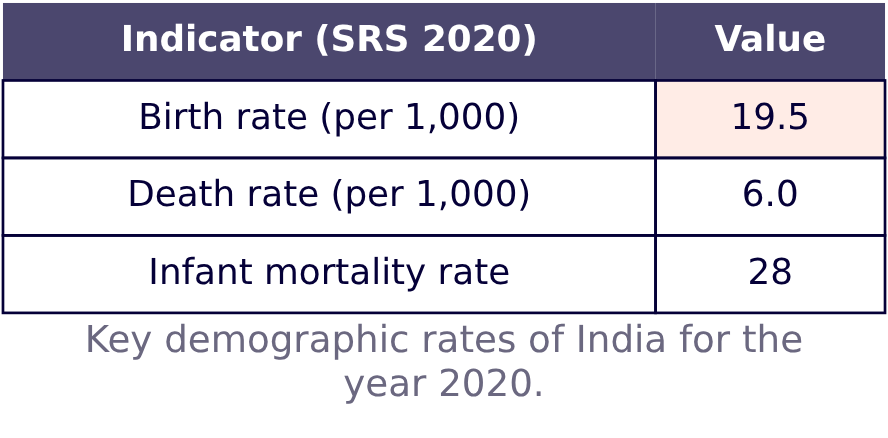 Read the three headline figures together: a birth rate of 19.5 against a death rate of 6.0 leaves a natural growth rate of about 13.5 per 1,000, and the infant mortality rate for the same year was 28 per 1,000 live births.
The trend also fixes the value - the birth rate was 25.8 in 2000 and 21.4 in 2013 and has fallen steadily since, so for 2020 a figure just under 20 is the one to expect.
Read the three headline figures together: a birth rate of 19.5 against a death rate of 6.0 leaves a natural growth rate of about 13.5 per 1,000, and the infant mortality rate for the same year was 28 per 1,000 live births.
The trend also fixes the value - the birth rate was 25.8 in 2000 and 21.4 in 2013 and has fallen steadily since, so for 2020 a figure just under 20 is the one to expect.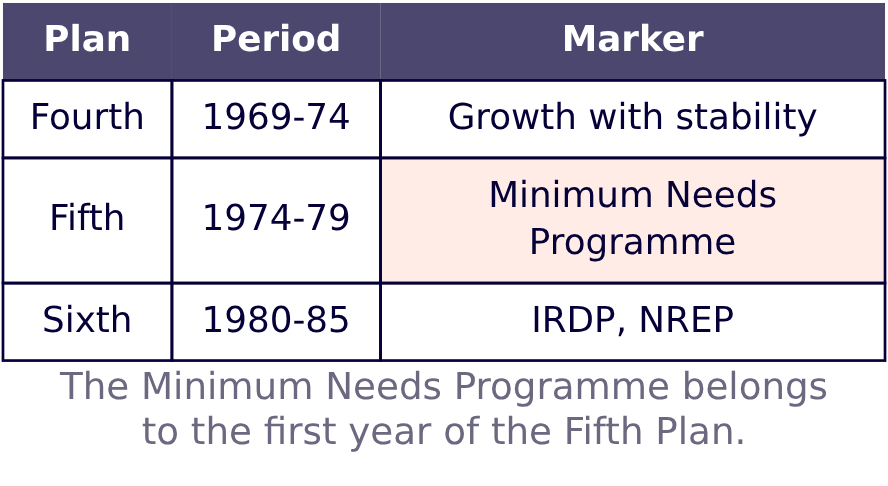 The Fifth Plan was drafted by D. P. Dhar around the twin aims of removal of poverty (Garibi Hatao) and attainment of self-reliance; the Janata government ended it a year early, in 1978.
Keep the neighbouring plans apart: the Fourth Plan (1969-74) stood for growth with stability, and the Sixth (1980-85) for the IRDP and the National Rural Employment Programme.
The Fifth Plan was drafted by D. P. Dhar around the twin aims of removal of poverty (Garibi Hatao) and attainment of self-reliance; the Janata government ended it a year early, in 1978.
Keep the neighbouring plans apart: the Fourth Plan (1969-74) stood for growth with stability, and the Sixth (1980-85) for the IRDP and the National Rural Employment Programme.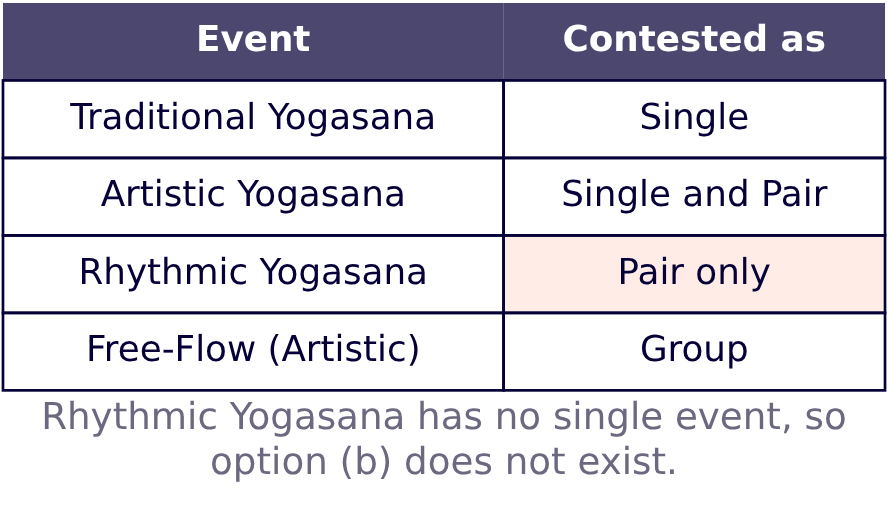 Rhythmic Yogasana is performed to music in a continuous flow and is contested only by a pair, so there is no Rhythmic Yogasana (Single) event; that is what the question is after.
Remember the asymmetry: Artistic appears in both Single and Pair forms, Rhythmic only in the Pair form.
Rhythmic Yogasana is performed to music in a continuous flow and is contested only by a pair, so there is no Rhythmic Yogasana (Single) event; that is what the question is after.
Remember the asymmetry: Artistic appears in both Single and Pair forms, Rhythmic only in the Pair form.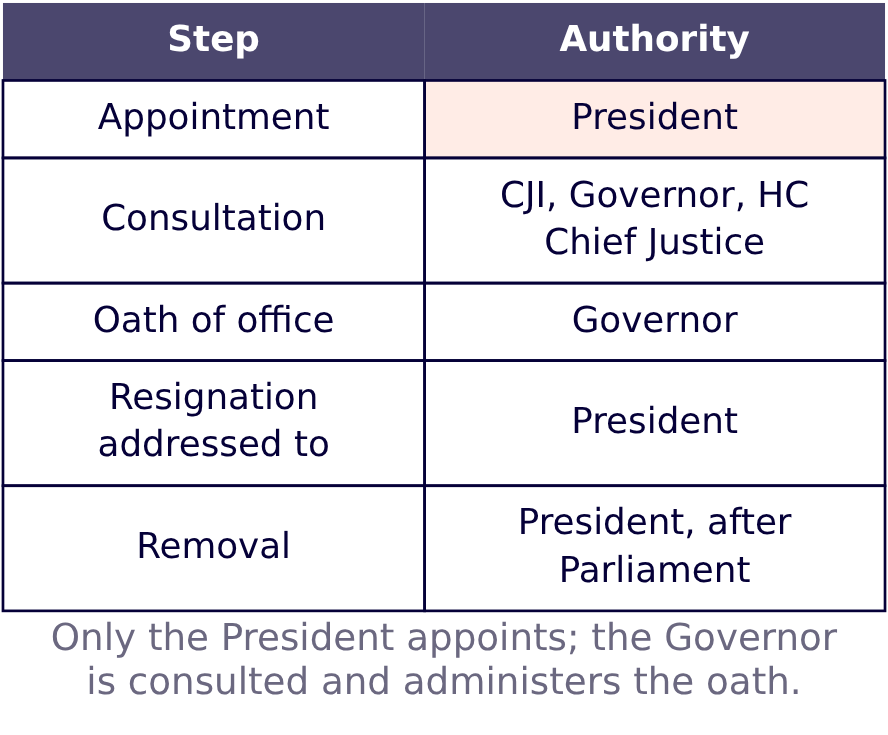 The Governor is only consulted - his own function is to administer the oath of office to a High Court judge under Article 219, which is the detail the option is built on.
Removal too is by an order of the President, passed after an address by both Houses of Parliament, exactly as for a judge of the Supreme Court.
The Governor is only consulted - his own function is to administer the oath of office to a High Court judge under Article 219, which is the detail the option is built on.
Removal too is by an order of the President, passed after an address by both Houses of Parliament, exactly as for a judge of the Supreme Court.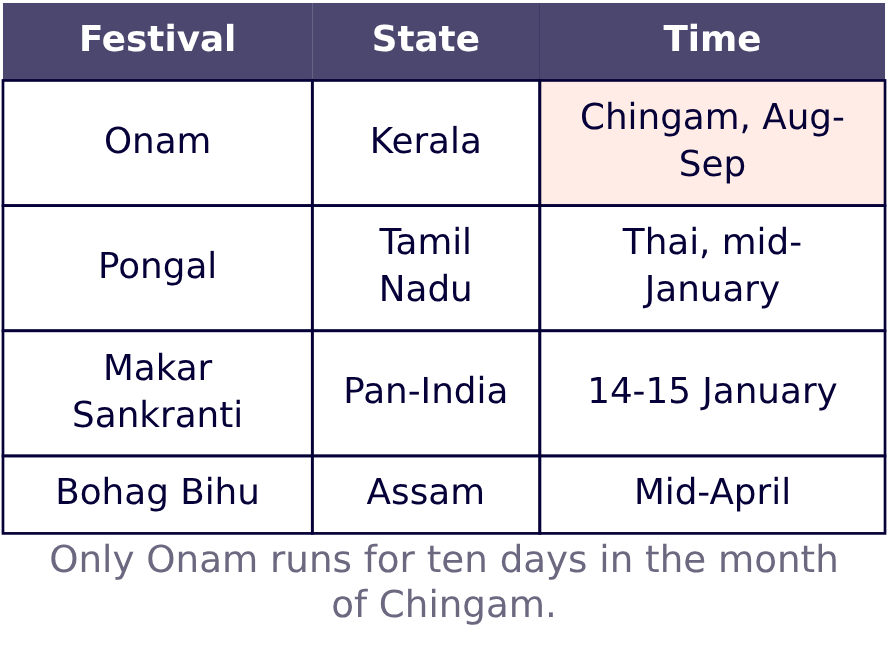 The other three sit elsewhere in the year: Makar Sankranti and Pongal fall in mid-January when the sun enters Capricorn, and Assam's Bohag (Rongali) Bihu falls in mid-April.
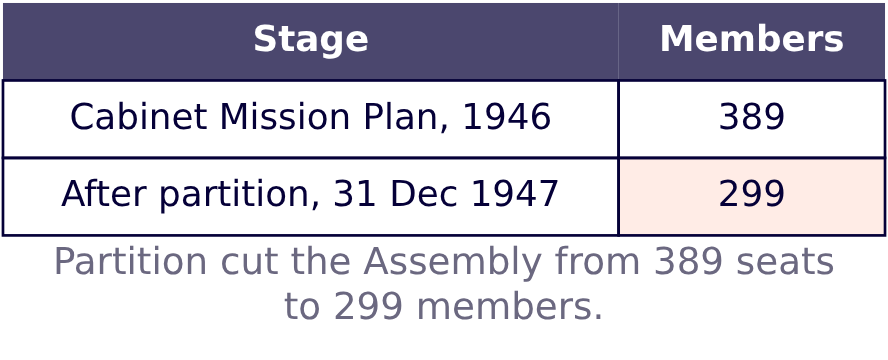 After the Mountbatten Plan of 3 June 1947 the members from the areas that formed Pakistan withdrew and set up their own assembly, so the strength of the Indian Constituent Assembly stood at 299 on 31 December 1947 - 229 from the provinces and 70 from the princely states.
Store the pair 389 and 299 together: the first is the number before partition, the second the working strength after it and the number that finally signed the Constitution.
After the Mountbatten Plan of 3 June 1947 the members from the areas that formed Pakistan withdrew and set up their own assembly, so the strength of the Indian Constituent Assembly stood at 299 on 31 December 1947 - 229 from the provinces and 70 from the princely states.
Store the pair 389 and 299 together: the first is the number before partition, the second the working strength after it and the number that finally signed the Constitution.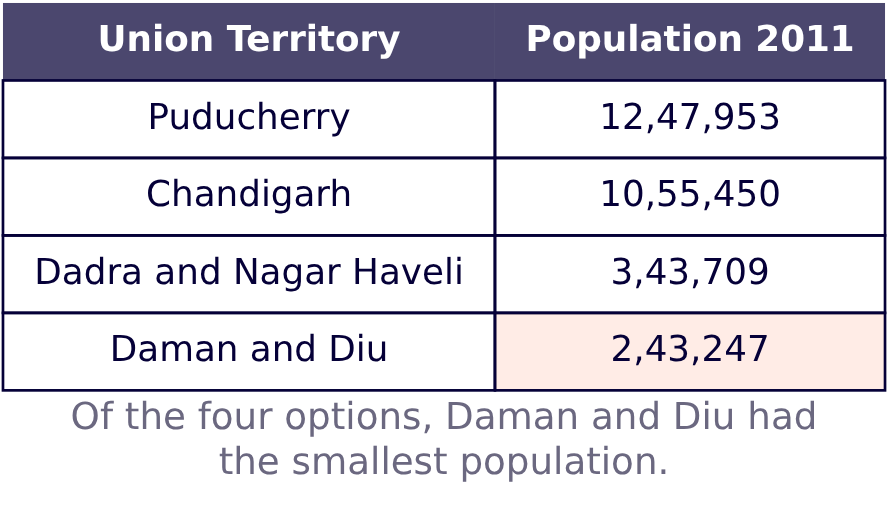 So among the four choices Daman and Diu is the smallest; the two are also the reason the pair was merged into a single Union Territory in January 2020.
Do not confuse population with density: Lakshadweep, with 64,473 people, was the least populous Union Territory of all in 2011, while Delhi was the most populous and also the most densely settled.
So among the four choices Daman and Diu is the smallest; the two are also the reason the pair was merged into a single Union Territory in January 2020.
Do not confuse population with density: Lakshadweep, with 64,473 people, was the least populous Union Territory of all in 2011, while Delhi was the most populous and also the most densely settled.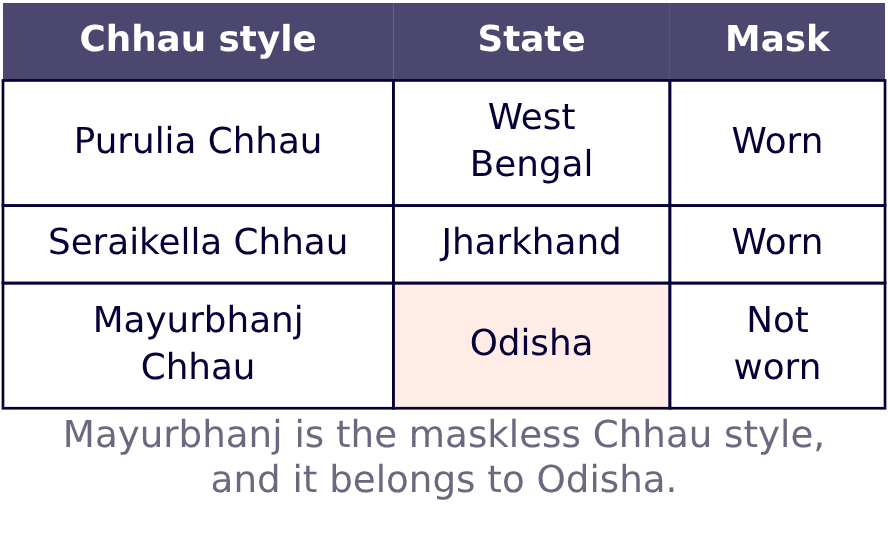 It is the one Chhau style danced without a mask - the dancer's face itself carries the expression - which is the usual way the three styles are told apart.
Chhau in all three styles was inscribed on UNESCO's Representative List of the Intangible Cultural Heritage of Humanity in 2010.
It is the one Chhau style danced without a mask - the dancer's face itself carries the expression - which is the usual way the three styles are told apart.
Chhau in all three styles was inscribed on UNESCO's Representative List of the Intangible Cultural Heritage of Humanity in 2010.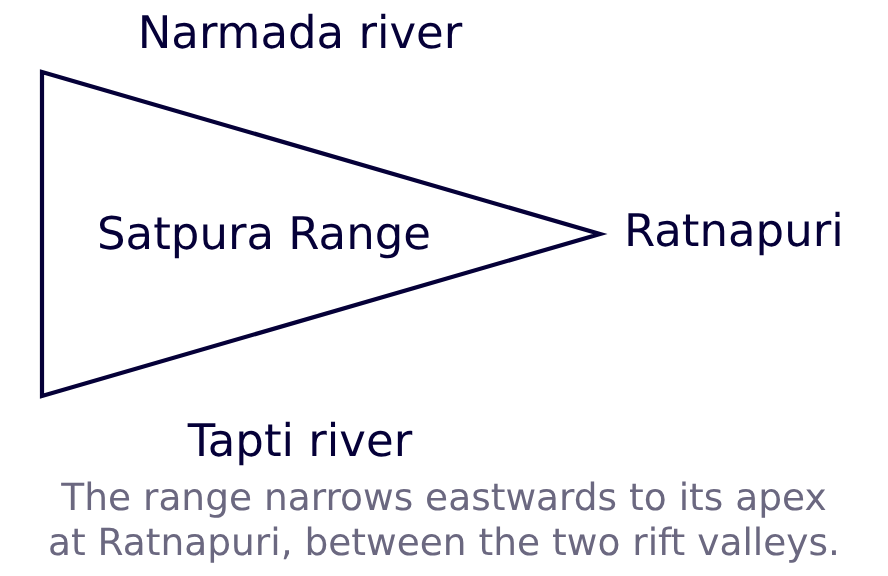 Both rivers occupy rift valleys, which is why they run in straight parallel lines on either side of the range; the Satpura forms the northern edge of the Deccan Plateau and carries Dhupgarh (1,350 m), the highest point of Madhya Pradesh, in the Mahadeo Hills.
The others do not fit the description: the Pir Panjal lies in the Himalayas of Jammu and Kashmir, the Purvanchal hills run along the north-eastern border, and the Aravalli runs north-east to south-west across Rajasthan.
Both rivers occupy rift valleys, which is why they run in straight parallel lines on either side of the range; the Satpura forms the northern edge of the Deccan Plateau and carries Dhupgarh (1,350 m), the highest point of Madhya Pradesh, in the Mahadeo Hills.
The others do not fit the description: the Pir Panjal lies in the Himalayas of Jammu and Kashmir, the Purvanchal hills run along the north-eastern border, and the Aravalli runs north-east to south-west across Rajasthan.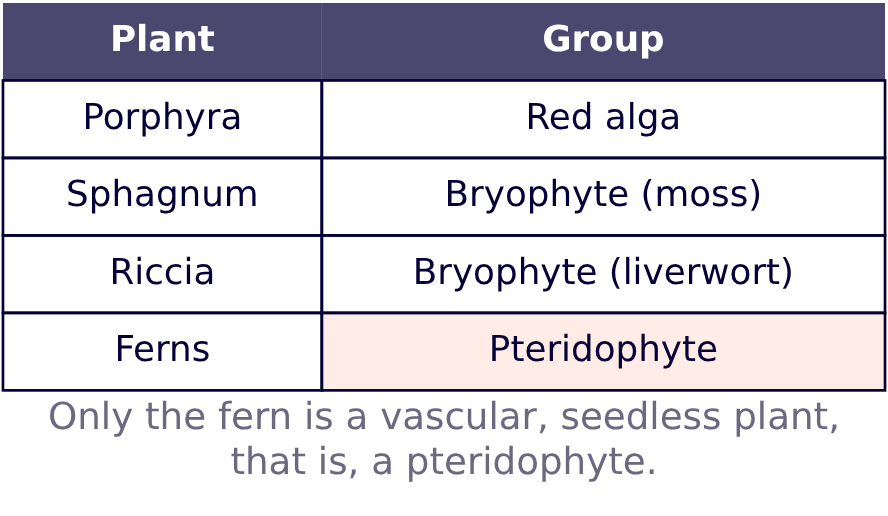 They reproduce by spores borne in sori on the underside of the leaf, and their male gametes must swim to the egg, which is why ferns are confined to moist, shady ground and cool hill slopes.
The other three are not pteridophytes: Porphyra is a red alga of the sea, while Sphagnum (a moss) and Riccia (a liverwort) are bryophytes - the amphibians of the plant kingdom, with no vascular tissue.
They reproduce by spores borne in sori on the underside of the leaf, and their male gametes must swim to the egg, which is why ferns are confined to moist, shady ground and cool hill slopes.
The other three are not pteridophytes: Porphyra is a red alga of the sea, while Sphagnum (a moss) and Riccia (a liverwort) are bryophytes - the amphibians of the plant kingdom, with no vascular tissue.