
1
Read the given statements and conclusions carefully. Assuming that the information given in the statements is true, even if it appears to be at variance with commonly known facts, decide which of the given conclusions logically follow(s) from the statements.
Statements:
All cubs are foals.
All cubs are puppies.
All kittens are puppies.
Conclusions:
(I): All kittens are foals.
(II): Some puppies are foals.
- A.Only conclusion (I) follows.
- B.Both conclusions (I) and (II) follow.
- C.Only conclusion (II) follows.
- D.Neither conclusion (I) nor (II) follows.
Solution
Syllogism
All cubs are foals and all cubs are puppies, so the class of cubs lies inside foals and inside puppies at the same time.
All kittens are puppies, but no statement ties kittens to foals, so they may be a separate part of the puppies circle.
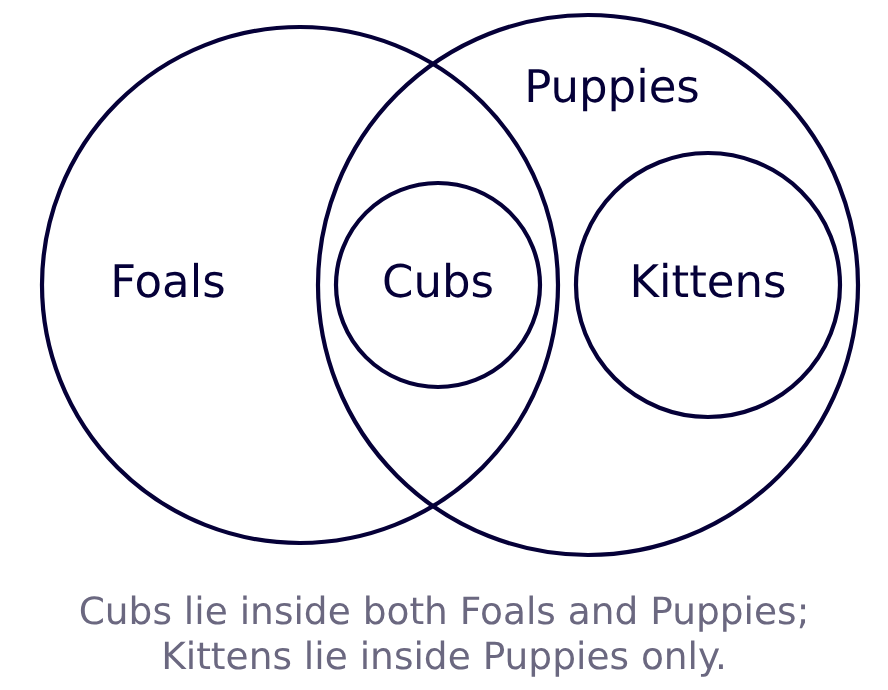 Conclusion (I): the kittens can lie entirely outside foals, so 'All kittens are foals' does not follow.
Conclusion (II): every cub is a puppy and also a foal, so the cubs are common to both classes and 'Some puppies are foals' does follow.
Only conclusion (II) follows, so the correct option is (c).
Conclusion (I): the kittens can lie entirely outside foals, so 'All kittens are foals' does not follow.
Conclusion (II): every cub is a puppy and also a foal, so the cubs are common to both classes and 'Some puppies are foals' does follow.
Only conclusion (II) follows, so the correct option is (c).
Conclusion (I): the kittens can lie entirely outside foals, so 'All kittens are foals' does not follow.
Conclusion (II): every cub is a puppy and also a foal, so the cubs are common to both classes and 'Some puppies are foals' does follow.
Only conclusion (II) follows, so the correct option is (c).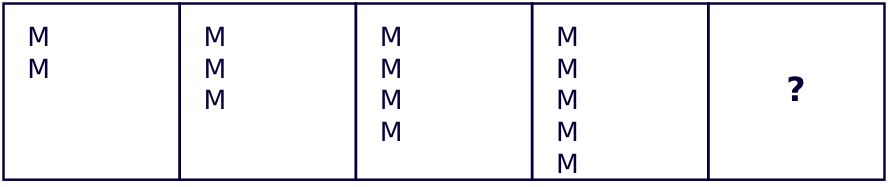
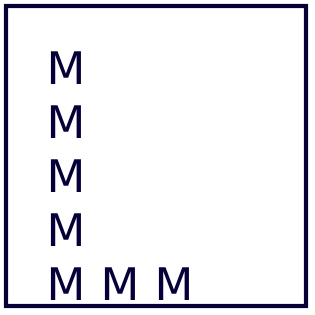
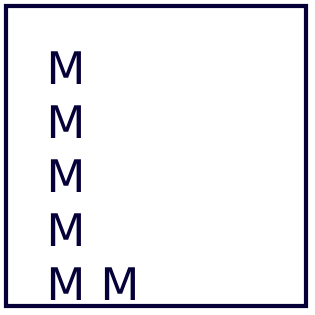
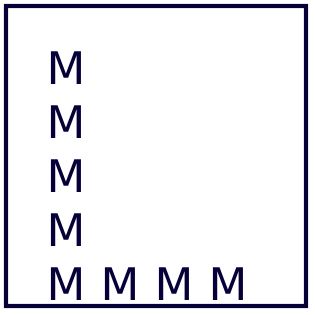
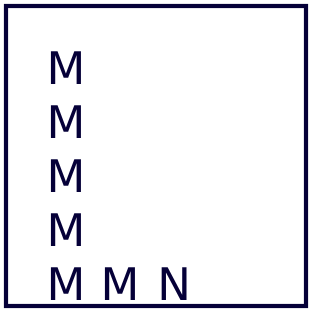
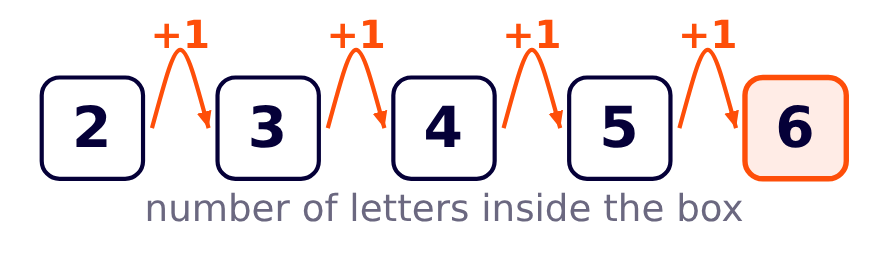 The box that replaces the question mark must therefore hold 5+1=6 letters.
One column of a box takes only five letters, so the sixth letter has to start a second column beside the bottom letter.
Only one option shows a column of five letters with exactly one extra letter beside the last of them; the other three show seven or eight letters.
Hence the correct option is (b).
The box that replaces the question mark must therefore hold 5+1=6 letters.
One column of a box takes only five letters, so the sixth letter has to start a second column beside the bottom letter.
Only one option shows a column of five letters with exactly one extra letter beside the last of them; the other three show seven or eight letters.
Hence the correct option is (b).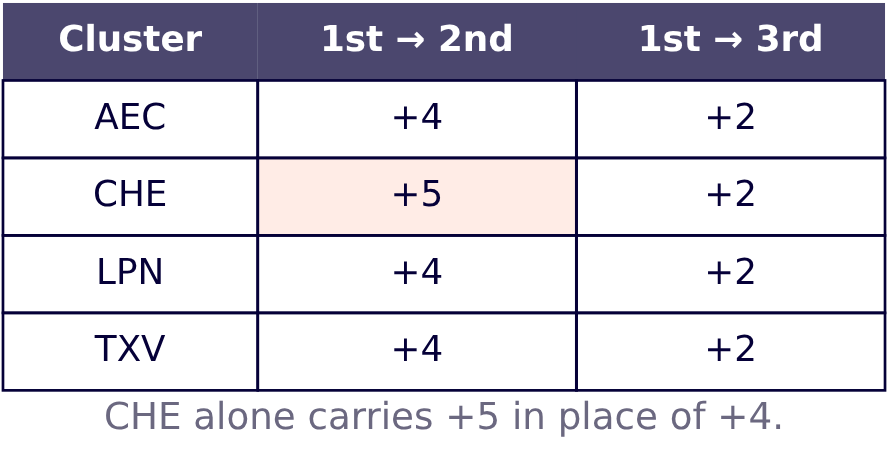 In AEC, LPN and TXV the second letter is 4 places after the first and the third letter is 2 places after the first.
In CHE the second letter H is 5 places after C, not 4, so this cluster breaks the pattern.
Hence CHE is the odd one out and the correct option is (b).
In AEC, LPN and TXV the second letter is 4 places after the first and the third letter is 2 places after the first.
In CHE the second letter H is 5 places after C, not 4, so this cluster breaks the pattern.
Hence CHE is the odd one out and the correct option is (b).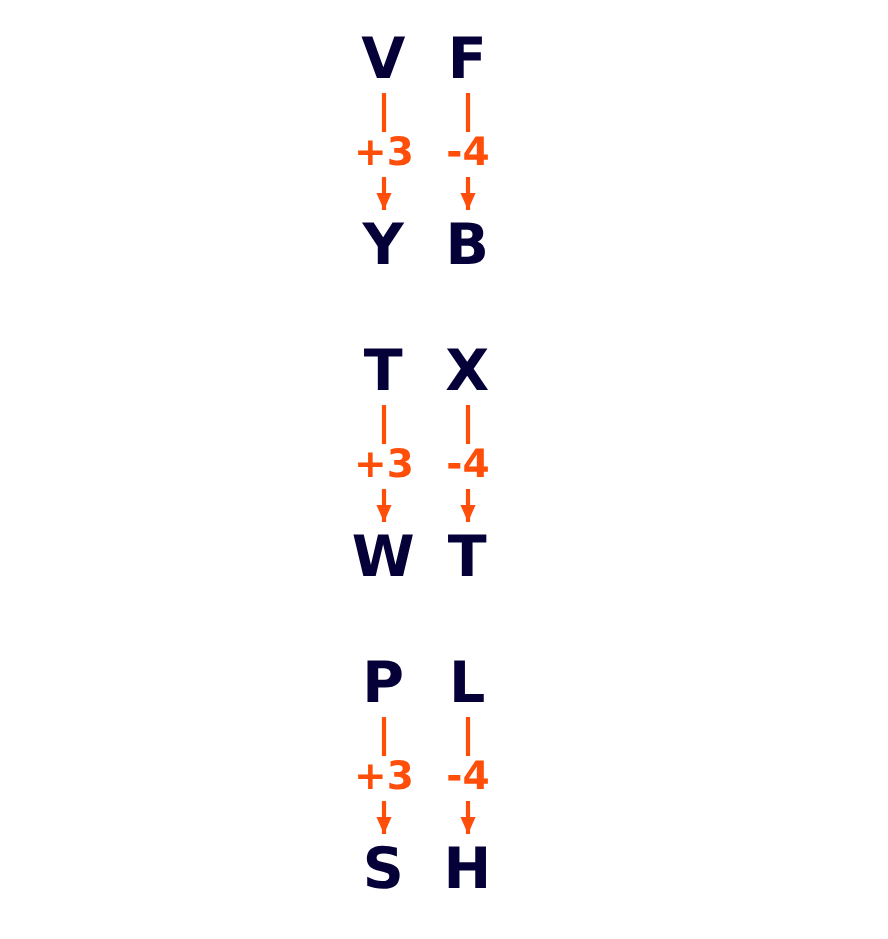 The first letter moves 3 places forward and the second letter moves 4 places back: , , and , .
So and , which gives the letter pair SH.
The number is replaced by 21 minus itself: 21-19=2 and 21-11=10, so here 21-6=15.
PL 6 is therefore related to SH-15 and the correct option is (c).
The first letter moves 3 places forward and the second letter moves 4 places back: , , and , .
So and , which gives the letter pair SH.
The number is replaced by 21 minus itself: 21-19=2 and 21-11=10, so here 21-6=15.
PL 6 is therefore related to SH-15 and the correct option is (c).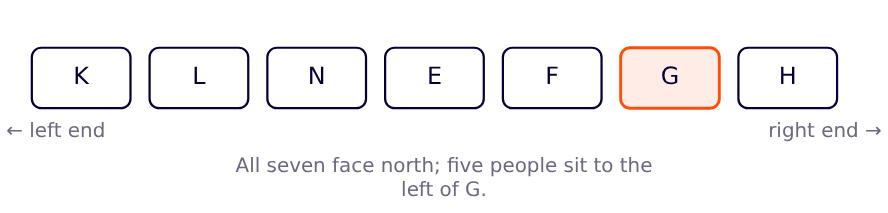 G is at seat 6, so five people sit to its left and the correct option is (c).
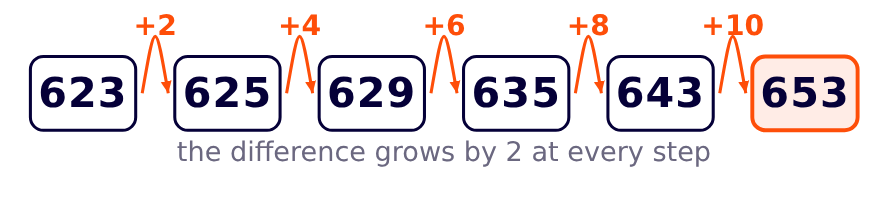 Required term =643+10=653, so the correct option is (c).
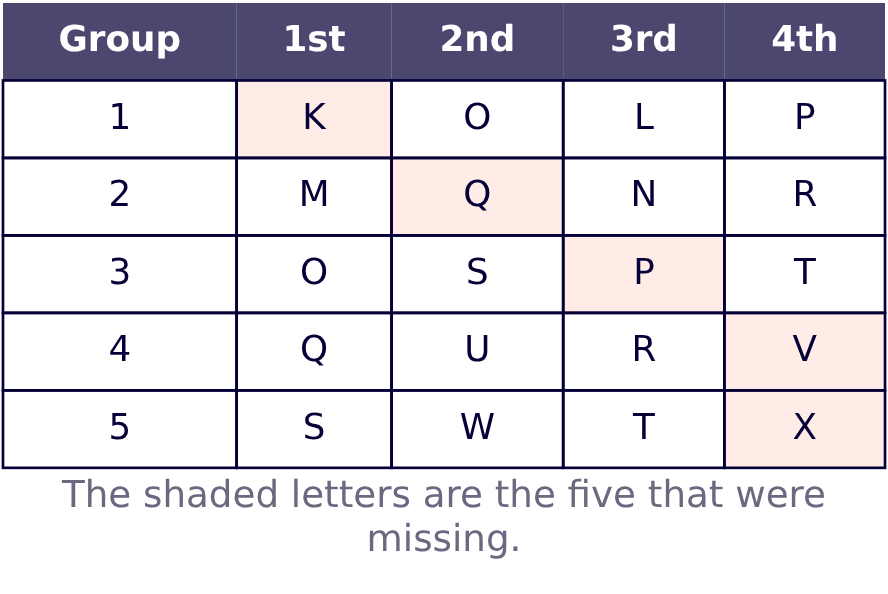 Read the table down each column: every letter is 2 places after the letter above it, so the columns run K M O Q S, then O Q S U W, then L N P R T, then P R T V X.
The five blanks are the 1st letter of group 1, the 2nd of group 2, the 3rd of group 3, the 4th of group 4 and the 4th of group 5.
Those letters are K, Q, P, V and X in that order, so the correct option is (d).
Read the table down each column: every letter is 2 places after the letter above it, so the columns run K M O Q S, then O Q S U W, then L N P R T, then P R T V X.
The five blanks are the 1st letter of group 1, the 2nd of group 2, the 3rd of group 3, the 4th of group 4 and the 4th of group 5.
Those letters are K, Q, P, V and X in that order, so the correct option is (d).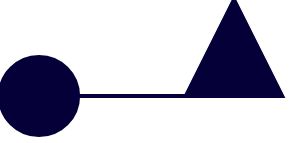
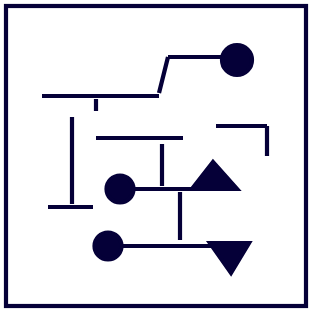
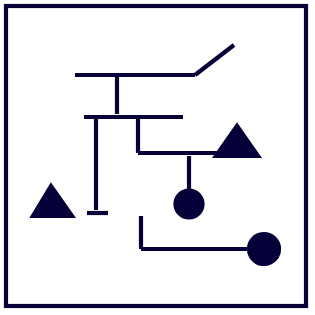
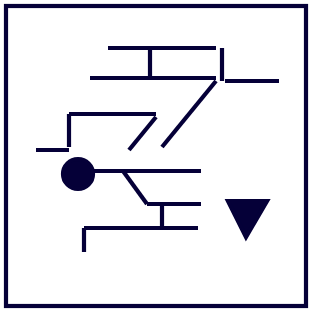
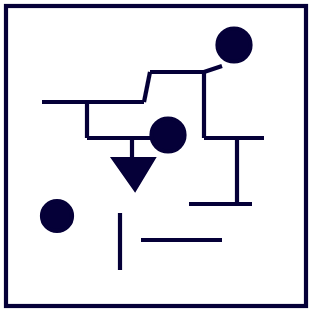
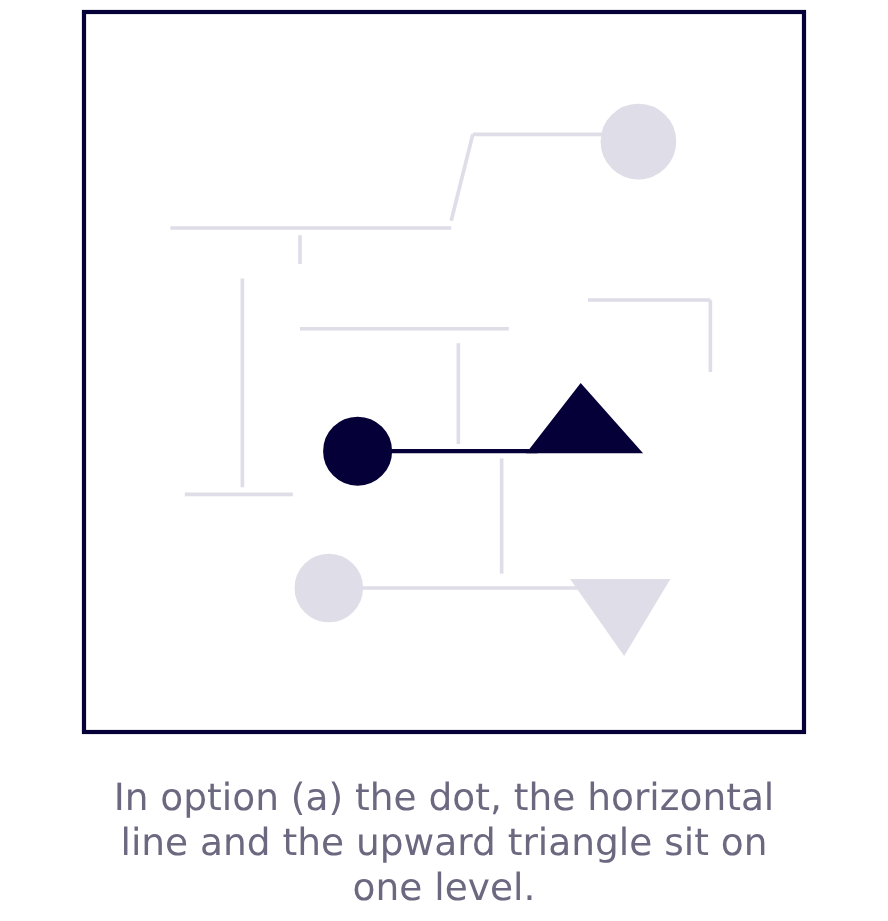 In option (a) the dot in the middle of the box runs right along a horizontal line straight into the base of an upward triangle - exactly the given unit.
In option (d) and option (c) the only triangle joined to a line points downward, and in option (b) the upward triangles are not joined to any dot by a horizontal line.
Hence the correct option is (a).
In option (a) the dot in the middle of the box runs right along a horizontal line straight into the base of an upward triangle - exactly the given unit.
In option (d) and option (c) the only triangle joined to a line points downward, and in option (b) the upward triangles are not joined to any dot by a horizontal line.
Hence the correct option is (a).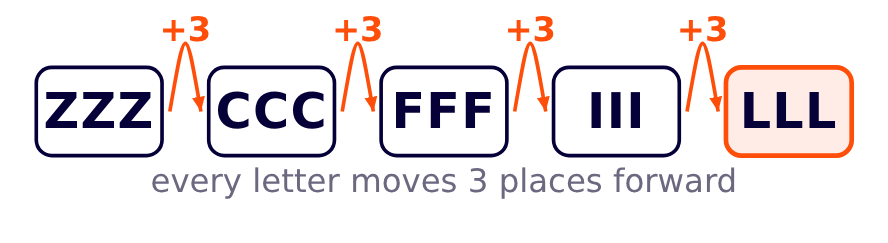 Three places after I(9) is the 12th letter, L, so the term is LLL and the correct option is (d).
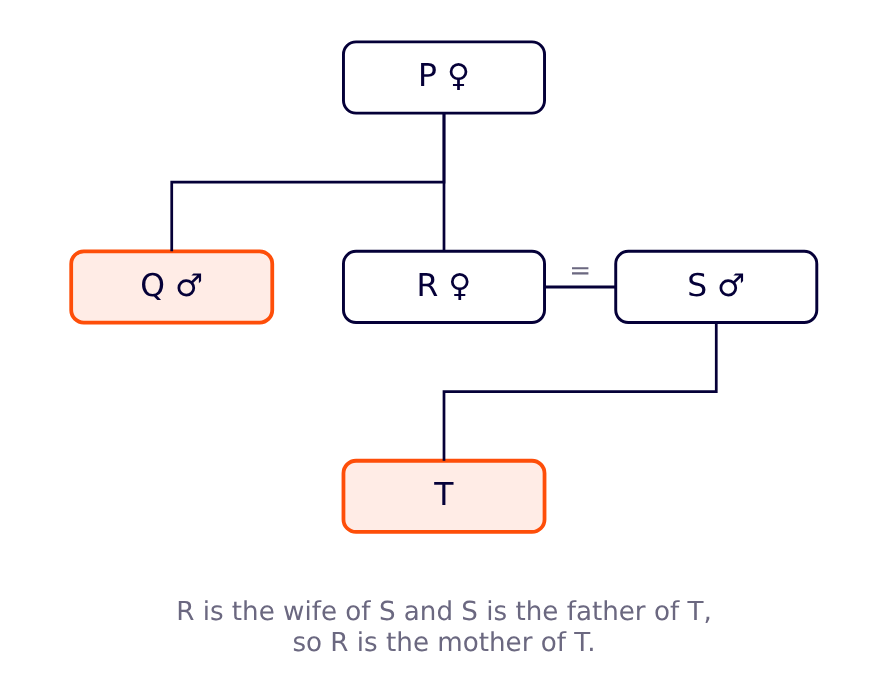 R is the wife of S and S is the father of T, so R is the mother of T.
Q is the brother of R, that is, the brother of T's mother.
Therefore Q is T's mother's brother and the correct option is (b).
R is the wife of S and S is the father of T, so R is the mother of T.
Q is the brother of R, that is, the brother of T's mother.
Therefore Q is T's mother's brother and the correct option is (b).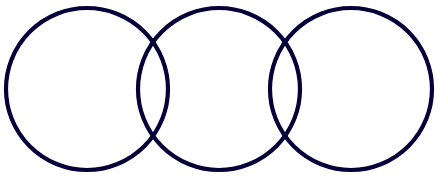
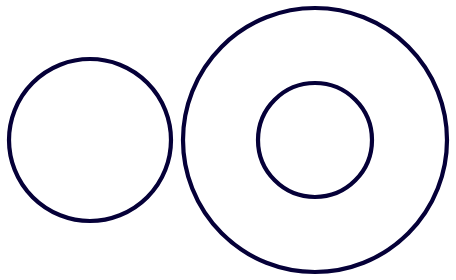
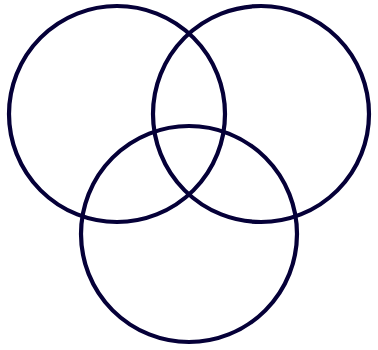

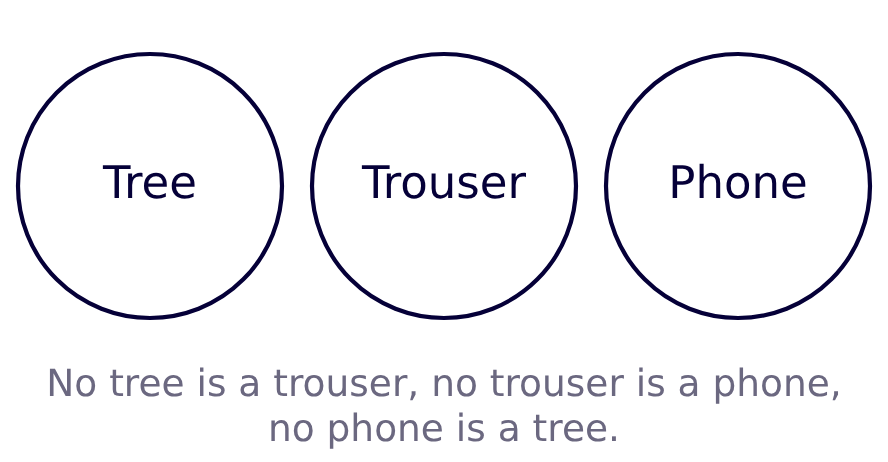 Separate classes are drawn as circles that neither touch nor cut one another.
Only one option shows three such circles, so the correct option is (d).
Separate classes are drawn as circles that neither touch nor cut one another.
Only one option shows three such circles, so the correct option is (d).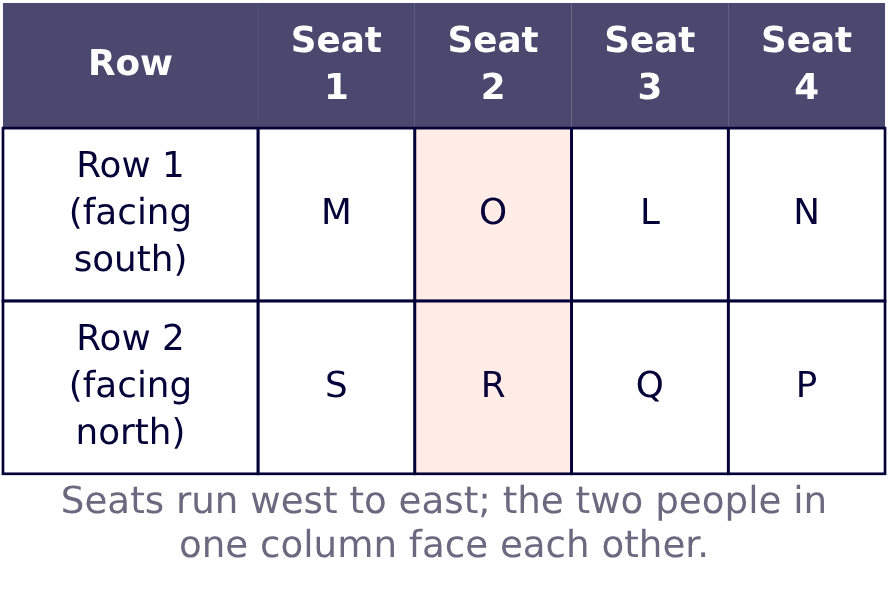 R is at seat 2 of row 2 and seat 2 of row 1 is O, so O faces R and the correct option is (d).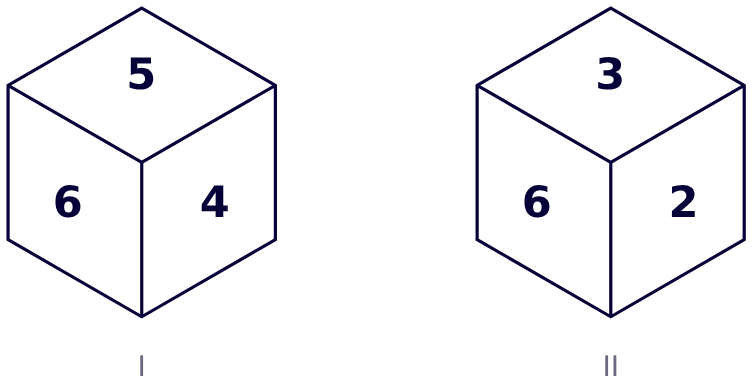
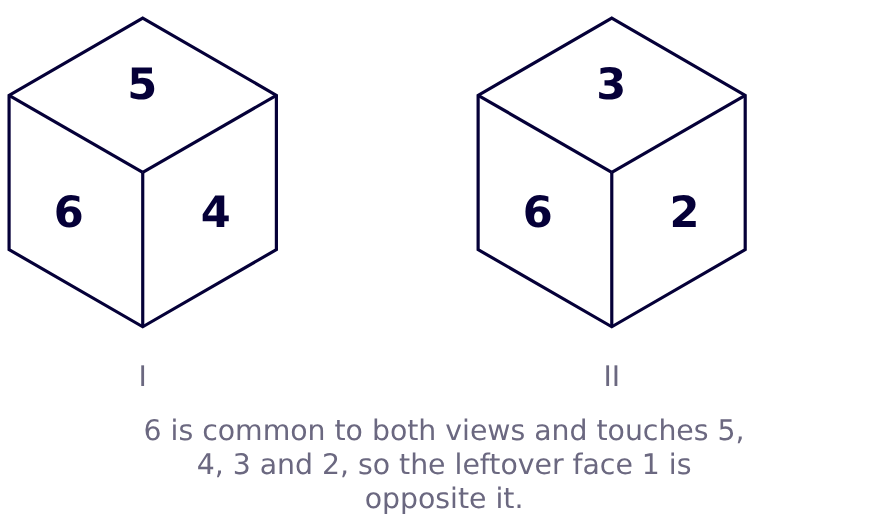 In the first position 6 touches 5 and 4; in the second position the same 6 touches 3 and 2.
Every face of a cube has exactly four neighbours, so 5, 4, 3 and 2 are all four neighbours of 6.
The only face left over is 1, so 1 lies opposite 6.
Therefore the face opposite 1 carries 6 and the correct option is (b).
In the first position 6 touches 5 and 4; in the second position the same 6 touches 3 and 2.
Every face of a cube has exactly four neighbours, so 5, 4, 3 and 2 are all four neighbours of 6.
The only face left over is 1, so 1 lies opposite 6.
Therefore the face opposite 1 carries 6 and the correct option is (b).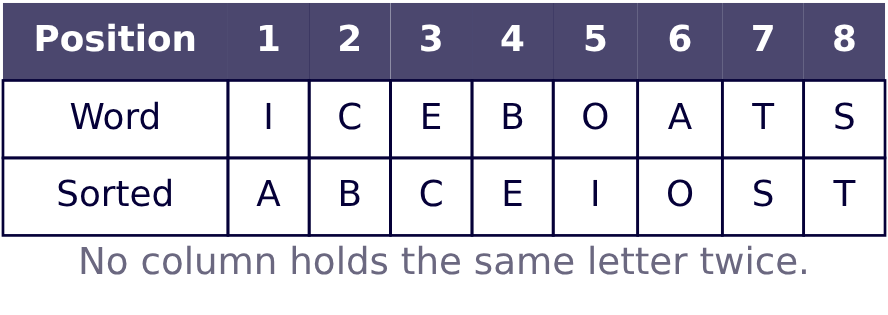 Now compare the two rows position by position: I/A, C/B, E/C, B/E, O/I, A/O, T/S and S/T.
Not a single position holds the same letter in both rows.
So zero letters keep their position and the correct option is (d).
Now compare the two rows position by position: I/A, C/B, E/C, B/E, O/I, A/O, T/S and S/T.
Not a single position holds the same letter in both rows.
So zero letters keep their position and the correct option is (d).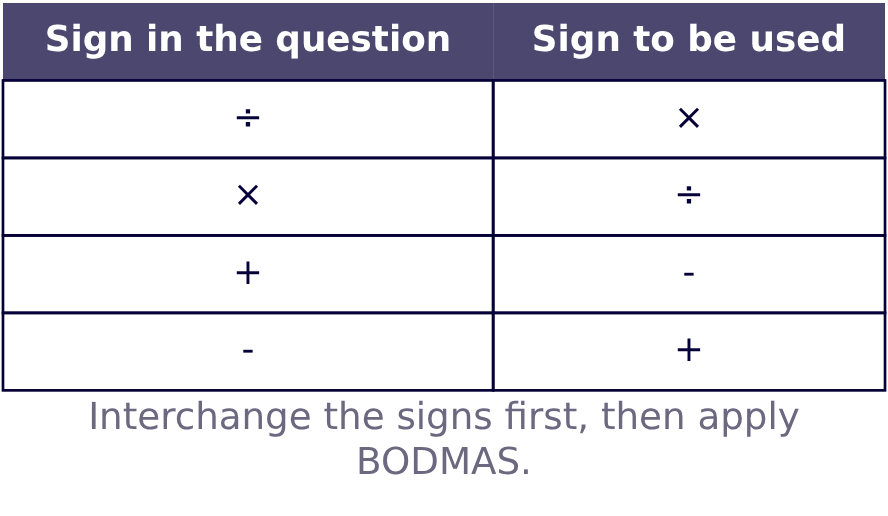 becomes .
By BODMAS do the multiplication and division first: and .
47+10-12=45
So the question mark stands for 45 and the correct option is (c).
becomes .
By BODMAS do the multiplication and division first: and .
47+10-12=45
So the question mark stands for 45 and the correct option is (c).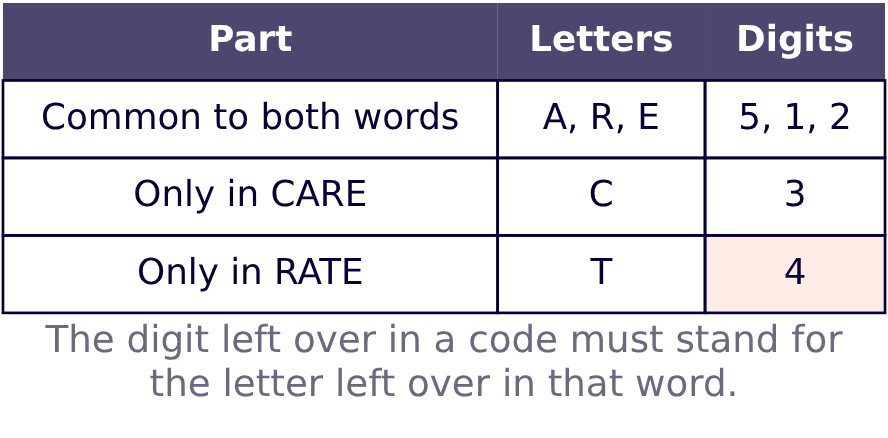 So the three common letters A, R and E use the three common digits 5, 1 and 2 in some order.
CARE has one extra letter C and one extra digit 3, so C is 3; RATE has one extra letter T and one extra digit 4.
Hence T is coded as 4 and the correct option is (d).
So the three common letters A, R and E use the three common digits 5, 1 and 2 in some order.
CARE has one extra letter C and one extra digit 3, so C is 3; RATE has one extra letter T and one extra digit 4.
Hence T is coded as 4 and the correct option is (d).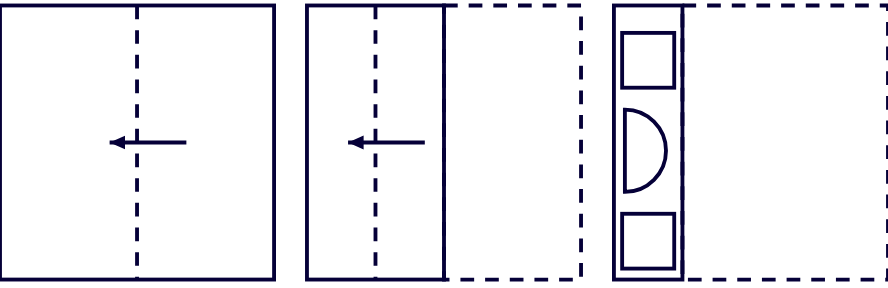
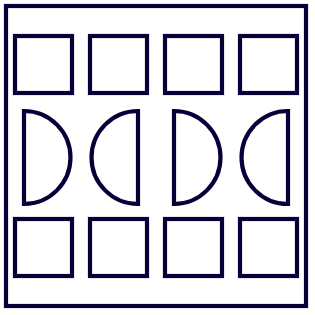
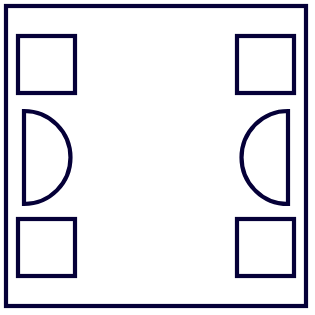
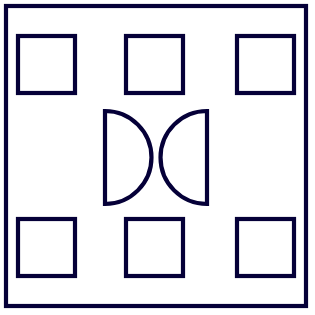
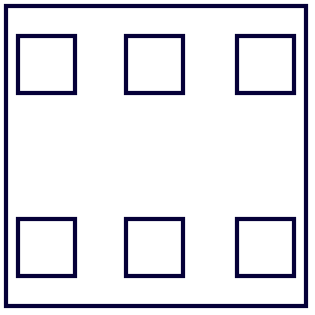
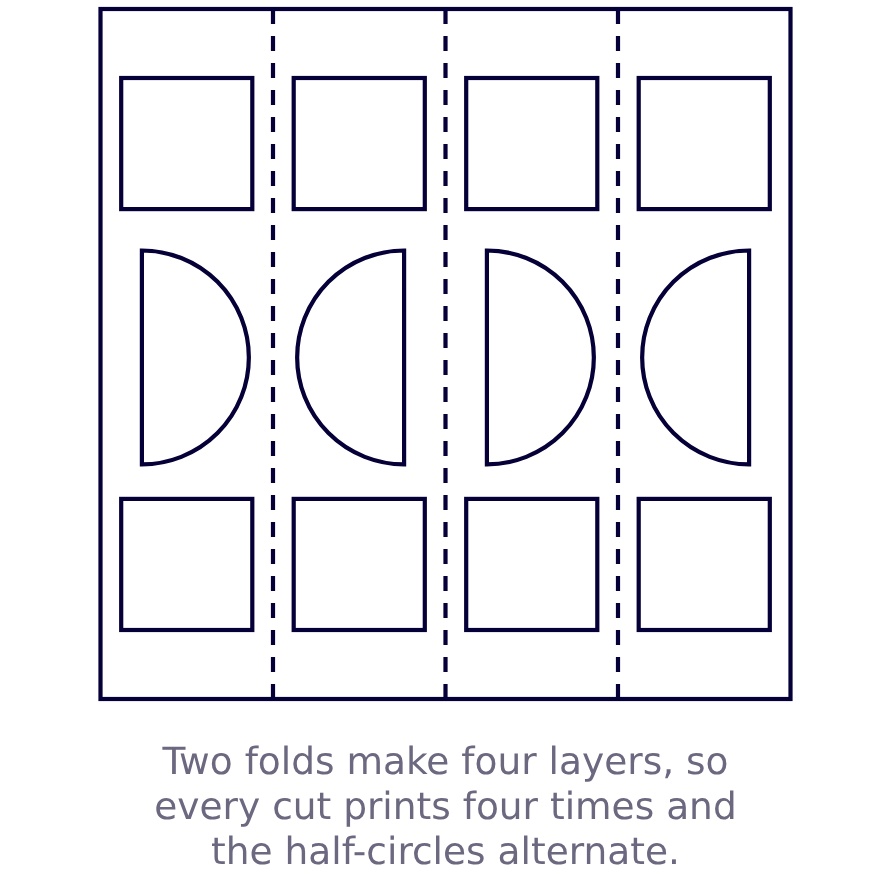 A fold acts like a mirror, so neighbouring half-circles must face opposite ways: the 1st and 3rd bulge to the right and the 2nd and 4th bulge to the left.
Option (b) shows only two of each shape, option (c) three squares and two half-circles and option (d) has no half-circle at all.
Only option (a) shows four of each with the half-circles mirrored in pairs, so the correct option is (a).
A fold acts like a mirror, so neighbouring half-circles must face opposite ways: the 1st and 3rd bulge to the right and the 2nd and 4th bulge to the left.
Option (b) shows only two of each shape, option (c) three squares and two half-circles and option (d) has no half-circle at all.
Only option (a) shows four of each with the half-circles mirrored in pairs, so the correct option is (a).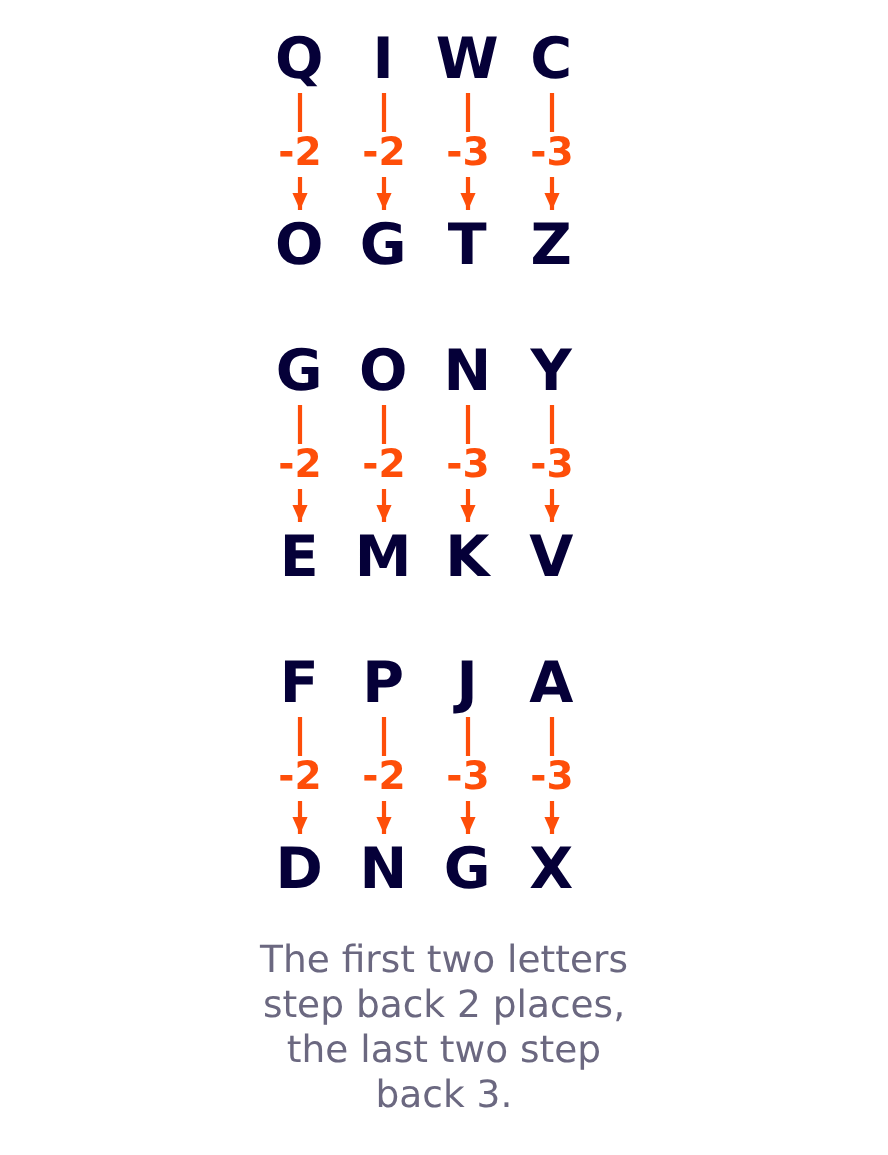 The first two letters go back 2 places and the last two letters go back 3 places: , , , , and , , , .
Apply the same shifts to FPJA: F-2=D, P-2=N, J-3=G and A-3=X, counting back from A through Z and Y.
So FPJA is related to DNGX and the correct option is (d).
The first two letters go back 2 places and the last two letters go back 3 places: , , , , and , , , .
Apply the same shifts to FPJA: F-2=D, P-2=N, J-3=G and A-3=X, counting back from A through Z and Y.
So FPJA is related to DNGX and the correct option is (d).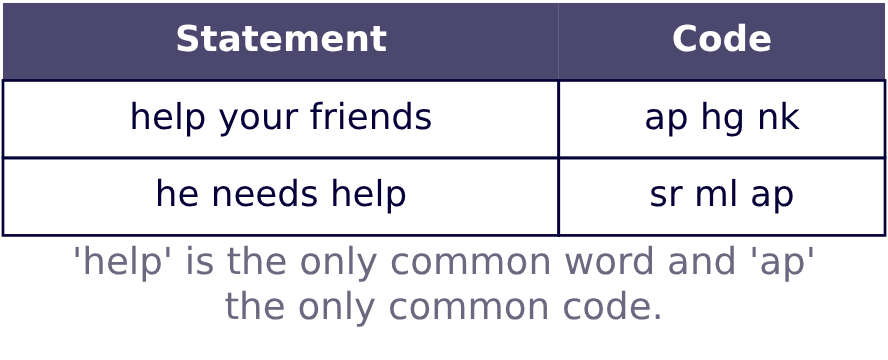 The only word that appears in both sentences is 'help', and the only code that appears in both code groups is 'ap'.
A repeated word must carry the repeated code, so 'help' is coded as 'ap' and the correct option is (d).
The only word that appears in both sentences is 'help', and the only code that appears in both code groups is 'ap'.
A repeated word must carry the repeated code, so 'help' is coded as 'ap' and the correct option is (d).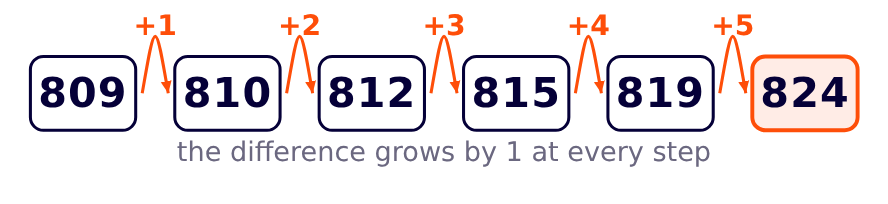 Required term =819+5=824, so the correct option is (d).