SSC GD Constable 17 February 2025 · Shift 3 · General Intelligence & Reasoning — questions with answers · ShikshaSphere
Chapter 131 of 210
17 February 2025 · Shift 3
General Intelligence & Reasoning
20 questions ~20 min readFree
20 questions
A
1
What will come in the place of the question mark '(?)' in the following equation, if ' ' and ' ' are interchanged and ' + ' and ' - ' are interchanged ?
?
A.64
B.65
C.66
D.63
Solution
Sign interchange
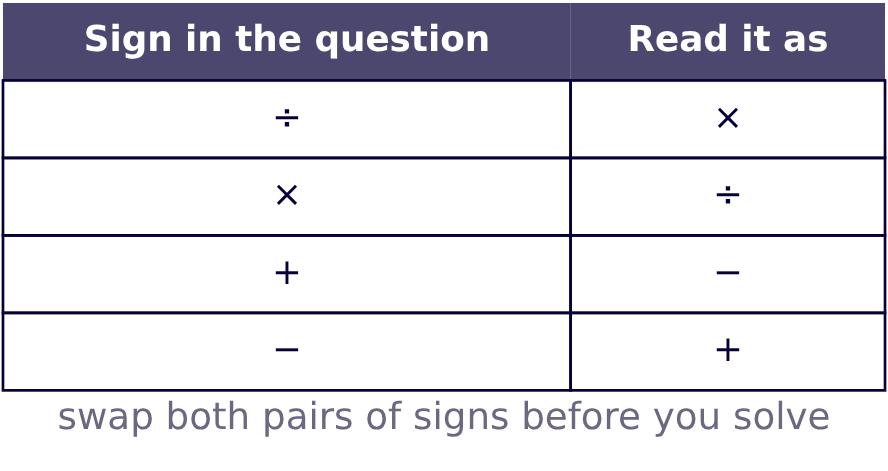
Rule: wherever appears read and wherever appears read ; wherever + appears read - and wherever - appears read +.
So is to be read as .
By BODMAS, do the division and the multiplication first: and .
Now 31+35-3=66-3=63.
So the required value is 63, i.e. option (d).
2
What should come in place of the question mark (?) in the given series based on the English alphabetical order ?
ABBA, CDDC, EFFE, ? , IJJI
A.GHHI
B.GGHG
C.GHHH
D.GHHG
Solution
Letter-cluster series
Each term uses only two letters: ABBA uses A and B, CDDC uses C and D, EFFE uses E and F.
The two letters are next to each other in the alphabet and the term is built as XYYX.
From one term to the next both letters move two places forward: (A, B), (C, D), (E, F), (G, H), (I, J).
The fourth term therefore uses G and H, and XYYX gives GHHG.
So the missing term is GHHG, i.e. option (d).
3
In a certain code language, 'DIMS' is coded as '1973' and 'MIND' is coded as '3279'. What is the code for 'N' in the given code language ?
A.9
B.2
C.3
D.7
Solution
Jumbled letter coding
In this type the four digits are the codes of the four letters, but not in the same order, so compare the two words as sets.
DIMS uses the digits 1, 9, 7, 3 and MIND uses the digits 3, 2, 7, 9.
The letters D, I and M occur in both words, so their three codes are the digits that occur in both lists: 9, 7 and 3.
S occurs only in DIMS, so S takes the left-over digit 1; N occurs only in MIND, so N takes the left-over digit 2.
So the code for N is 2, i.e. option (b).
4
Identify the figure given in the options, which when put in place of the question mark (?) will logically complete the series.
A.
B.
C.
D.
Solution
Figure series
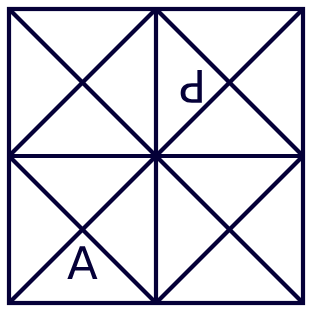
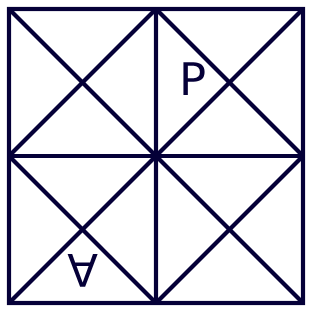
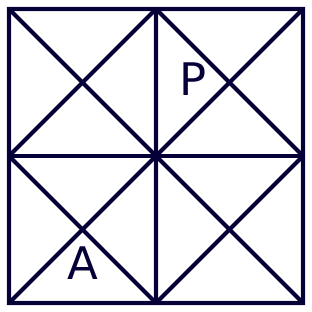
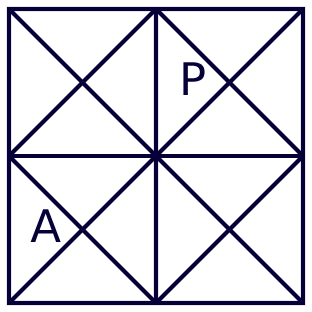
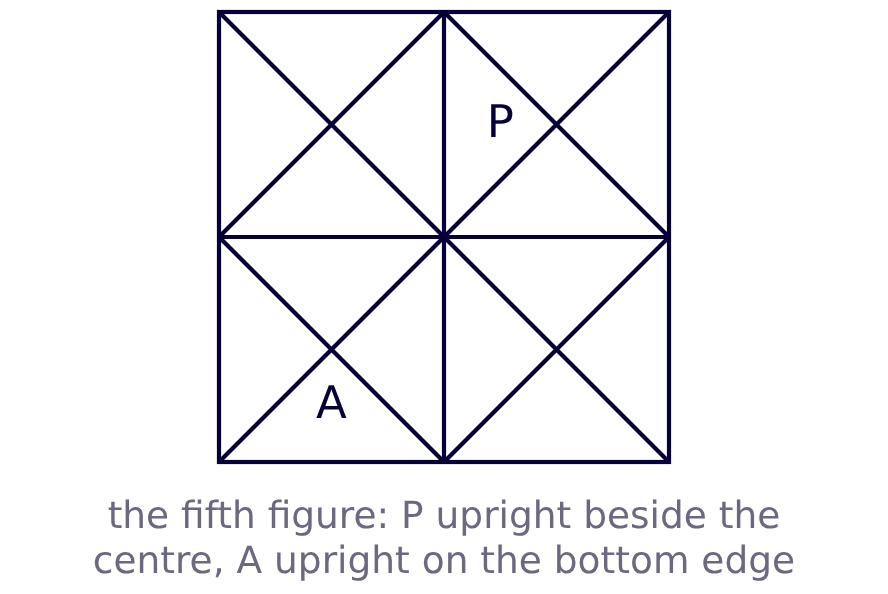
Each figure is a square cut into four quadrants, and every quadrant carries an X, so there are 16 small triangles; two letters, A and P, travel through them.
A always sits in a triangle that touches the outer border and moves one such triangle clockwise each time: top edge (right half), right edge (top half), right edge (bottom half), bottom edge (right half).
So in the fifth figure A must be on the bottom edge, left half.
P always sits in a triangle that touches the centre and turns a quarter turn anticlockwise each time: top-right quadrant, top-left, bottom-left, bottom-right.
So in the fifth figure P returns to the top-right quadrant, against the vertical middle line.
Both letters also turn upside down at every step, so after the fourth (upside-down) figure both stand upright again.
Only option (c) shows an upright P beside the centre in the top-right quadrant together with an upright A on the bottom edge: (a) has P upside down, (b) has A upside down, and (d) puts A on the left edge instead of the bottom edge.
5
In a certain code language,
' means ' A is the mother of B ',
' ' means ' A is the brother of B ',
' means ' A is the wife of B ' and
' means ' is the father of .
Based on the above, how is related to N if ' '?
A.Father's brother
B.Mother's mother
C.Wife's father
D.Brother's wife
Solution
Coded blood relations
Break the chain into single links and read each symbol.
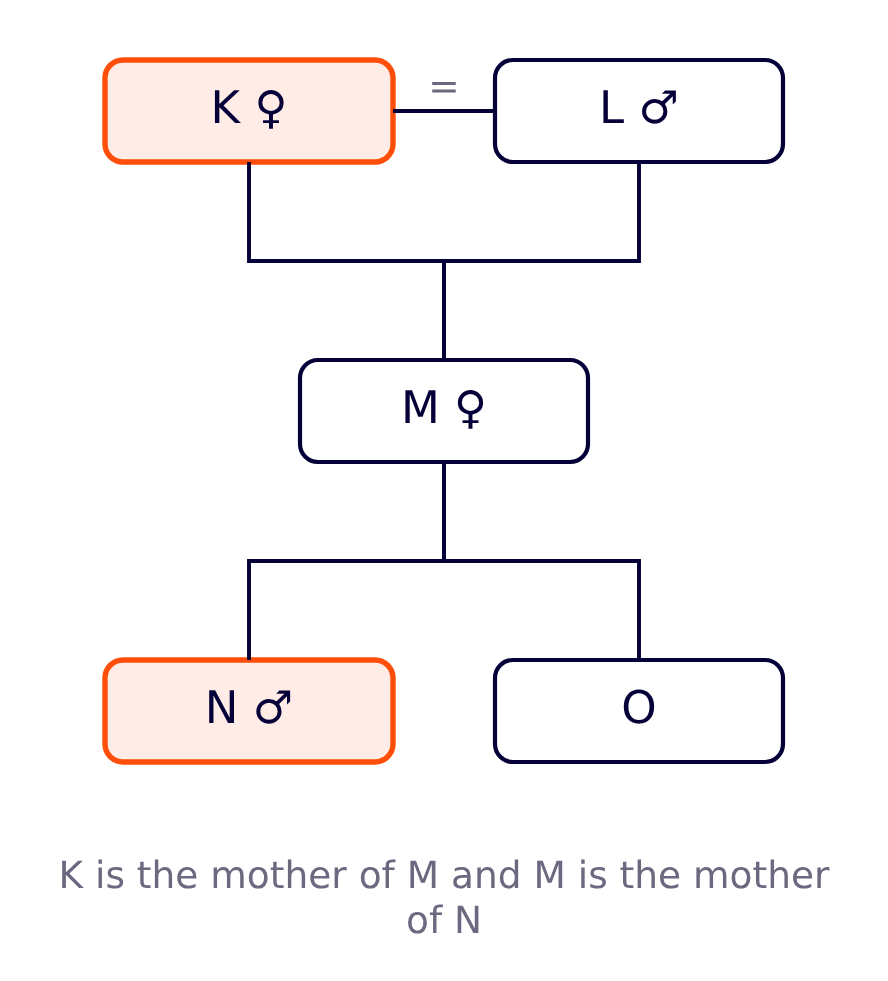
: K is the wife of L.
: L is the father of M, and since K is L's wife, K is the mother of M.
M+N: M is the mother of N.
The last link N-O (N is the brother of O) is not needed for this question.
So the mother of N is M, and the mother of M is K.
Hence K is the mother's mother of N, i.e. option (b).
6
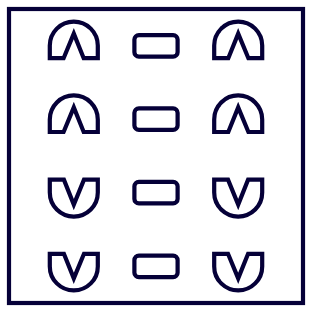
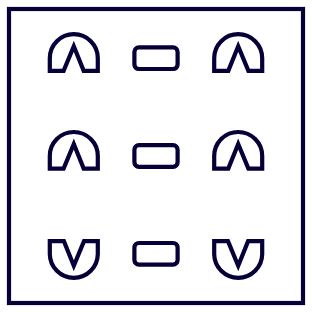
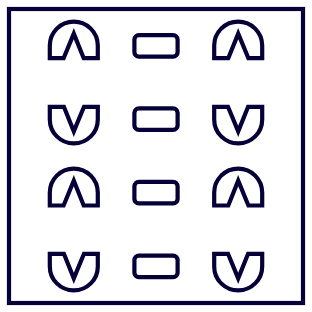
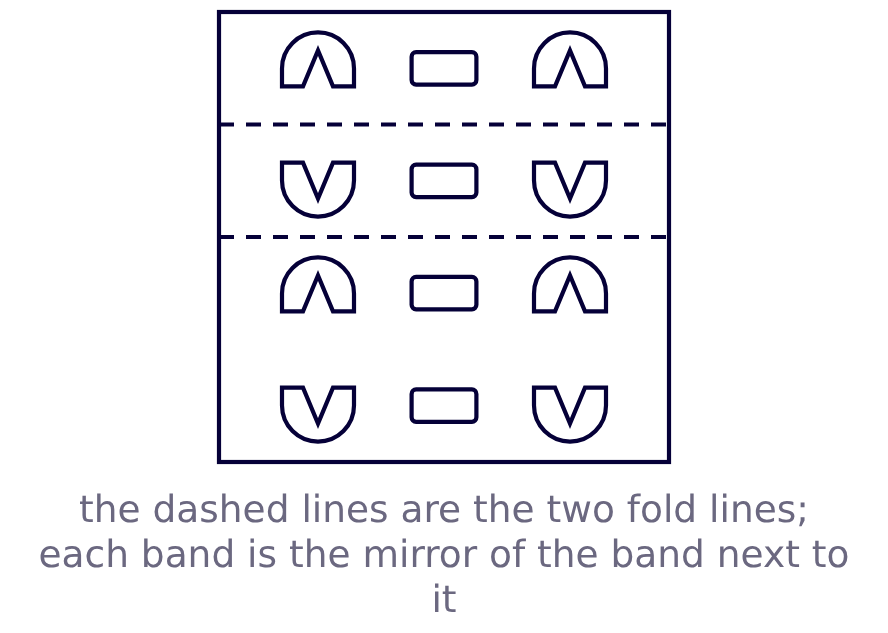
A paper is folded and cut as shown below. How will it appear when unfolded?
A.
B.
C.
D.
Solution
Paper folding and cutting
The sheet is folded upwards in half, and that half is folded upwards in half again, so the narrow strip that is cut is four layers thick and the unfolded sheet must show four equal bands.
Opening the second fold copies the cuts across the quarter line, and opening the first fold copies everything across the middle line.
A copy taken across a fold line is a mirror image, so the arches in the copied band point the opposite way.
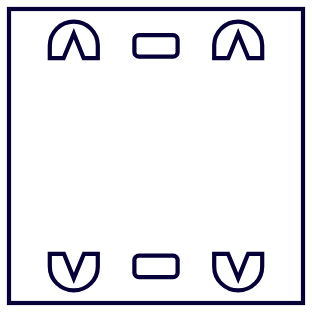
Band 1 (the strip itself) has the arches upright, band 2 is its mirror and has them upside down, band 3 is upright again and band 4 is upside down.
So the four bands alternate upright, upside down, upright, upside down, which is option (d).
Option (b) also has four bands but keeps the two upright ones together, while (a) has two bands and (c) has three, so they cannot come from four layers.
7
'TQ 100' is related to 'SR 10' in a certain way. In the same way, 'WO 9' is related to 'VP 3'. To which of the given options is 'JP 121' related, following the same logic?
A.IQ 11
B.JQ 11
C.KQ 11
D.IQ 12
Solution
Letter-number analogy
Compare TQ 100 with SR 10 part by part: T becomes S, one step back; Q becomes R, one step forward; and 100 becomes .
Check the rule on WO 9 and VP 3: W to V is one step back, O to P is one step forward, and .
Apply the same rule to JP 121: J goes back to I, P goes forward to Q, and .
So JP 121 is related to IQ 11, i.e. option (a).
Option (b) leaves the first letter unchanged, (c) moves it forward instead of back and (d) keeps 12 instead of the square root 11.
8
Seven people, L, M, N, O, W, X and Y, are sitting in a row, facing north (but not necessarily in the same order). Only five people sit between W and X. N sits to the immediate left of X . Only one person sits between N and L . M sits at some place to the left of O but at some place to the right of Y. Who sits third from the left end of the line?
A.L
B.Y
C.M
D.W
Solution
Linear seating
Number the seats 1 to 7 from the left; all seven face north, so seat 1 is the left end.
Five people sit between W and X, so W and X occupy the two ends, seats 1 and 7.
N is immediately left of X, so X cannot be at seat 1; hence X is at seat 7, N at seat 6 and W at seat 1.
Only one person sits between N and L, so L is at seat 4.
Seats 2, 3 and 5 are left for Y, M and O, and M is right of Y but left of O, so Y is at 2, M at 3 and O at 5.
Third from the left end is seat 3, which is M, i.e. option (c).
9
Each letter in the word MONKEYS is arranged in the English alphabetical order. How many letters are there in the English alphabetical order between the letter which is third from the left end and the one which is fourth from the right end in the new letter-cluster thus formed?
A.2
B.3
C.0
D.1
Solution
Alphabetical rearrangement
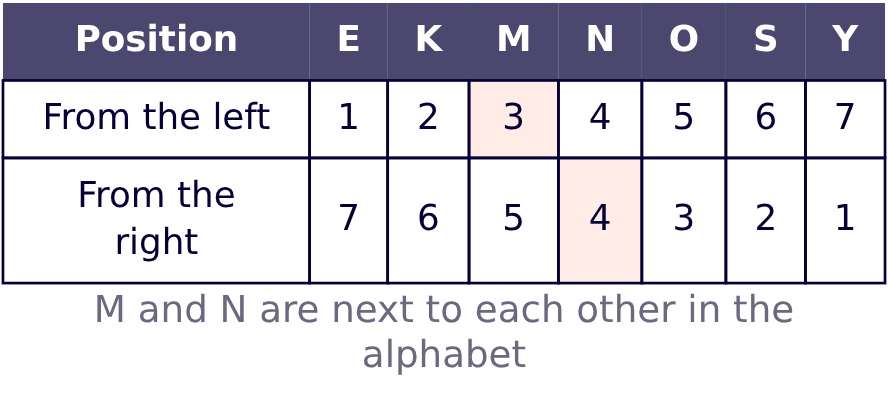
Arrange the letters of MONKEYS in alphabetical order: E, K, M, N, O, S, Y, giving the cluster EKMNOSY.
Third from the left end is M; fourth from the right end is the fourth position counted back from Y, which is N.
In the alphabet M is the 13th letter and N the 14th, so they are next to each other.
There is no letter between M and N, so the answer is 0, i.e. option (c).
10
What should come in place of the question mark (?) in the given series?
18, 28, 40, 54, 70, ?
A.88
B.90
C.87
D.89
Solution
Number series
Take the difference of each pair of neighbouring terms.
28-18=10, 40-28=12, 54-40=14, 70-54=16.
The differences themselves grow by 2 every time, so the next difference is 16+2=18.
So the missing term is 70+18=88, i.e. option (a).
11
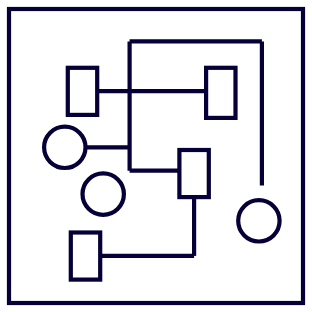
Select the option in which the given figure (X) is embedded (rotation is NOT allowed).
A.
B.
C.
D.
Solution
Embedded figure
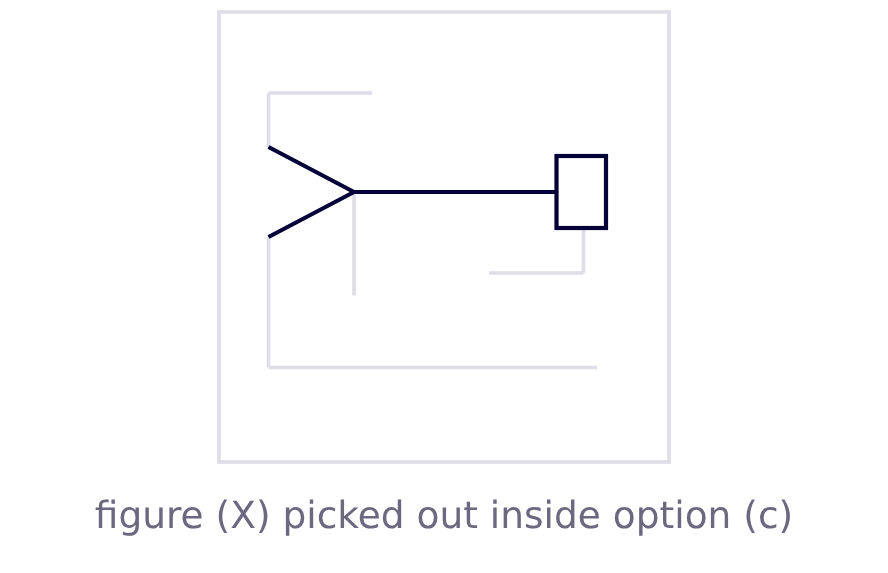
First describe figure (X) exactly: two slanting strokes meet at a point on the right, a horizontal line runs to the right from that point, and a small upright rectangle closes the far end of that line.
Rotation is not allowed, so all three parts must appear the same way round and joined in the same way.
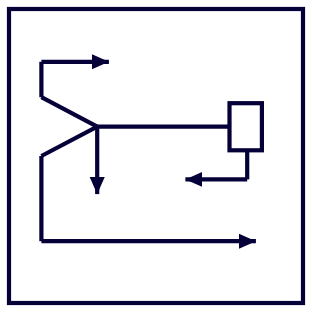
Option (c) contains exactly that: the two slanting strokes meet at a point just left of the middle, the horizontal line leaves that point towards the right and ends on the small upright rectangle.
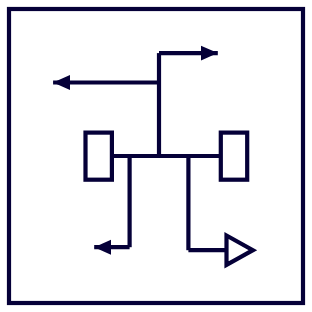
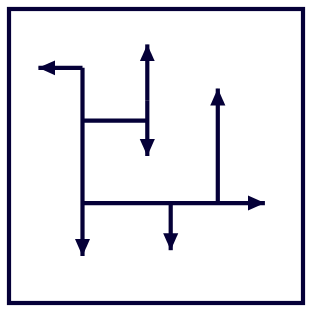
In (a) and (b) every line is horizontal or vertical, so no two strokes meet at a slanting point; (d) does have rectangles, but they are joined only by right-angled lines, so the slanting pair is missing there too.
Hence the figure is embedded in option (c).
12
ABYW is related to VWTR in a certain way based on the English alphabetical order. In the same way, UVSQ is related to PQNL. To which of the given options is GHEC related, following the same logic ?
A.BBYX
B.BCYX
C.BDYC
D.BCZX
Solution
Letter-cluster analogy
Compare ABYW with VWTR position by position: A(1) to V(22), B(2) to W(23), Y(25) to T(20), W(23) to R(18).
Every letter moves 5 places back, and when the count runs past A it continues from Z.
Check on the second pair: U(21) to P(16), V(22) to Q(17), S(19) to N(14), Q(17) to L(12) - again -5 each time.
Now GHEC: G(7) to B(2), H(8) to C(3), E(5) to Z(26) after wrapping round, C(3) to X(24) after wrapping round.
So GHEC is related to BCZX, i.e. option (d).
13
Based on the English alphabetical order, three of the following four letter-clusters are alike in a certain way and thus form a group. Which letter-cluster DOES NOT belong to that group?
(Note: The odd one out is not based on the number of consonants/vowels or their position in the letter-cluster.)
A.KNG
B.PRM
C.EGB
D.GID
Solution
Odd one out
Write the alphabet position of each letter and find the two gaps inside every cluster.
PRM: P(16) to R(18) is +2, R(18) to M(13) is -5.
EGB: E(5) to G(7) is +2, G(7) to B(2) is -5; GID: G(7) to I(9) is +2, I(9) to D(4) is -5.
KNG: K(11) to N(14) is +3 and N(14) to G(7) is -7, so its gaps are different from the other three.
Hence KNG does not belong to the group, i.e. option (a).
14
Select the option that represents the letters that, when sequentially placed from left to right in the blanks below, will complete the letter series.
HI_L_H_K_MH__LMHIK__
A.MKILIKLM
B.MKLIIKML
C.KMLIIKML
D.KMILIKLM
Solution
Missing letters series
There are twenty places and eight blanks, so look for a block that repeats.
The letters that are already there fit the block HIKLM written four times over.
Block 1 needs K and M, block 2 needs I and L, block 3 needs I and K, and block 4 needs L and M.
Reading the blanks from left to right gives K, M, I, L, I, K, L, M.
So the answer is KMILIKLM, i.e. option (d).
15
What should come in place of the question mark (?) in the given series?
13, 18, 29, 34, 45, ?
A.58
B.48
C.56
D.50
Solution
Number series
Take the difference of each pair of neighbouring terms.
18-13=5, 29-18=11, 34-29=5, 45-34=11.
The differences repeat in the pattern +5, +11, so the next one is +5.
So the missing term is 45+5=50, i.e. option (d).
16
Read the given statements and conclusions carefully. Assuming that the information given in the statements is true, even if it appears to be at variance with commonly known facts, decide which of the given conclusions logically follow(s) from the statements.Statements: All trees are mud.
Some mud are sand.
No sand is a flower.
Conclusions: (I): No tree is a flower.
(II): Some sand are trees.
A.Neither conclusion (I) nor (II) follows.
B.Only conclusion (I) follows.
C.Only conclusion (II) follows.
D.Both conclusions (I) and (II) follow.
Solution
Syllogism
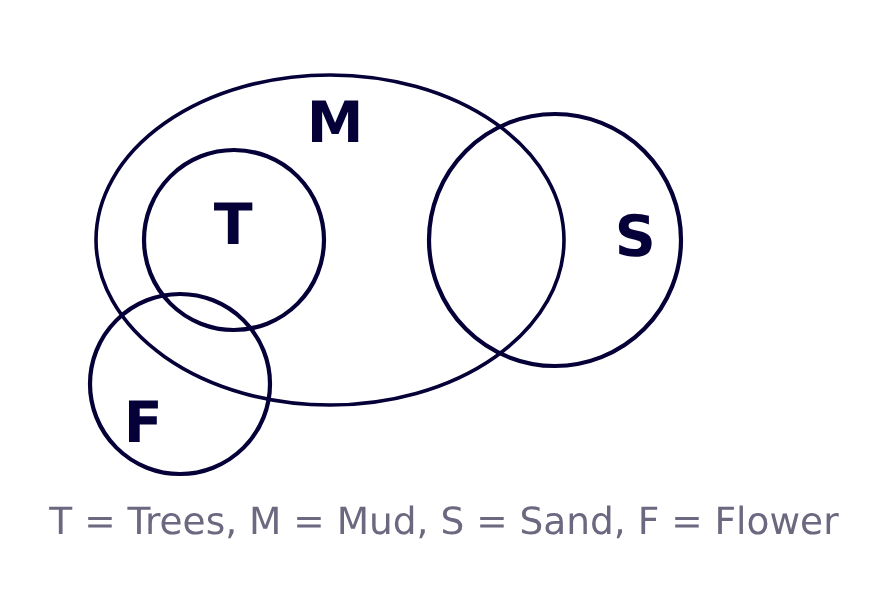
Draw the three statements: the whole of Trees lies inside Mud, Sand cuts Mud only partly, and Sand stays completely away from Flower.
Nothing forces the trees into the sandy part of the mud, so the trees may lie in the part of Mud that Sand does not touch.
That part is free to meet Flower, as the picture shows, so 'No tree is a flower' can be false and conclusion (I) does not follow.
'Some mud are sand' says nothing about the trees, so the sand may lie entirely outside Trees, and 'Some sand are trees' can be false too, so conclusion (II) does not follow.
As one picture makes both conclusions fail, neither of them follows, i.e. option (a).
17
K, L, M, N, O, P and Q are sitting around a circular table, facing the centre (but not necessarily in the same order). M sits second to the right of L. Q sits to the immediate right of M. O sits fourth to the right of K. N sits to the immediate left of P. What is the position of N with respect to L ?
A.Third to the Right
B.Second to the Left
C.Second to the Right
D.Immediate Left
Solution
Circular seating
All seven face the centre, so for each of them the right hand points anticlockwise and the left hand clockwise; number the seven seats 1 to 7 clockwise.
Put L at seat 1. M is second to L's right, so M is two seats anticlockwise, at seat 6; Q is immediately to M's right, so Q is at seat 5.
Seats 2, 3, 4 and 7 are left for K, N, O and P.
O is fourth to K's right, that is four seats anticlockwise from K, which works only for K at seat 4 and O at seat 7.
N is immediately left of P, that is one seat clockwise from P, so P takes seat 2 and N takes seat 3.
Going clockwise from L we pass P and then reach N, and clockwise is the left side, so N sits second to the left of L, i.e. option (b).
18
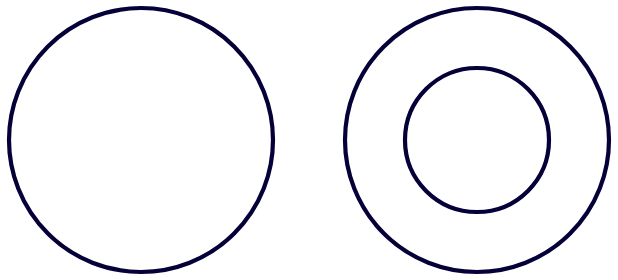
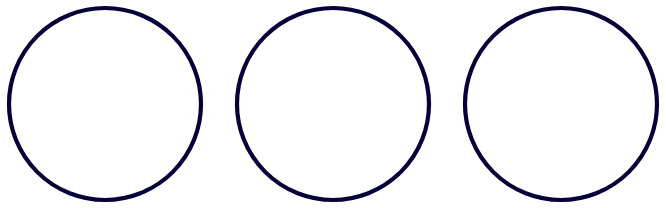
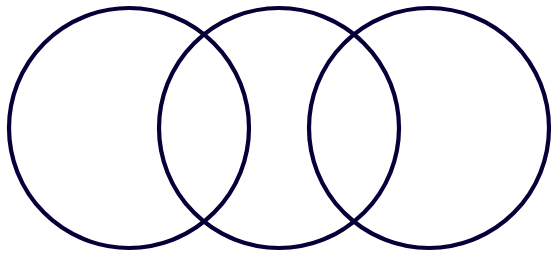
Select the Venn diagram that best illustrates the relationship between the following classes.
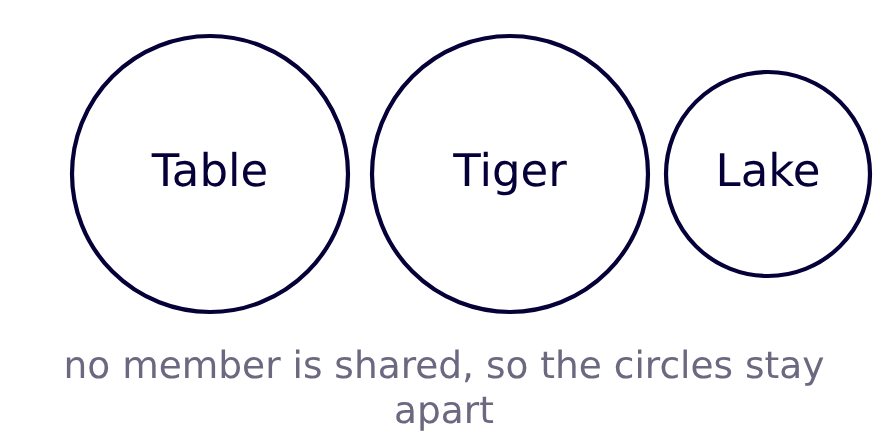
Table, Tiger, Lake
A.
B.
C.
D.
Solution
Venn diagram of classes
Take the three classes two at a time.
A table is a piece of furniture and a tiger is an animal, so no table is a tiger.
A lake is a body of water, so no tiger is a lake and no table is a lake either.
No object belongs to two of the classes, so the three circles must stand completely apart.
That is option (c); (a) and (d) show circles that share a part and (b) shows one class lying inside another.
19
In a certain code language 'VSDO' is coded as '20-17-2-13' and 'ILCY' is coded as '7-10- 1-23'. What is the code for 'QNRF' in the given language ?
A.17-15-18-5
B.16-14-18-6
C.15-12-16-4
D.13-14-17-5
Solution
Letter-to-number coding
Write the alphabet position of each letter of VSDO: V =22, S =19, D =4, O =15.
The code is 20-17-2-13, and 22-2=20, 19-2=17, 4-2=2, 15-2=13, so every letter is coded by its position minus 2.
Check on ILCY: 9-2=7, 12-2=10, 3-2=1, 25-2=23, which is 7-10-1-23.
For QNRF the positions are Q =17, N =14, R =18, F =6.
Subtracting 2 from each: 17-2=15, 14-2=12, 18-2=16, 6-2=4.
So QNRF is coded as 15-12-16-4, i.e. option (c).
20
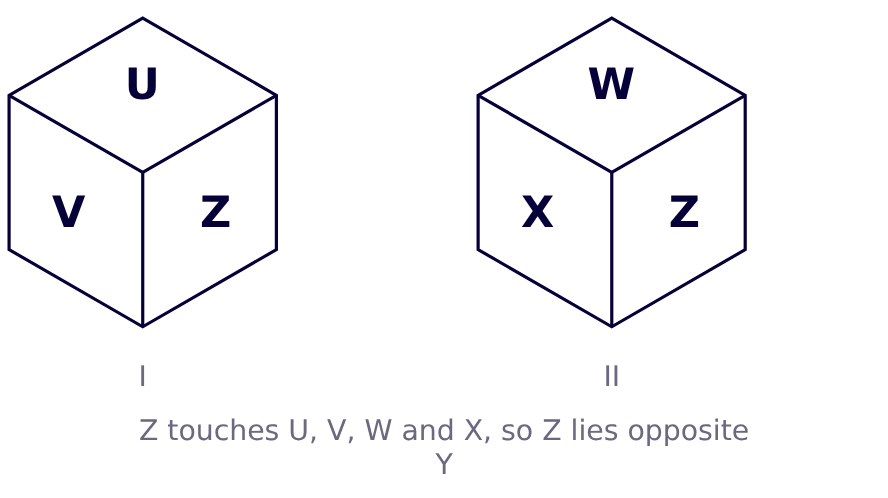
A dice has its faces marked by letters U, V, W, X, Y and Z. Two different positions of the same dice are given below. Select the letter that will be on the face opposite to the one having Y?
A.Z
B.V
C.X
D.U
Solution
Dice - opposite faces
Z is the letter common to the two views, and the two views together show U, V, W and X once each.
Two faces seen together in one view share an edge, so they cannot be opposite each other.
In view I, Z shares an edge with U and V; in view II, Z shares an edge with W and X.
So Z is next to all four of U, V, W and X, and none of them can lie opposite Z.
Y is the only letter left, so Y lies opposite Z, and the face opposite Y carries Z, i.e. option (a).
Finished reading? Now test yourself.
The same 20 questions, but with a timer and the answers hidden — 15 minutes.

 So is to be read as .
By BODMAS, do the division and the multiplication first: and .
Now 31+35-3=66-3=63.
So the required value is 63, i.e. option (d).
So is to be read as .
By BODMAS, do the division and the multiplication first: and .
Now 31+35-3=66-3=63.
So the required value is 63, i.e. option (d).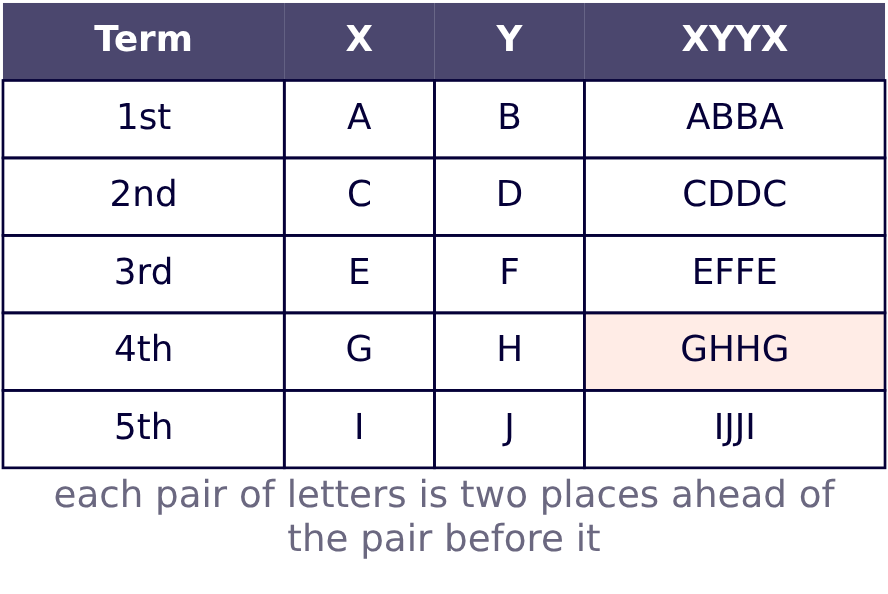 The fourth term therefore uses G and H, and XYYX gives GHHG.
So the missing term is GHHG, i.e. option (d).
The fourth term therefore uses G and H, and XYYX gives GHHG.
So the missing term is GHHG, i.e. option (d).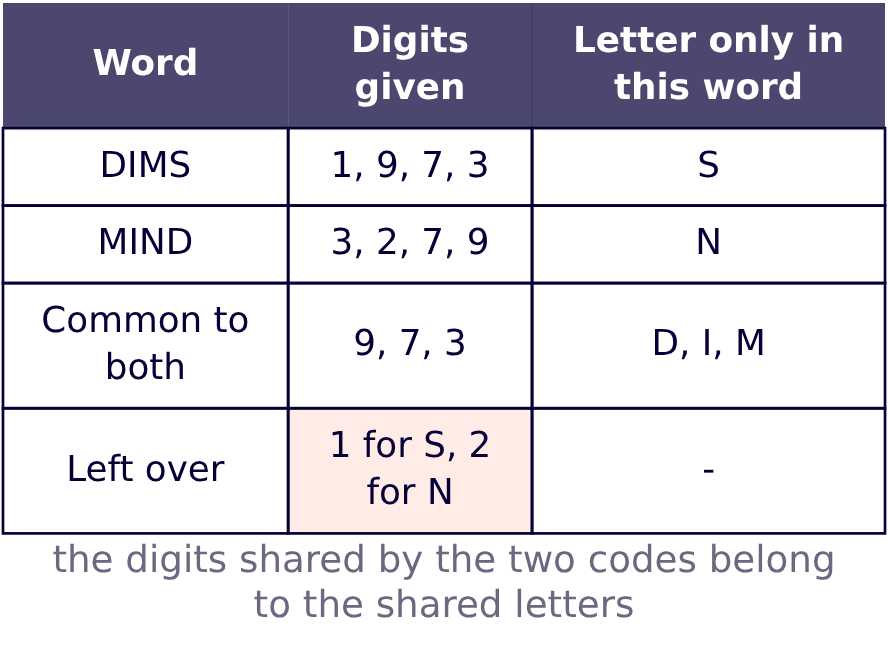 S occurs only in DIMS, so S takes the left-over digit 1; N occurs only in MIND, so N takes the left-over digit 2.
So the code for N is 2, i.e. option (b).
S occurs only in DIMS, so S takes the left-over digit 1; N occurs only in MIND, so N takes the left-over digit 2.
So the code for N is 2, i.e. option (b).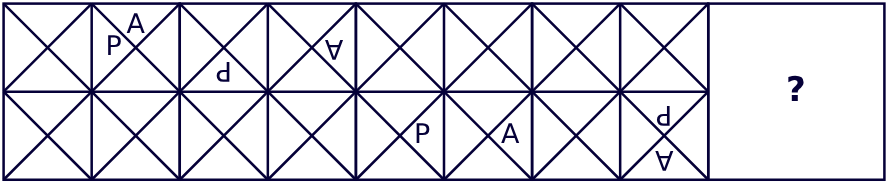
 Only option (c) shows an upright P beside the centre in the top-right quadrant together with an upright A on the bottom edge: (a) has P upside down, (b) has A upside down, and (d) puts A on the left edge instead of the bottom edge.
 The last link N-O (N is the brother of O) is not needed for this question.
So the mother of N is M, and the mother of M is K.
Hence K is the mother's mother of N, i.e. option (b).
The last link N-O (N is the brother of O) is not needed for this question.
So the mother of N is M, and the mother of M is K.
Hence K is the mother's mother of N, i.e. option (b).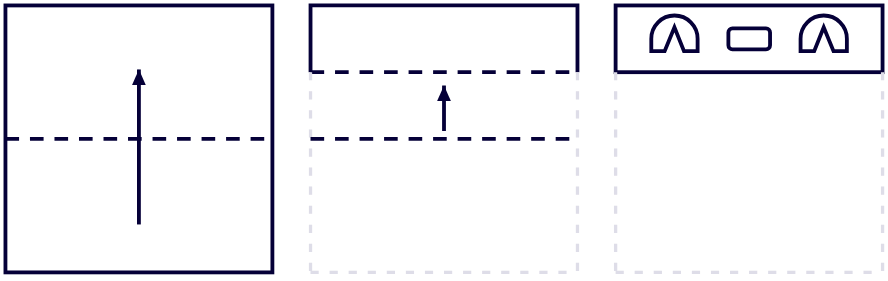
 Band 1 (the strip itself) has the arches upright, band 2 is its mirror and has them upside down, band 3 is upright again and band 4 is upside down.
So the four bands alternate upright, upside down, upright, upside down, which is option (d).
Option (b) also has four bands but keeps the two upright ones together, while (a) has two bands and (c) has three, so they cannot come from four layers.
Band 1 (the strip itself) has the arches upright, band 2 is its mirror and has them upside down, band 3 is upright again and band 4 is upside down.
So the four bands alternate upright, upside down, upright, upside down, which is option (d).
Option (b) also has four bands but keeps the two upright ones together, while (a) has two bands and (c) has three, so they cannot come from four layers.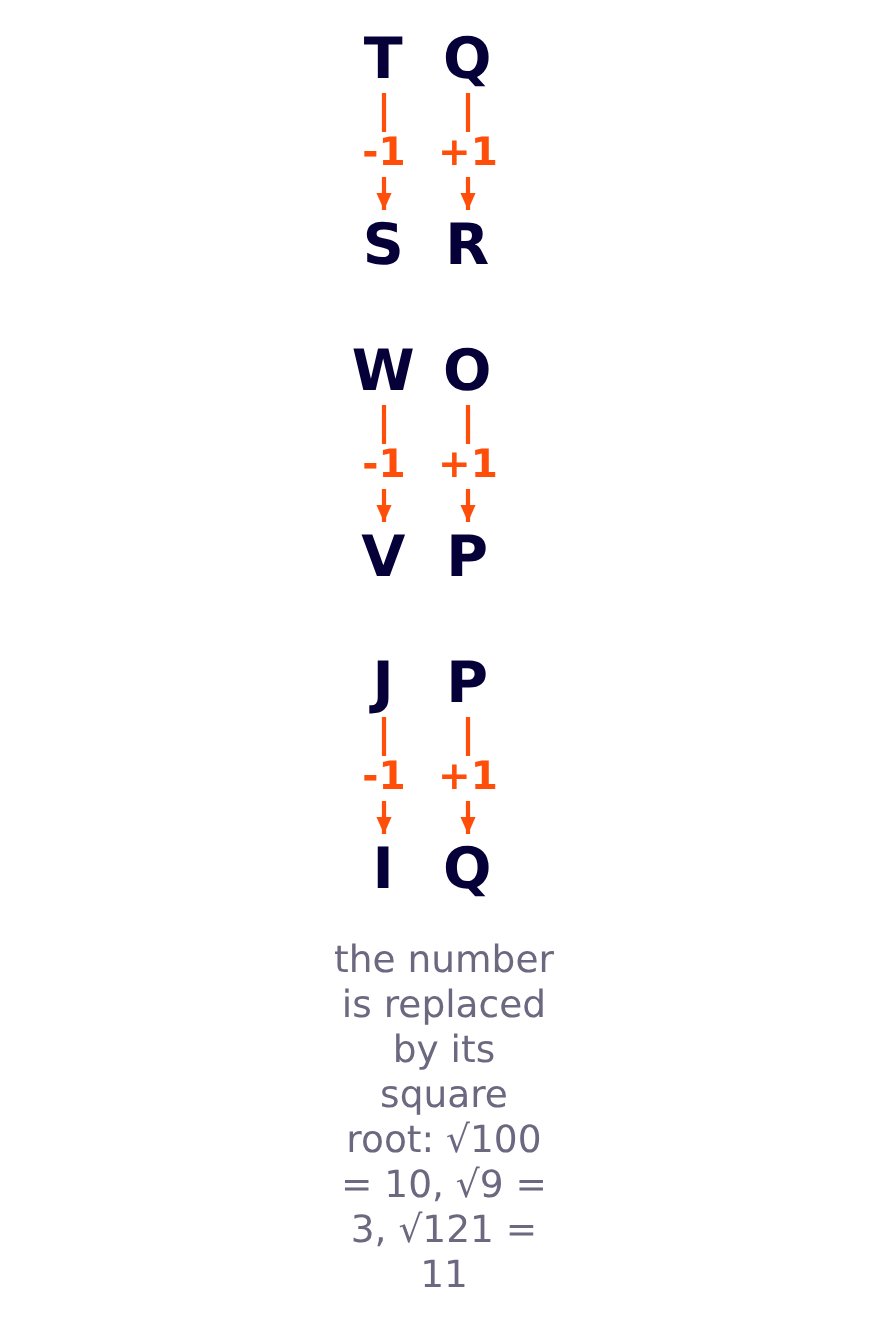 Check the rule on WO 9 and VP 3: W to V is one step back, O to P is one step forward, and .
Apply the same rule to JP 121: J goes back to I, P goes forward to Q, and .
So JP 121 is related to IQ 11, i.e. option (a).
Option (b) leaves the first letter unchanged, (c) moves it forward instead of back and (d) keeps 12 instead of the square root 11.
Check the rule on WO 9 and VP 3: W to V is one step back, O to P is one step forward, and .
Apply the same rule to JP 121: J goes back to I, P goes forward to Q, and .
So JP 121 is related to IQ 11, i.e. option (a).
Option (b) leaves the first letter unchanged, (c) moves it forward instead of back and (d) keeps 12 instead of the square root 11.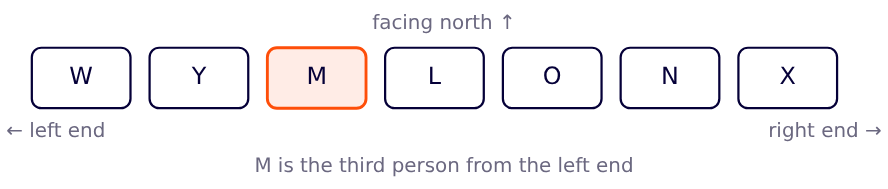 Third from the left end is seat 3, which is M, i.e. option (c).
 Third from the left end is M; fourth from the right end is the fourth position counted back from Y, which is N.
In the alphabet M is the 13th letter and N the 14th, so they are next to each other.
There is no letter between M and N, so the answer is 0, i.e. option (c).
Third from the left end is M; fourth from the right end is the fourth position counted back from Y, which is N.
In the alphabet M is the 13th letter and N the 14th, so they are next to each other.
There is no letter between M and N, so the answer is 0, i.e. option (c).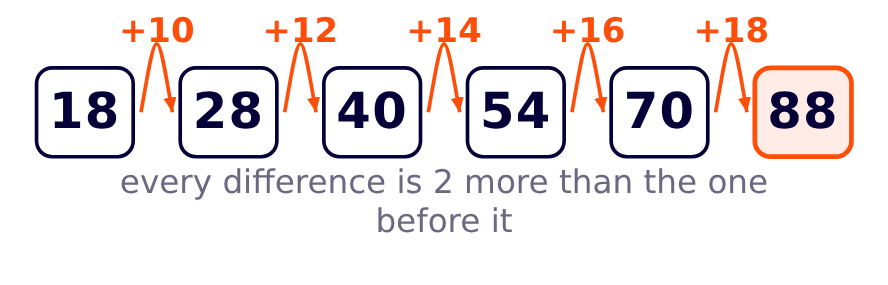 So the missing term is 70+18=88, i.e. option (a).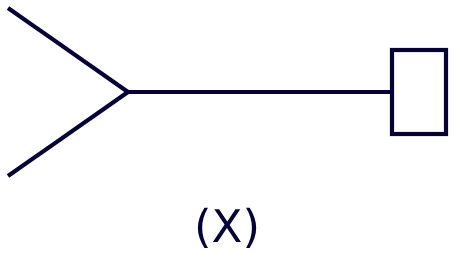
 Option (c) contains exactly that: the two slanting strokes meet at a point just left of the middle, the horizontal line leaves that point towards the right and ends on the small upright rectangle.
In (a) and (b) every line is horizontal or vertical, so no two strokes meet at a slanting point; (d) does have rectangles, but they are joined only by right-angled lines, so the slanting pair is missing there too.
Hence the figure is embedded in option (c).
Option (c) contains exactly that: the two slanting strokes meet at a point just left of the middle, the horizontal line leaves that point towards the right and ends on the small upright rectangle.
In (a) and (b) every line is horizontal or vertical, so no two strokes meet at a slanting point; (d) does have rectangles, but they are joined only by right-angled lines, so the slanting pair is missing there too.
Hence the figure is embedded in option (c).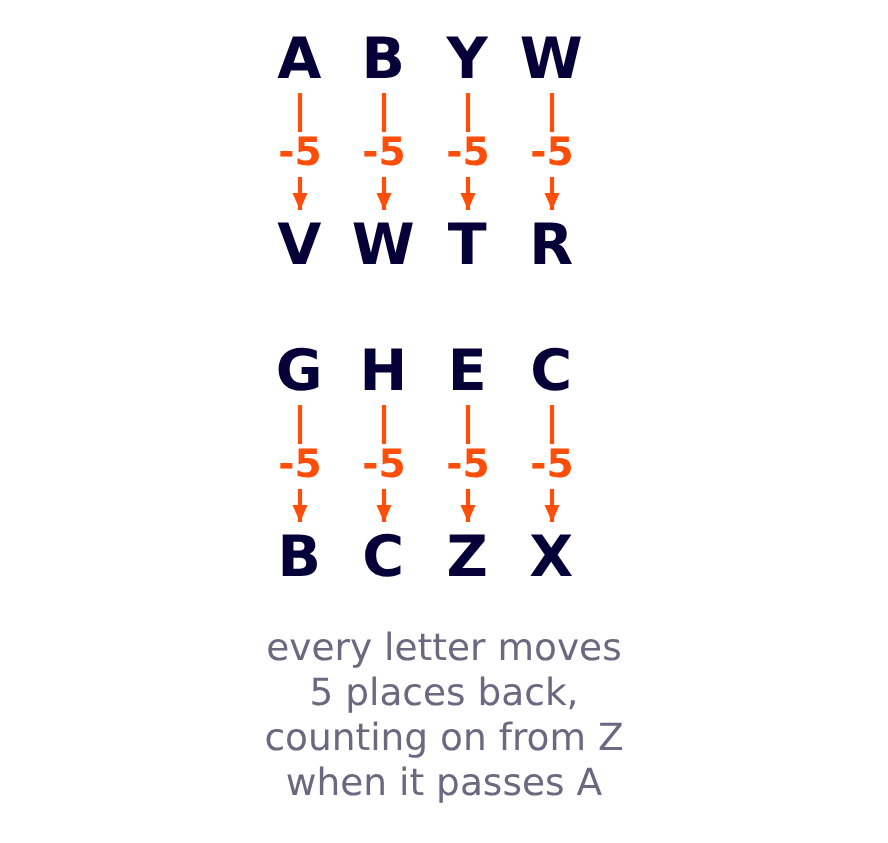 Now GHEC: G(7) to B(2), H(8) to C(3), E(5) to Z(26) after wrapping round, C(3) to X(24) after wrapping round.
So GHEC is related to BCZX, i.e. option (d).
Now GHEC: G(7) to B(2), H(8) to C(3), E(5) to Z(26) after wrapping round, C(3) to X(24) after wrapping round.
So GHEC is related to BCZX, i.e. option (d).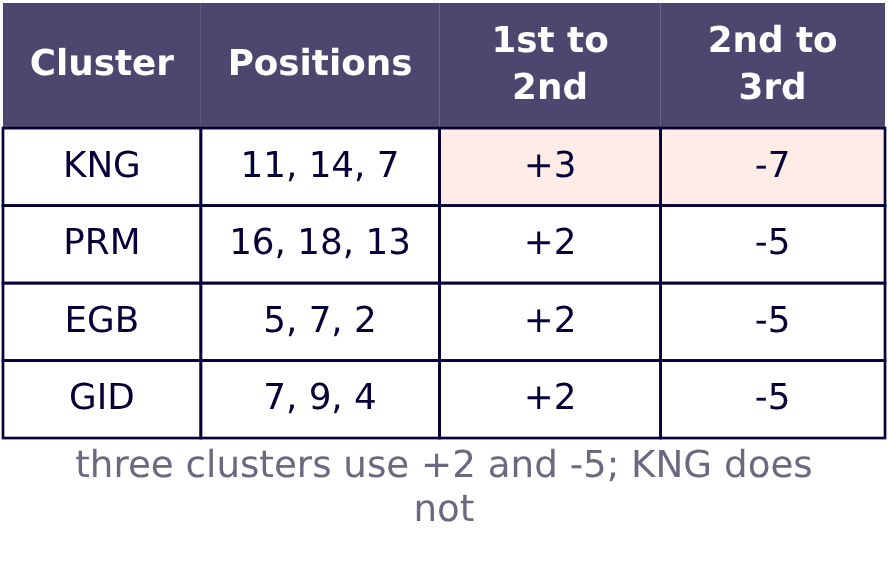 KNG: K(11) to N(14) is +3 and N(14) to G(7) is -7, so its gaps are different from the other three.
Hence KNG does not belong to the group, i.e. option (a).
KNG: K(11) to N(14) is +3 and N(14) to G(7) is -7, so its gaps are different from the other three.
Hence KNG does not belong to the group, i.e. option (a).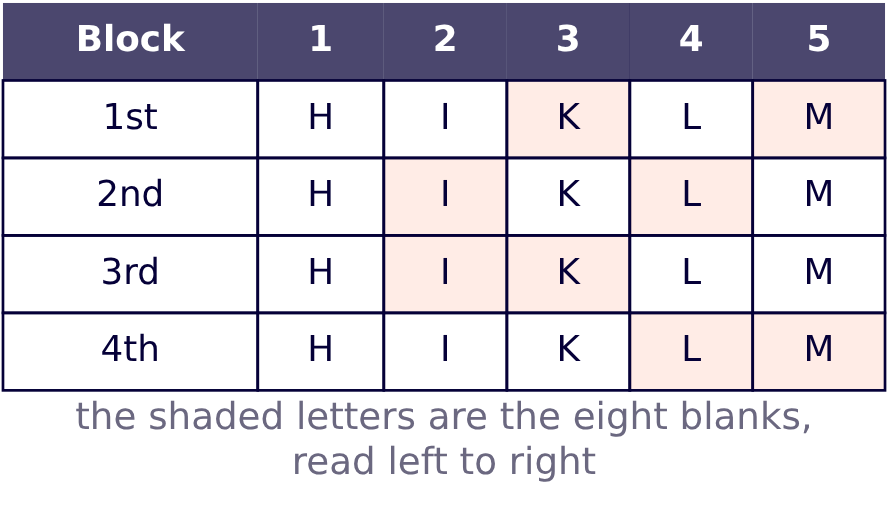 Block 1 needs K and M, block 2 needs I and L, block 3 needs I and K, and block 4 needs L and M.
Reading the blanks from left to right gives K, M, I, L, I, K, L, M.
So the answer is KMILIKLM, i.e. option (d).
Block 1 needs K and M, block 2 needs I and L, block 3 needs I and K, and block 4 needs L and M.
Reading the blanks from left to right gives K, M, I, L, I, K, L, M.
So the answer is KMILIKLM, i.e. option (d).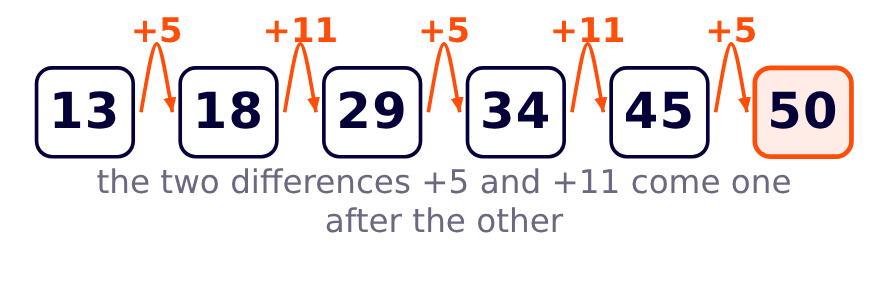 So the missing term is 45+5=50, i.e. option (d).
 Nothing forces the trees into the sandy part of the mud, so the trees may lie in the part of Mud that Sand does not touch.
That part is free to meet Flower, as the picture shows, so 'No tree is a flower' can be false and conclusion (I) does not follow.
'Some mud are sand' says nothing about the trees, so the sand may lie entirely outside Trees, and 'Some sand are trees' can be false too, so conclusion (II) does not follow.
As one picture makes both conclusions fail, neither of them follows, i.e. option (a).
Nothing forces the trees into the sandy part of the mud, so the trees may lie in the part of Mud that Sand does not touch.
That part is free to meet Flower, as the picture shows, so 'No tree is a flower' can be false and conclusion (I) does not follow.
'Some mud are sand' says nothing about the trees, so the sand may lie entirely outside Trees, and 'Some sand are trees' can be false too, so conclusion (II) does not follow.
As one picture makes both conclusions fail, neither of them follows, i.e. option (a).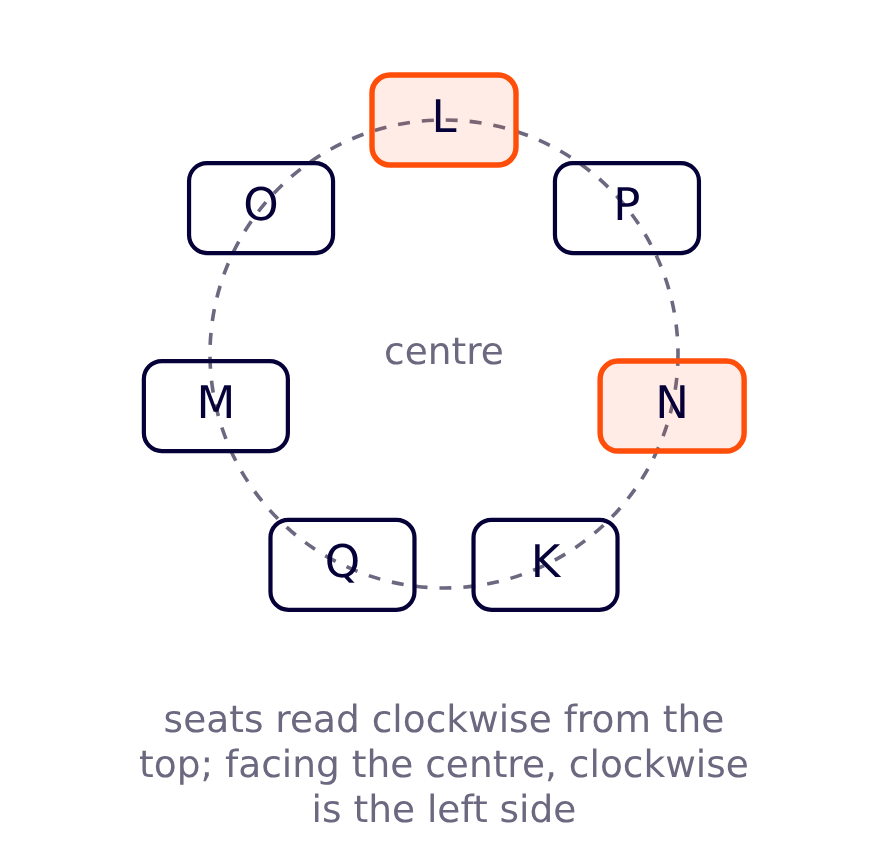 Going clockwise from L we pass P and then reach N, and clockwise is the left side, so N sits second to the left of L, i.e. option (b).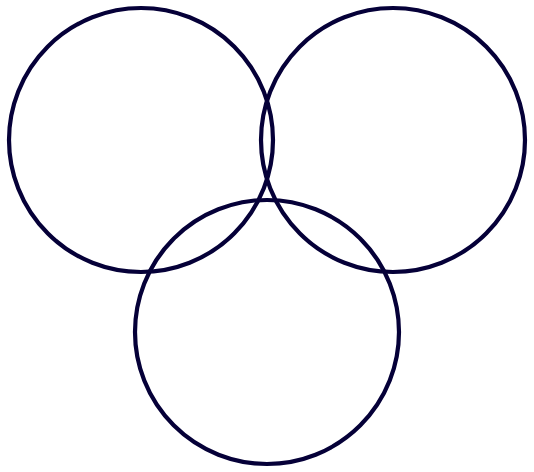
 No object belongs to two of the classes, so the three circles must stand completely apart.
That is option (c); (a) and (d) show circles that share a part and (b) shows one class lying inside another.
No object belongs to two of the classes, so the three circles must stand completely apart.
That is option (c); (a) and (d) show circles that share a part and (b) shows one class lying inside another.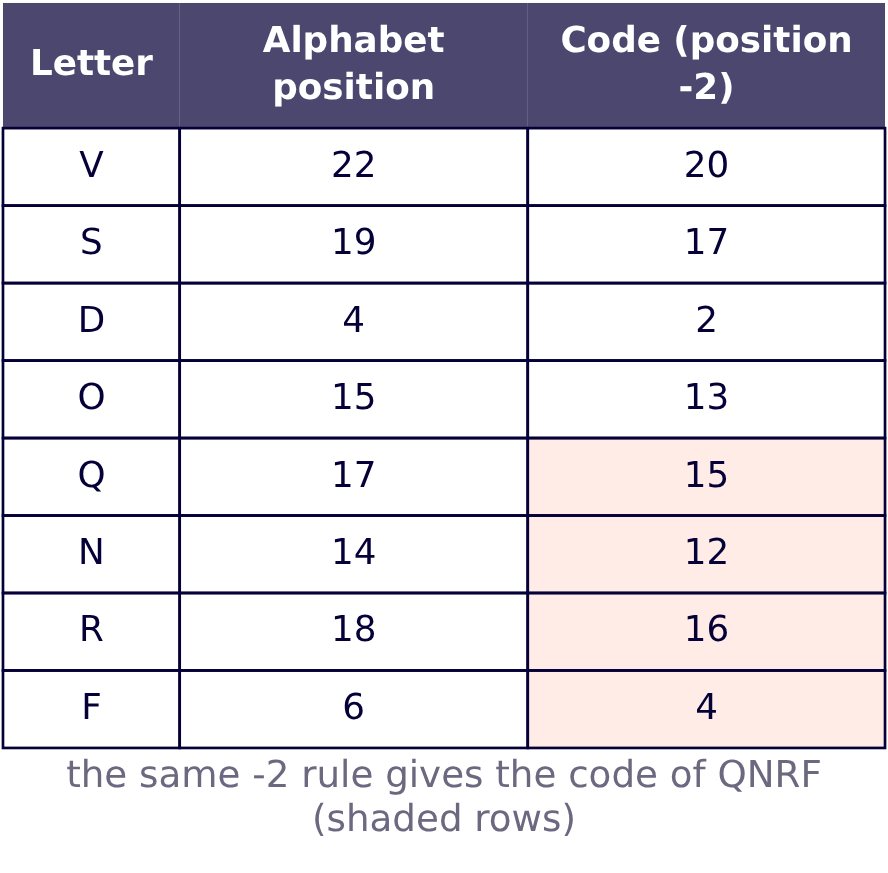 For QNRF the positions are Q =17, N =14, R =18, F =6.
Subtracting 2 from each: 17-2=15, 14-2=12, 18-2=16, 6-2=4.
So QNRF is coded as 15-12-16-4, i.e. option (c).
For QNRF the positions are Q =17, N =14, R =18, F =6.
Subtracting 2 from each: 17-2=15, 14-2=12, 18-2=16, 6-2=4.
So QNRF is coded as 15-12-16-4, i.e. option (c).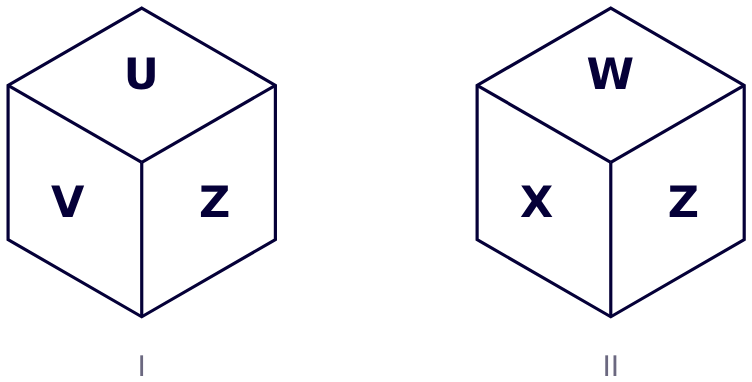
 Two faces seen together in one view share an edge, so they cannot be opposite each other.
In view I, Z shares an edge with U and V; in view II, Z shares an edge with W and X.
So Z is next to all four of U, V, W and X, and none of them can lie opposite Z.
Y is the only letter left, so Y lies opposite Z, and the face opposite Y carries Z, i.e. option (a).
Two faces seen together in one view share an edge, so they cannot be opposite each other.
In view I, Z shares an edge with U and V; in view II, Z shares an edge with W and X.
So Z is next to all four of U, V, W and X, and none of them can lie opposite Z.
Y is the only letter left, so Y lies opposite Z, and the face opposite Y carries Z, i.e. option (a).