
21
Padma Bhushan awardee Lalgudi Gopala Jayaraman was associated with which of the following musical genres?
- A.Carnatic music
- B.Ghazal
- C.Dance music
- D.Folk music
Solution
Carnatic music
Lalgudi Gopala Jayaraman (1930-2013) was a violinist, vocalist and composer of Carnatic music, the classical tradition of South India, and the creator of the singing 'Lalgudi bani' style of violin playing.
Along with M.S. Gopalakrishnan and T.N. Krishnan he is counted in the 'violin trinity' of Carnatic music; he received the Padma Shri in 1972 and the Padma Bhushan in 2001.
Ghazal belongs to the Hindustani-Urdu light classical tradition of the north, and folk music is regional and orally transmitted, so neither describes a Carnatic violinist of the Tamil Nadu concert stage.
Hence the correct option is (a).
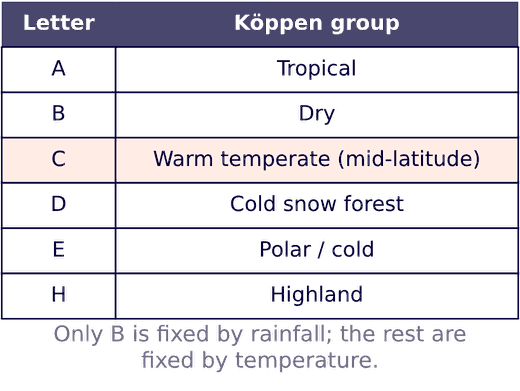 The warm temperate or mid-latitude group is C: the coldest month averages above C but below C, which is the mild-winter belt that includes India's western coastal and monsoon margins.
D is the cold snow-forest group (coldest month C or below) and H is the highland climate added later for mountains, while W is not a group letter at all - it is a lower-case subdivision (BW) meaning desert.
Hence the correct option is (b).
The warm temperate or mid-latitude group is C: the coldest month averages above C but below C, which is the mild-winter belt that includes India's western coastal and monsoon margins.
D is the cold snow-forest group (coldest month C or below) and H is the highland climate added later for mountains, while W is not a group letter at all - it is a lower-case subdivision (BW) meaning desert.
Hence the correct option is (b).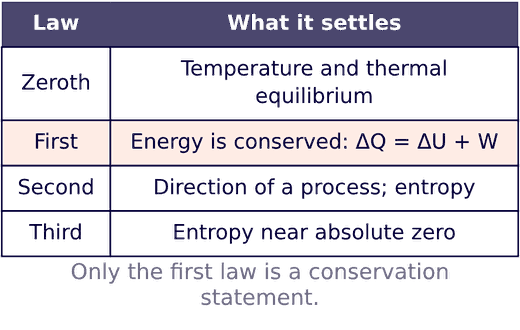 The other laws answer different questions: the zeroth law defines temperature through thermal equilibrium, the second fixes the direction of a change (heat flows hot to cold, entropy of an isolated system never falls) and the third says entropy tends to a constant as temperature approaches absolute zero.
Hence the correct option is (b).
The other laws answer different questions: the zeroth law defines temperature through thermal equilibrium, the second fixes the direction of a change (heat flows hot to cold, entropy of an isolated system never falls) and the third says entropy tends to a constant as temperature approaches absolute zero.
Hence the correct option is (b).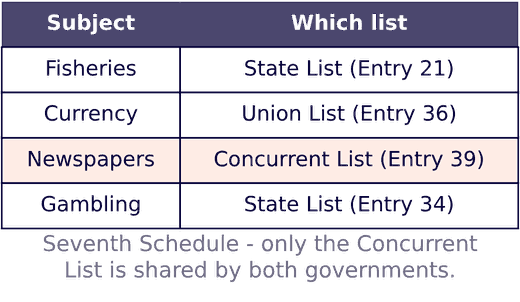 Currency and coinage are Union subjects, while fisheries and gambling are State subjects - each of those belongs to one government alone.
If a central and a state law on a Concurrent subject clash, Article 254 makes the central law prevail.
Hence the correct option is (c).
Currency and coinage are Union subjects, while fisheries and gambling are State subjects - each of those belongs to one government alone.
If a central and a state law on a Concurrent subject clash, Article 254 makes the central law prevail.
Hence the correct option is (c).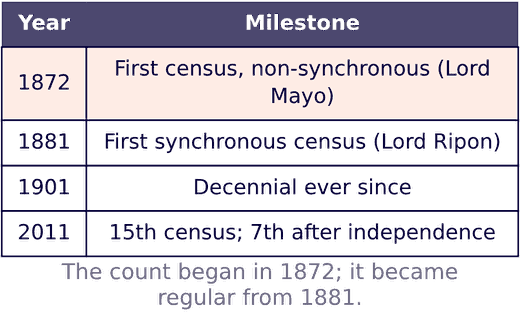 So 1881 and 1901 mark later stages, not the start; 1947 and 1951 are after independence, and Census 2011 was the 15th in the series and the 7th after independence.
Hence the correct option is (b).
So 1881 and 1901 mark later stages, not the start; 1947 and 1951 are after independence, and Census 2011 was the 15th in the series and the 7th after independence.
Hence the correct option is (b).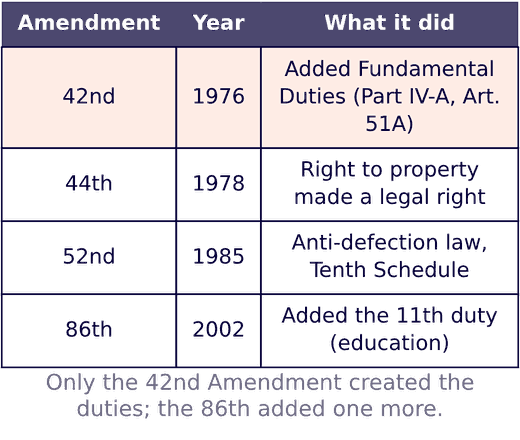 The 44th Amendment (1978) removed the right to property from Fundamental Rights, the 52nd (1985) brought in the anti-defection law of the Tenth Schedule and the 46th (1982) dealt with sales tax - none of them touched the duties.
The 42nd Amendment is called the 'Mini-Constitution' because it changed so much of the Constitution at one stroke.
Hence the correct option is (a).
The 44th Amendment (1978) removed the right to property from Fundamental Rights, the 52nd (1985) brought in the anti-defection law of the Tenth Schedule and the 46th (1982) dealt with sales tax - none of them touched the duties.
The 42nd Amendment is called the 'Mini-Constitution' because it changed so much of the Constitution at one stroke.
Hence the correct option is (a).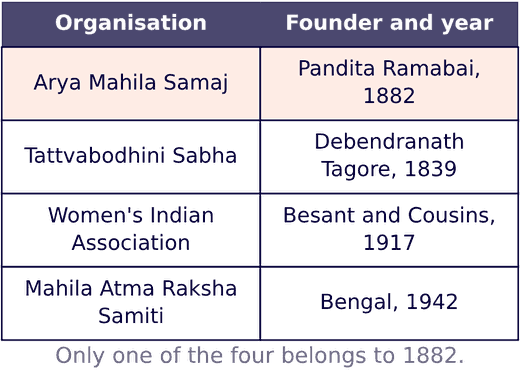 The dates alone rule the others out: the Tattvabodhini Sabha is of 1839 (Debendranath Tagore), the Women's Indian Association of 1917 (Annie Besant and Margaret Cousins) and the Mahila Atma Raksha Samiti of 1942 in Bengal.
Hence the correct option is (c).
The dates alone rule the others out: the Tattvabodhini Sabha is of 1839 (Debendranath Tagore), the Women's Indian Association of 1917 (Annie Besant and Margaret Cousins) and the Mahila Atma Raksha Samiti of 1942 in Bengal.
Hence the correct option is (c).