
1
Based on the English alphabetical order, three of the following four letter-clusters are alike in a certain way and thus form a group. Which letter-cluster DOES NOT belong to that group? (Note: The odd one out is not based on the number of consonants/vowels or their position in the letter-cluster.)
- A.LIM
- B.BYC
- C.QNR
- D.IGJ
Solution
Odd letter-cluster
Write each letter's place in the alphabet and look at the two jumps inside the cluster.
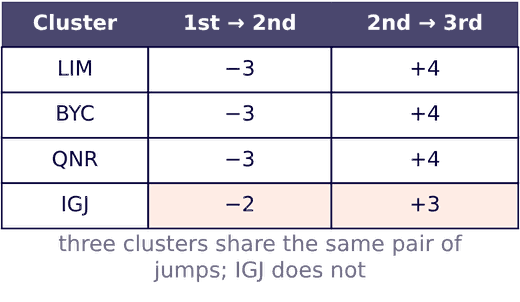 LIM gives and ; BYC and QNR repeat the same pair (from B, three steps back runs A, Z, Y).
IGJ gives and , so both of its jumps are one short.
Hence IGJ does not belong to the group - option (d).
LIM gives and ; BYC and QNR repeat the same pair (from B, three steps back runs A, Z, Y).
IGJ gives and , so both of its jumps are one short.
Hence IGJ does not belong to the group - option (d).
LIM gives and ; BYC and QNR repeat the same pair (from B, three steps back runs A, Z, Y).
IGJ gives and , so both of its jumps are one short.
Hence IGJ does not belong to the group - option (d).
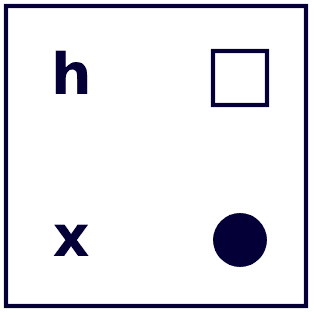
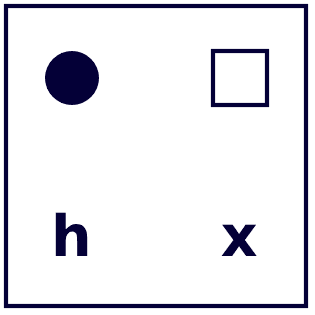
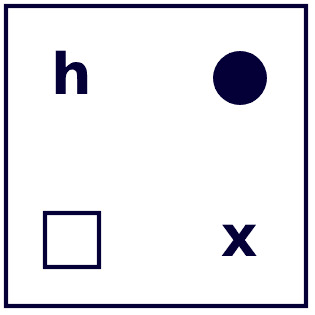
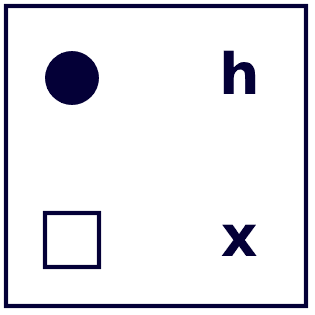
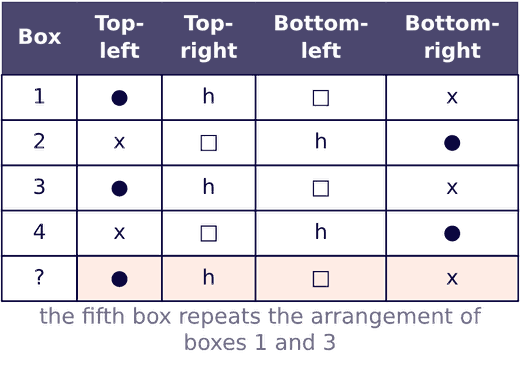 Boxes 1 and 3 carry the filled dot at the top-left, h at the top-right, the hollow square at the bottom-left and x at the bottom-right.
Boxes 2 and 4 are the other arrangement, x and the hollow square on top with h and the filled dot below.
The fifth box continues the alternation, so it must repeat boxes 1 and 3 exactly.
Option (b) also starts with the filled dot, but it puts the hollow square beside it; only option (d) has the filled dot AND h on the top row with the hollow square and x below - option (d).
Boxes 1 and 3 carry the filled dot at the top-left, h at the top-right, the hollow square at the bottom-left and x at the bottom-right.
Boxes 2 and 4 are the other arrangement, x and the hollow square on top with h and the filled dot below.
The fifth box continues the alternation, so it must repeat boxes 1 and 3 exactly.
Option (b) also starts with the filled dot, but it puts the hollow square beside it; only option (d) has the filled dot AND h on the top row with the hollow square and x below - option (d).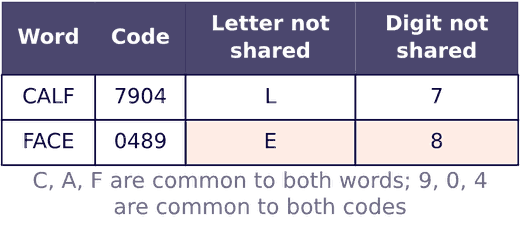 CALF and FACE share the letters C, A and F, and their codes 7904 and 0489 share the digits 9, 0 and 4.
So C, A and F use up 9, 0 and 4 in some order, which leaves each word's unshared letter tied to its unshared digit.
L is the extra letter of CALF and 7 the extra digit, so L = 7; E is the extra letter of FACE and 8 the extra digit, so E = 8.
Hence the code for E is 8 - option (d).
CALF and FACE share the letters C, A and F, and their codes 7904 and 0489 share the digits 9, 0 and 4.
So C, A and F use up 9, 0 and 4 in some order, which leaves each word's unshared letter tied to its unshared digit.
L is the extra letter of CALF and 7 the extra digit, so L = 7; E is the extra letter of FACE and 8 the extra digit, so E = 8.
Hence the code for E is 8 - option (d).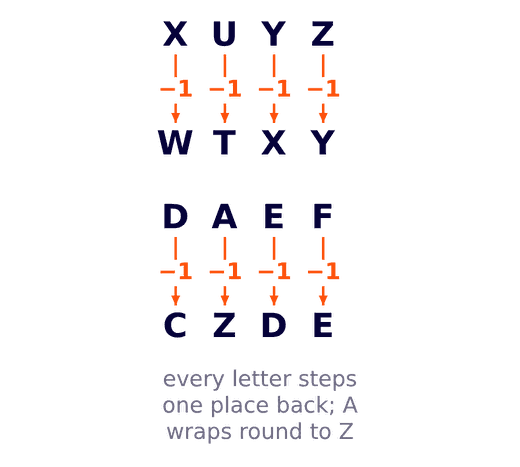 , , , : every letter of XUYZ moves one step BACK, and EBFG DAEF does exactly the same.
Apply -1 to DAEF: , (A wraps round to the end of the alphabet), , .
That gives CZDE - option (d).
, , , : every letter of XUYZ moves one step BACK, and EBFG DAEF does exactly the same.
Apply -1 to DAEF: , (A wraps round to the end of the alphabet), , .
That gives CZDE - option (d).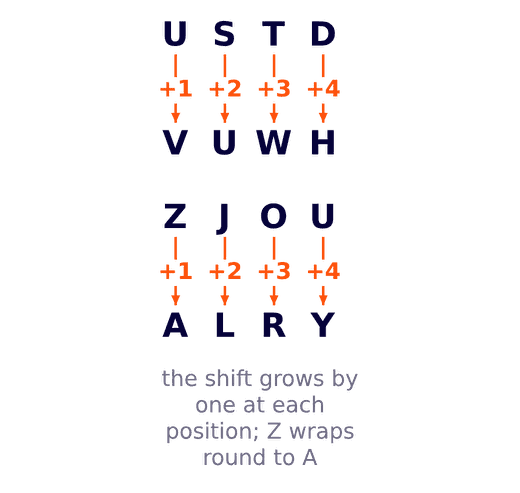 USTD VUWH uses +1, +2, +3, +4, and PAVG QCYK uses the very same four shifts.
Apply them to ZJOU: Z+1 = A (Z wraps round to the start), J+2 = L, O+3 = R, U+4 = Y.
So ZJOU is related to ALRY - option (d).
USTD VUWH uses +1, +2, +3, +4, and PAVG QCYK uses the very same four shifts.
Apply them to ZJOU: Z+1 = A (Z wraps round to the start), J+2 = L, O+3 = R, U+4 = Y.
So ZJOU is related to ALRY - option (d).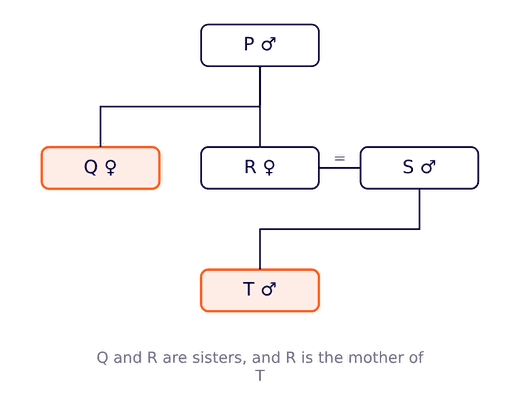 R is the wife of S, and T is the son of S, so T is the son of R as well.
R is therefore T's mother, and Q is R's sister.
So Q is T's mother's sister - option (b).
R is the wife of S, and T is the son of S, so T is the son of R as well.
R is therefore T's mother, and Q is R's sister.
So Q is T's mother's sister - option (b).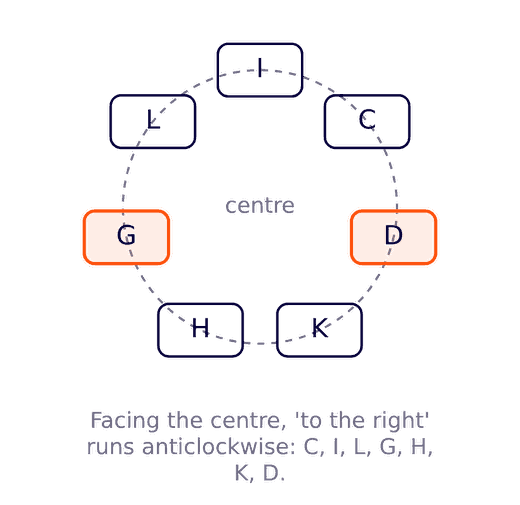 Now count to D's right: C is first, I second, L third and G fourth.
So G sits fourth to the right of D - option (a).
Now count to D's right: C is first, I second, L third and G fourth.
So G sits fourth to the right of D - option (a).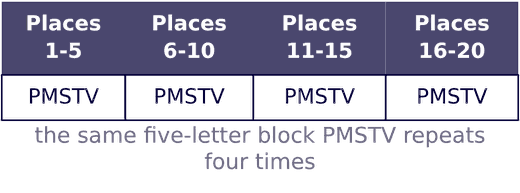 The printed letters fit the block PMSTV perfectly: PMS at places 1-3, P at 6, TV at 9-10, M at 12, TV at 14-15, PM at 16-17 and V at 20.
The blanks are therefore places 4, 5, 7, 8, 11, 13, 18 and 19, which the block fills with T, V, M, S, P, S, S, T.
That combination is TVMSPSST - option (b).
The printed letters fit the block PMSTV perfectly: PMS at places 1-3, P at 6, TV at 9-10, M at 12, TV at 14-15, PM at 16-17 and V at 20.
The blanks are therefore places 4, 5, 7, 8, 11, 13, 18 and 19, which the block fills with T, V, M, S, P, S, S, T.
That combination is TVMSPSST - option (b).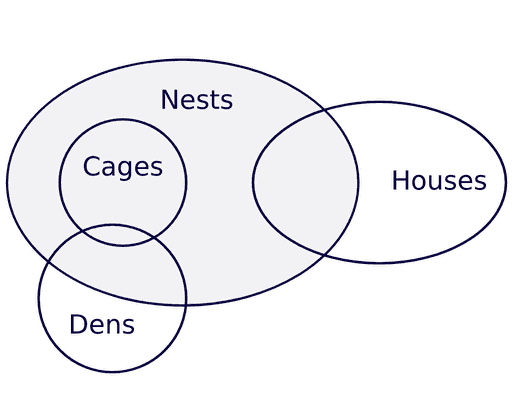 'All cages are nests' puts Cages wholly inside Nests; 'Some nests are houses' only needs Nests and Houses to overlap somewhere; 'No house is a den' keeps Dens clear of Houses.
Nothing forces Dens away from Cages, so the picture may let dens sit inside the Cages circle - 'No cage is a den' need not be true, and (I) does not follow.
The Nests-Houses overlap need not reach the Cages circle at all, so 'Some houses are cages' need not be true either, and (II) does not follow.
Hence neither conclusion follows - option (d).
'All cages are nests' puts Cages wholly inside Nests; 'Some nests are houses' only needs Nests and Houses to overlap somewhere; 'No house is a den' keeps Dens clear of Houses.
Nothing forces Dens away from Cages, so the picture may let dens sit inside the Cages circle - 'No cage is a den' need not be true, and (I) does not follow.
The Nests-Houses overlap need not reach the Cages circle at all, so 'Some houses are cages' need not be true either, and (II) does not follow.
Hence neither conclusion follows - option (d).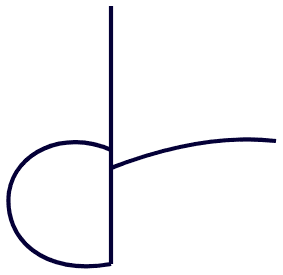 (X)
(X)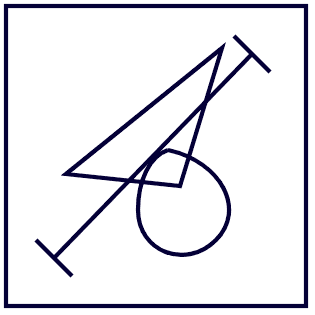
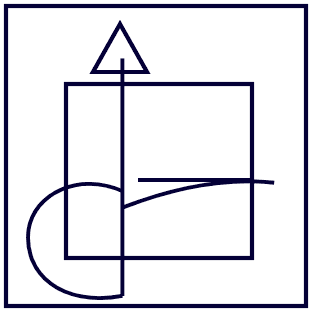
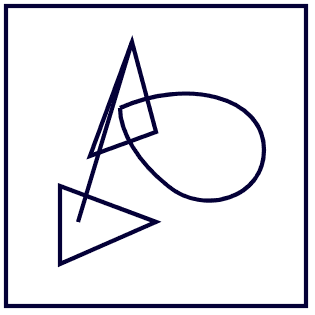
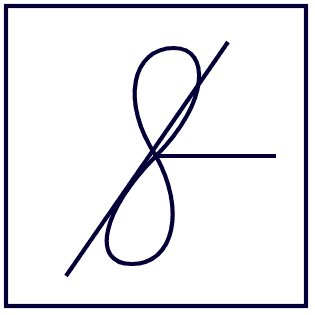
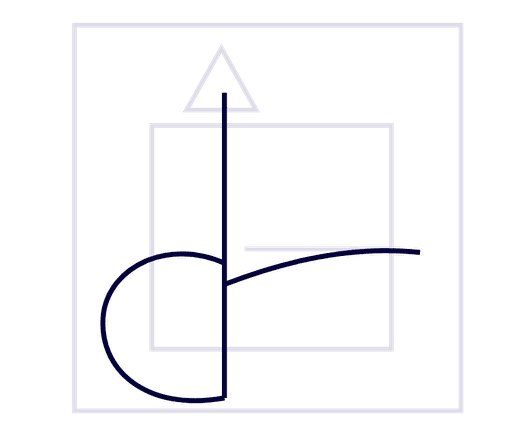 Option (b) carries all three exactly so - the stroke is vertical, the single loop hangs on its lower-left and one curve runs off to the right; the square and the small triangle are merely drawn on top of it.
Option (a) has the very same shape turned through about , and the question forbids rotation.
In option (c) the loop hangs on the RIGHT of a slanted stroke, and option (d) has TWO loops instead of one.
So (X) is embedded only in option (b).
Option (b) carries all three exactly so - the stroke is vertical, the single loop hangs on its lower-left and one curve runs off to the right; the square and the small triangle are merely drawn on top of it.
Option (a) has the very same shape turned through about , and the question forbids rotation.
In option (c) the loop hangs on the RIGHT of a slanted stroke, and option (d) has TWO loops instead of one.
So (X) is embedded only in option (b). First letters E, F, G, H rise by +1, so the next is I; second letters B, C, D, E rise by +1, so the next is F; third letters F, G, H, I rise by +1, so the next is J.
Putting the three together gives IFJ; option (b) has the same letters but in the order I, J, F, which does not match position by position.
So the missing term is IFJ - option (d).
First letters E, F, G, H rise by +1, so the next is I; second letters B, C, D, E rise by +1, so the next is F; third letters F, G, H, I rise by +1, so the next is J.
Putting the three together gives IFJ; option (b) has the same letters but in the order I, J, F, which does not match position by position.
So the missing term is IFJ - option (d).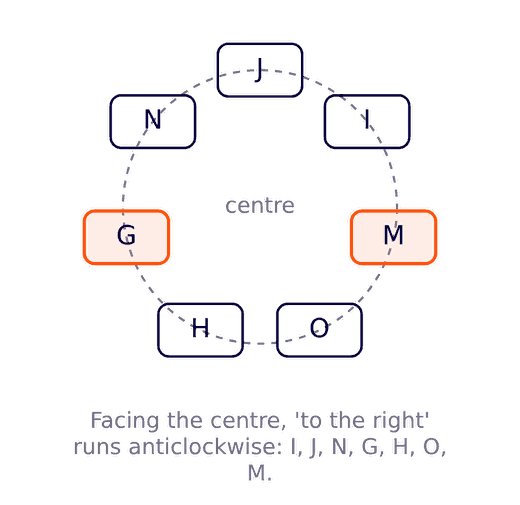 Count to M's right: I is first, J second, N third and G fourth.
So G sits fourth to the right of M - option (c).
Count to M's right: I is first, J second, N third and G fourth.
So G sits fourth to the right of M - option (c).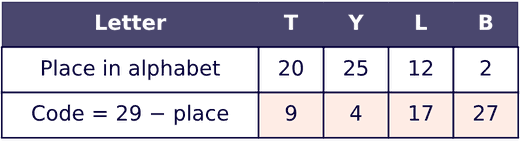 FWOD: F(6)+23 = 29, W(23)+6 = 29, O(15)+14 = 29, D(4)+25 = 29; SINH does the same, 19+10 = 29, 9+20 = 29, 14+15 = 29, 8+21 = 29.
So the code of a letter is 29 - (its place in the alphabet).
For TYLB: 29-20 = 9, 29-25 = 4, 29-12 = 17, 29-2 = 27.
That is 9-4-17-27 - option (c).
FWOD: F(6)+23 = 29, W(23)+6 = 29, O(15)+14 = 29, D(4)+25 = 29; SINH does the same, 19+10 = 29, 9+20 = 29, 14+15 = 29, 8+21 = 29.
So the code of a letter is 29 - (its place in the alphabet).
For TYLB: 29-20 = 9, 29-25 = 4, 29-12 = 17, 29-2 = 27.
That is 9-4-17-27 - option (c).
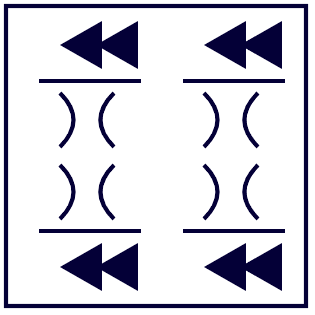
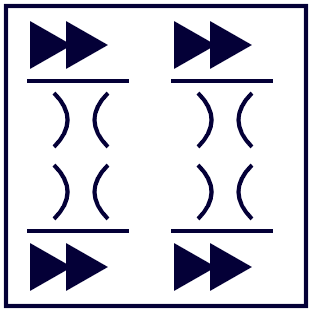
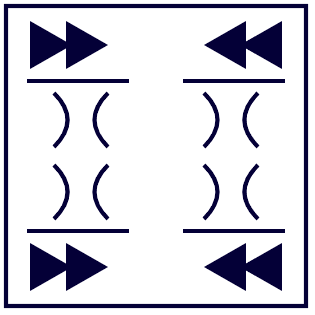
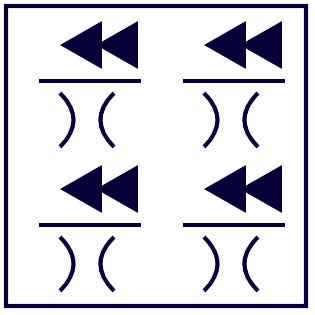
 Options (a) and (b) point all four arrow-heads the same way instead of mirroring the left column, and option (d) also leaves the lower half the right way up.
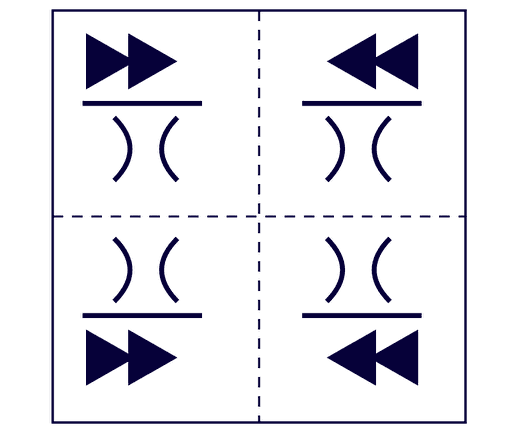
Only option (c) points the two left-hand arrow-heads right and the two right-hand ones left, with the lower half turned upside down - option (c).
Options (a) and (b) point all four arrow-heads the same way instead of mirroring the left column, and option (d) also leaves the lower half the right way up.
Only option (c) points the two left-hand arrow-heads right and the two right-hand ones left, with the lower half turned upside down - option (c).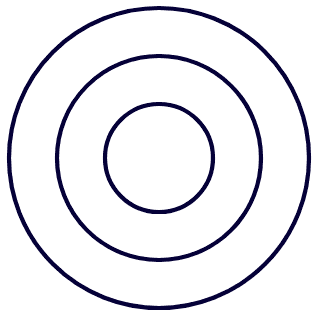
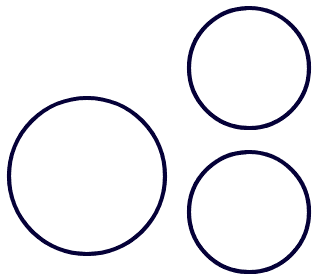
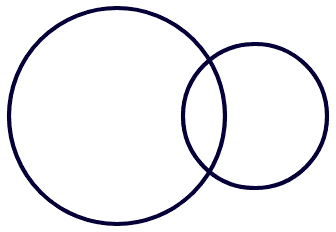
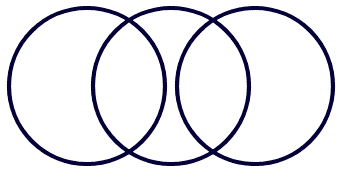
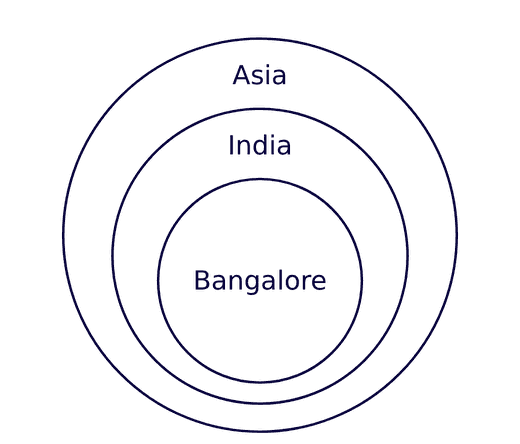 Three circles drawn one inside the other is exactly option (a).
Option (c) offers only two circles for three classes, while (b) and (d) leave part of India outside Asia, which is false.
Hence option (a) is correct.
Three circles drawn one inside the other is exactly option (a).
Option (c) offers only two circles for three classes, while (b) and (d) leave part of India outside Asia, which is false.
Hence option (a) is correct.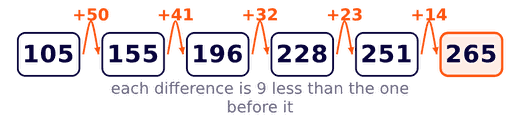 155-105 = 50, 196-155 = 41, 228-196 = 32, 251-228 = 23.
The differences themselves fall by 9 each time, so the next difference is 23-9 = 14.
251+14 = 265.
So the missing term is 265 - option (b).
155-105 = 50, 196-155 = 41, 228-196 = 32, 251-228 = 23.
The differences themselves fall by 9 each time, so the next difference is 23-9 = 14.
251+14 = 265.
So the missing term is 265 - option (b).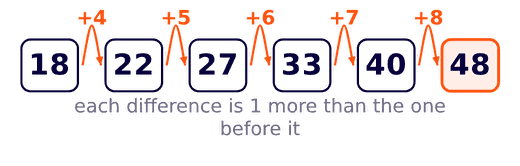 22-18 = 4, 27-22 = 5, 33-27 = 6, 40-33 = 7.
The differences rise by 1 each time, so the next one is 8.
40+8 = 48.
So the missing term is 48 - option (b).
22-18 = 4, 27-22 = 5, 33-27 = 6, 40-33 = 7.
The differences rise by 1 each time, so the next one is 8.
40+8 = 48.
So the missing term is 48 - option (b).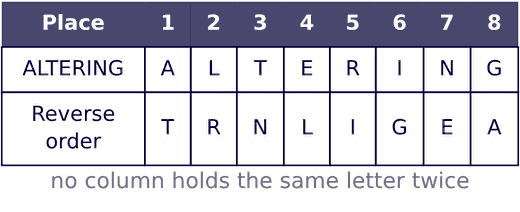 Now compare the two rows place by place: A/T, L/R, T/N, E/L, R/I, I/G, N/E, G/A.
Not a single position holds the same letter in both rows.
So the number of letters whose position stays unchanged is zero - option (b).
Now compare the two rows place by place: A/T, L/R, T/N, E/L, R/I, I/G, N/E, G/A.
Not a single position holds the same letter in both rows.
So the number of letters whose position stays unchanged is zero - option (b).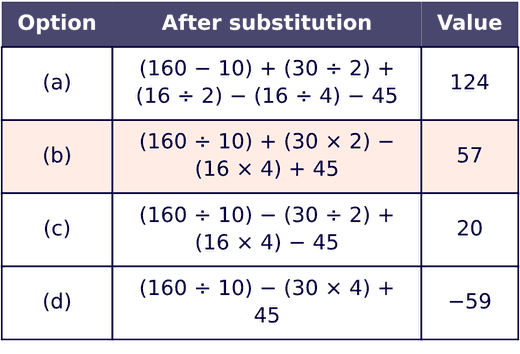 The other three simplify to 124, 20 and -59, none of which is 57.
So the required expression is option (b).
The other three simplify to 124, 20 and -59, none of which is 57.
So the required expression is option (b).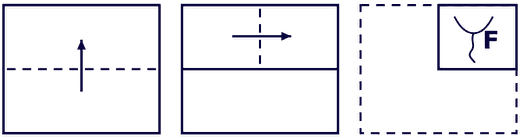
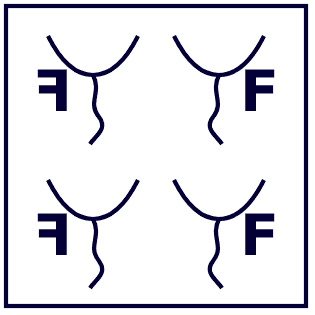
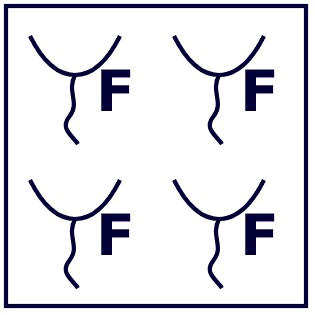
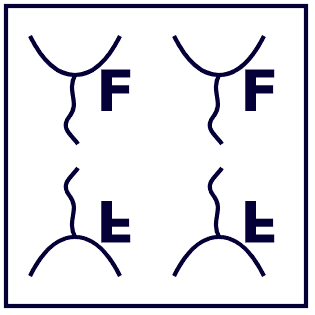
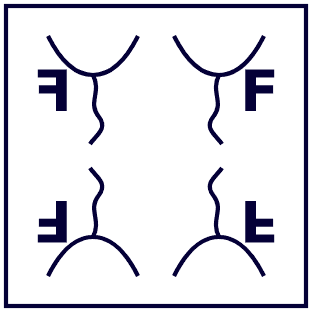
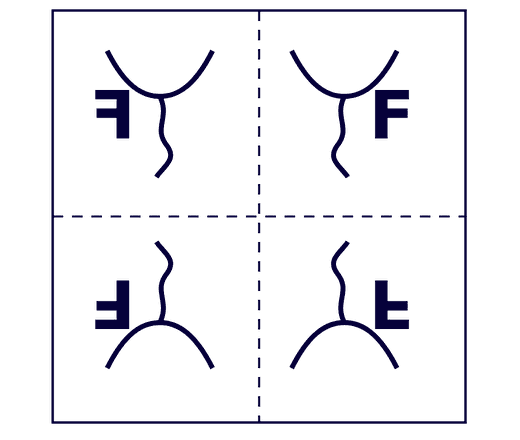 Option (b) simply repeats one mark four times, option (a) leaves the lower half the right way up, and option (c) keeps the F facing the same way in both columns.
Only option (d) carries BOTH changes - a mirrored pair across the top and the same pair turned upside down below - option (d).
Option (b) simply repeats one mark four times, option (a) leaves the lower half the right way up, and option (c) keeps the F facing the same way in both columns.
Only option (d) carries BOTH changes - a mirrored pair across the top and the same pair turned upside down below - option (d).