SSC GD Constable 20 February 2025 · Shift 2 · General Intelligence & Reasoning — questions with answers · ShikshaSphere
Chapter 171 of 210
20 February 2025 · Shift 2
General Intelligence & Reasoning
20 questions ~20 min readFree
20 questions
A
1
Six people A, B, C, R, S and T are sitting around a circular table facing the centre (but not necessarily in the same order) . Only three people sit between A and when counted from the right of . Only two people sit between A and B. R sits to the immediate right of C. How many people sit between T and A when counted from the left of A?
A.Four
B.Three
C.One
D.Two
Solution
Circular seating
For people facing the centre, a person's left is the clockwise side of the table and the right is the anticlockwise side.
Three people sit between S and A when counted from the right of S, so A is the fourth seat anticlockwise from S.
Only two people sit between A and B, and in a circle of six that is possible only when B sits exactly opposite A.
Three seats are left for C, R and T; R must be the seat immediately anticlockwise of C (that is C's immediate right), which fixes C, R and T.
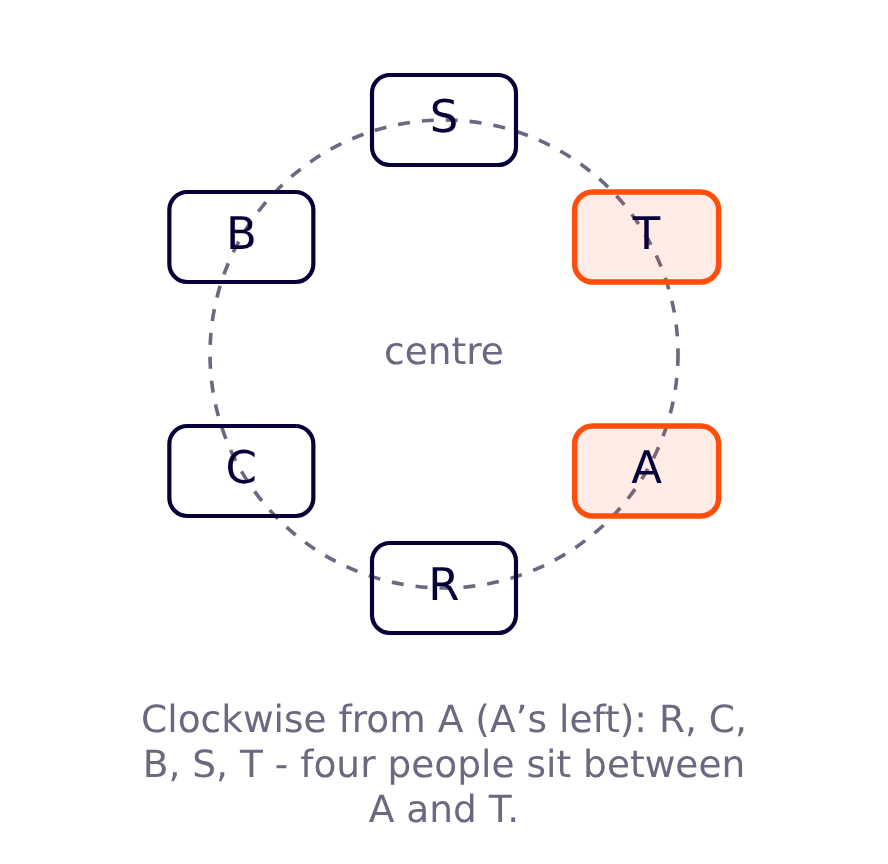
Counting from the left of A, that is clockwise, the order is R, C, B, S, T.
So four people sit between A and T, and the correct option is (a).
2
What should come in place of the question mark (?) in the given series?
450, 451, 454, 459, 466, ?
A.477
B.475
C.476
D.473
Solution
Number series
Take the difference between consecutive terms: 451-450=1, 454-451=3, 459-454=5, 466-459=7.
The differences are the successive odd numbers 1, 3, 5, 7, so the next difference is 9.
Missing term =466+9=475.
Hence the correct option is (b).
3
In a certain code language, 'XHOS' is coded as '84' and 'CRFY' is coded as '112'. What is the code for 'ZIOE' in the given language?
A.110
B.106
C.98
D.92
Solution
Letter-to-number coding
Replace every letter by its position counted from the END of the alphabet (A=26, B=25, …, Z=1).
and , which is the given code.
and , so the rule is: twice the sum of the reverse positions.
, so the code is .
Hence the correct option is (b).
4
In a certain code language, 'PAIR' is coded as '7643' and 'REAP' is coded as '7536'. How is 'E' coded in the given language?
A.4
B.6
C.7
D.5
Solution
Letter-digit coding
'PAIR' and 'REAP' are built from the same letters except that PAIR has I where REAP has E; P, A and R are common to both.
The digits common to 7643 and 7536 are 7, 6 and 3, so those three stand for P, A and R in some order.
The digit of 'PAIR' that is left over is 4, so I=4; the digit of 'REAP' that is left over is 5, so E=5.
Hence the correct option is (d).
5
Read the given statements and conclusions carefully. Assuming that the information given in the statements is true, even if it appears to be at variance with commonly known facts, decide which of the given conclusions logically follow(s) from the statements.Statements:
All pianists are musicians.
All musicians are singers.
No singer is a composer.
Conclusions:
(I): No pianist is a composer.
(II): Some singers are pianists.
A.Neither conclusion (I) nor (II) follows.
B.Both conclusions (I) and (II) follow.
C.Only conclusion (II) follows.
D.Only conclusion (I) follows.
Solution
Syllogism
All pianists are musicians and all musicians are singers, so the pianists lie completely inside the singers.
No singer is a composer, so the whole singer circle stands apart from the composer circle.
Conclusion (I): the pianists are inside the singers and no singer is a composer, so no pianist can be a composer - it follows.
Conclusion (II): every pianist is a singer, so those pianists are singers who are pianists, which makes 'Some singers are pianists' true - it follows as well.
Both conclusions follow, so the correct option is (b).
6
The sequence of folding a piece of paper and the manner in which the folded paper is cut is shown in the following figures. How would this paper look when unfolded?
A.
B.
C.
D.
Solution
Paper folding and cutting
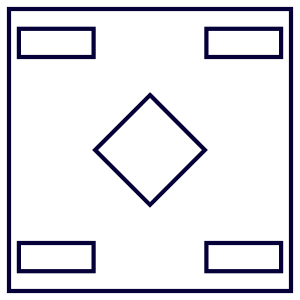
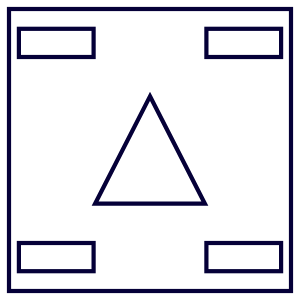
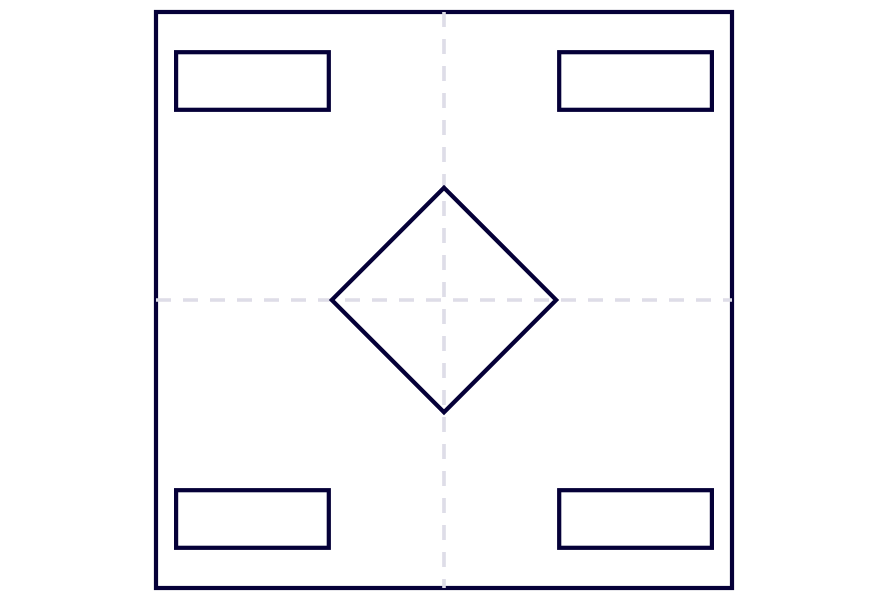
The first fold takes the bottom half up and the second fold takes the right half onto the left, so the piece that is cut is the top-left quarter and the sheet opens about the horizontal and the vertical centre lines.
Every cut therefore appears four times, once in each quarter, mirrored across both centre lines.
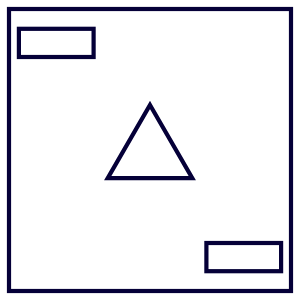
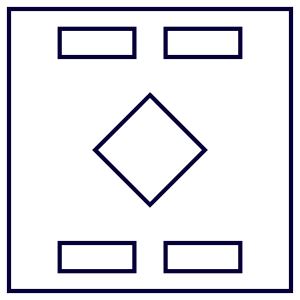
The small rectangle lies close to the OUTER left edge of the quarter, far from both creases, so its four copies land near the four outer corners of the sheet - not in a group beside the centre line.
The slanting cut removes the corner of the quarter that is the centre of the whole sheet; a corner sitting on BOTH creases opens out into one complete four-sided diamond, not a triangle.
Only the figure with four rectangles at the four outer corners and one full diamond at the centre matches, so the correct option is (c).
7
Based on the English alphabetical order, three of the following four letter-clusters are alike in a certain way and thus form a group. Which is the one that DOES NOT belong to that group? (Note: The odd one out is not based on the number of consonants/vowels or their position in the letter-cluster.)
A.UVQ
B.IMH
C.WXS
D.IJE
Solution
Odd one out (letter-clusters)
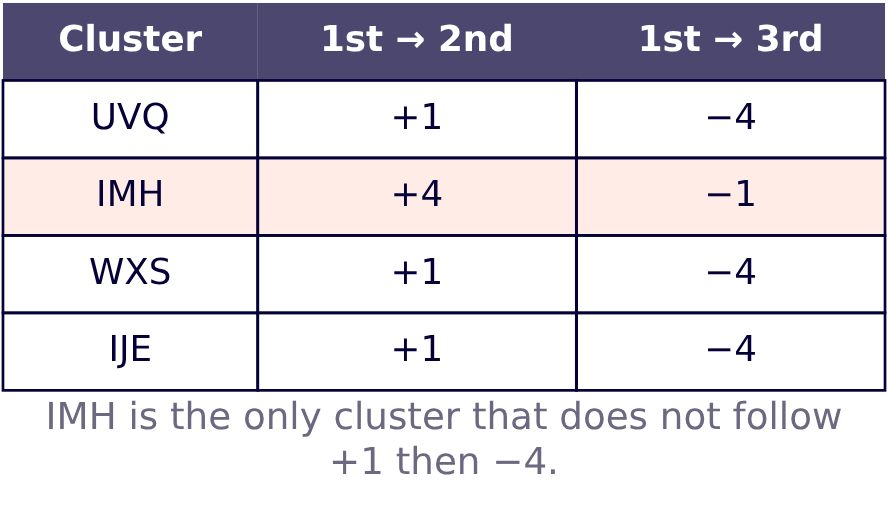
Compare the second and the third letter of each cluster with its first letter.
UVQ: U+1=V and U-4=Q; WXS: W+1=X and W-4=S; IJE: I+1=J and I-4=E.
IMH does not obey it: I+4=M and I-1=H, so the two shifts are interchanged.
Hence the odd one out is IMH and the correct option is (b).
8
Select the option that represents the letters that, when sequentially placed from left to right in the blanks below, will complete the letter series.
__TB_NA_BM_A
A.NAMTN
B.TAMNA
C.MTANN
D.NTMAN
Solution
Letter series (blanks)
The series has 12 places; number them 1 to 12 and write down the letters that are already given.
T and B are at places 3 and 4, N and A at 6 and 7, B and M at 9 and 10 and A at 12 - the same letters reappear five places later, so the block repeats after every five letters.
The repeating block is NATBM, so the series is NATBM / NATBM / NA.
The blanks at places 1, 2, 5, 8 and 11 therefore take N, A, M, T and N.
Hence the correct option is (a).
9
In a certain code language, ' ' means ' A is the brother of B ', ' ' means ' is the son of ', ' ' means ' A is the father of B ' and ' ' means ' is the wife of '.
How is P related to A if ' '?
A.Mother's sister's sister
B.Mother's father
C.Mother's brother's son
D.Mother's sister's brother
Solution
Coded blood relations
Break the string P<B!S:T/A into single relations and read it from left to right.
P<B means P is the son of B; B!S means B is the brother of S; S:T means S is the wife of T; T/A means T is the father of A.
T is A's father and S is T's wife, so S is A's mother.
B is S's brother, so B is A's mother's brother.
P is the son of B, so P is A's mother's brother's son.
Hence the correct option is (c).
10
Seven people, A, B, L, M, N, S and T, are sitting in a row, facing north (but not necessarily in the same order).
Only three people sit to the left of T. Only B sits to the right of A. Only three people sit between A and S. L sits at some place to the left of N but at some place to the right of M. How many people sit between M and N ?
A.Three
B.One
C.Four
D.Two
Solution
Linear seating
Number the seats 1 to 7 from the left end of the row.
Only three people sit to the left of T, so T is at seat 4; only B sits to the right of A, so A is at seat 6 and B at seat 7.
Only three people sit between A and S, so S is at seat 2.
Seats 1, 3 and 5 are left for M, L and N, and M is to the left of L which is to the left of N, so M = 1, L = 3 and N = 5.
Between M (seat 1) and N (seat 5) sit S, L and T - three people, so the correct option is (a).
11
SHMA is related to PJOX in a certain way based on the English alphabetical order. In the same way, RBUX is related to ODWU. To which of the given options is NCTV related, following the same logic?
A.JFVU
B.KEVS
C.LDWT
D.LEWS
Solution
Letter-cluster analogy
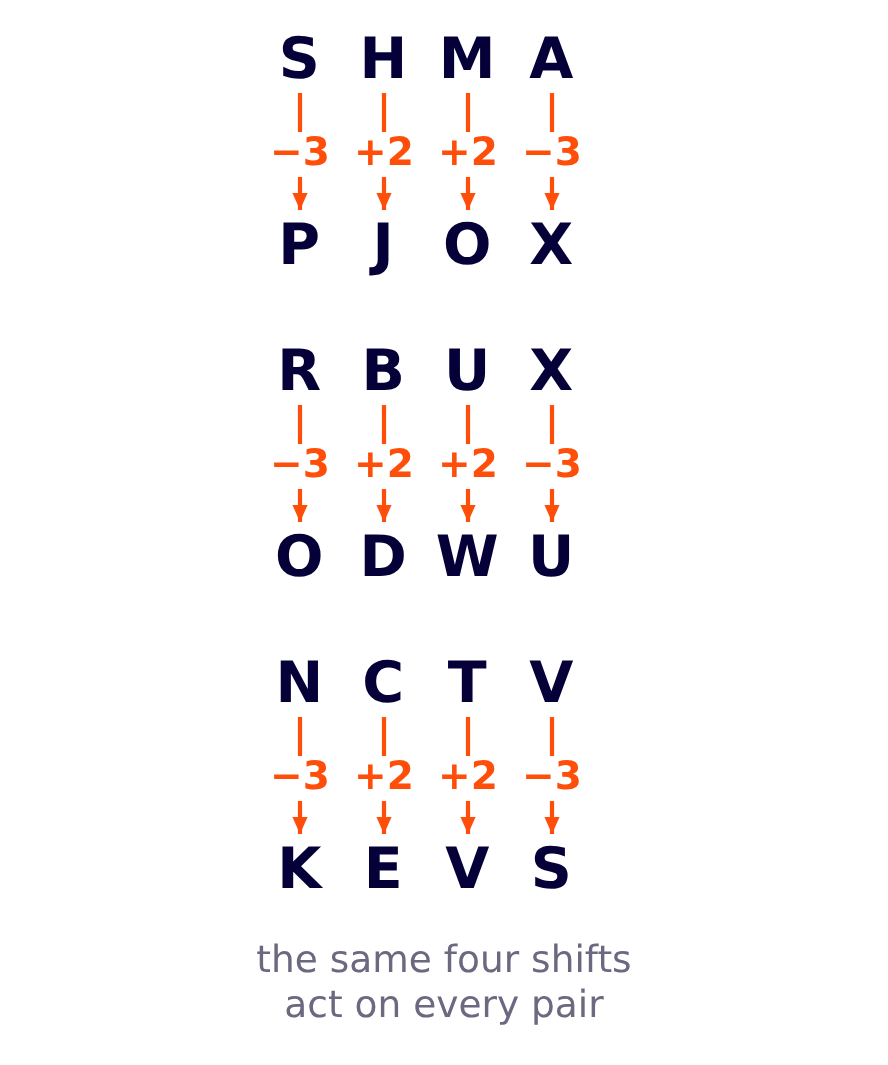
Compare the two clusters letter by letter, position by position.
The shifts are -3, +2, +2, -3, and the same four shifts turn RBUX into ODWU, which confirms the rule.
Apply them to NCTV: N-3=K, C+2=E, T+2=V, V-3=S.
So NCTV is related to KEVS and the correct option is (b).
12
What should come in place of the question mark (?) in the given series based on the English alphabetical order? ATE VOZ QJU LEP?
A.HZK
B.GZK
C.GYK
D.GZL
Solution
Letter series
Compare the terms letter by letter: , , - each first letter moves 5 places back.
The second and third letters do the same: and .
So from LEP: L-5=G, E-5=Z (from E, five steps back runs A, then wraps to Z) and P-5=K.
The missing term is GZK, so the correct option is (b).
13
The position(s) of how many letters will remain unchanged if each letter in the word CLIMBER is arranged in the English alphabetical order?
A.Two
B.None
C.Three
D.One
Solution
Alphabetical rearrangement
Write CLIMBER and, under it, its seven letters arranged alphabetically: B, C, E, I, L, M, R.
Compare the two rows place by place: C-B, L-C, I-E, M-I, B-L, E-M all differ.
Only the 7th place holds the same letter R in both rows.
So exactly one letter keeps its position and the correct option is (d).
14
'PWGZ' is related to 'RZIC' in a certain way based on the English alphabetical order. In the same way, 'UELO' is related to 'WHNR'. To which of the following is 'JDVB' related, following the same logic?
A.NFWD
B.NFXD
C.LGXE
D.MHYF
Solution
Letter-cluster analogy
Compare the pairs position by position.
The shifts are +2, +3, +2, +3; they also turn UELO into WHNR, which confirms the rule.
Apply them to JDVB: J+2=L, D+3=G, V+2=X, B+3=E.
So JDVB is related to LGXE and the correct option is (c).
15
Select the option figure in which the given figure ( X ) is embedded as its part (rotation NOT allowed).
(X)
A.
B.
C.
D.
Solution
Embedded figure
Figure (X) is a square with a right-angled triangle standing on its top-right corner: one leg goes straight up from that corner and the other goes straight to the right, and a slanting line closes them.
Both legs of the triangle are as long as the side of the square, so the option must contain a square whose top-right corner carries exactly that triangle, in exactly that orientation.
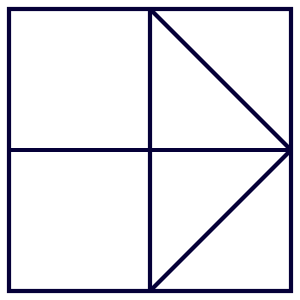
In option (c) the lower-left quarter of the big square is that square; the upper half of the vertical centre line is the upward leg, the right half of the horizontal centre line is the rightward leg, and the slant from the top of the centre line to the middle of the right edge closes the triangle.
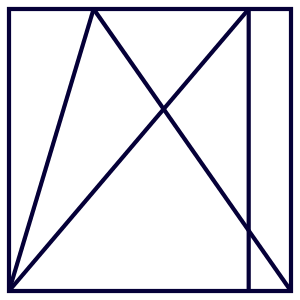
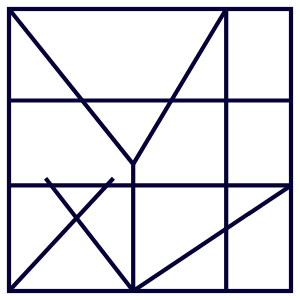
In (a) and (b) no square has a right-angled triangle of the same size sitting on its top-right corner, and in (d) the horizontal lines do not pass through the corner of any such square.
Hence the correct option is (c).
16
The sequence of folding a piece of paper and the manner in which the folded paper is cut is shown in the following figures. How would this paper look when unfolded?
A.
B.
C.
D.
Solution
Paper folding and cutting
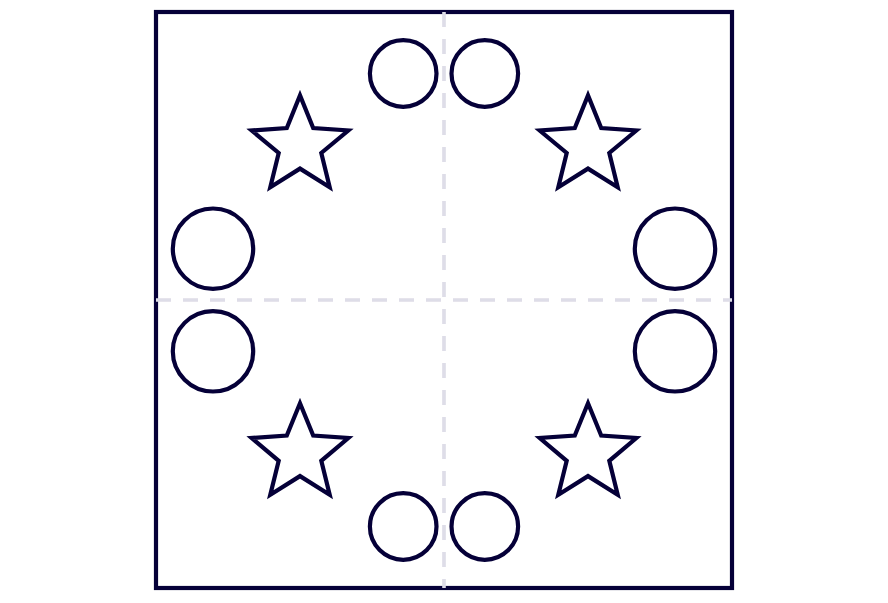
The bottom half is folded up and then the right half is folded onto the left, so the cut piece is the top-left quarter and the sheet opens about the horizontal and the vertical centre lines.
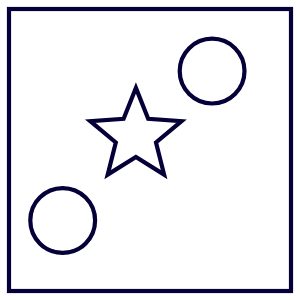
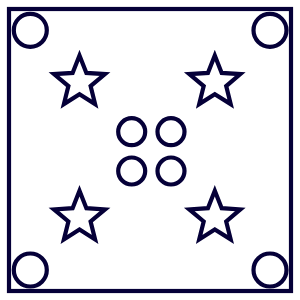
Each cut therefore appears four times, so 1 star and 2 circles become 4 stars and 8 circles - that alone rules out (b), which has one star, and (c), which has only four circles.
In the folded quarter the star sits at its centre, one circle sits near the top close to the vertical crease and the other sits near the outer left edge close to the horizontal crease.
So the circles open into a pair side by side at the top centre, a matching pair at the bottom centre and a pair one above the other at the middle of each side - none of them lands in a corner or at the centre of the sheet, which rules out (d).
Hence the correct option is (a).
17
Identify the figure given in the options which when put in place of the question mark (?) will logically complete the series.
A.
B.
C.
D.
Solution
Figure series
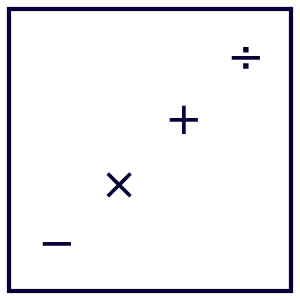
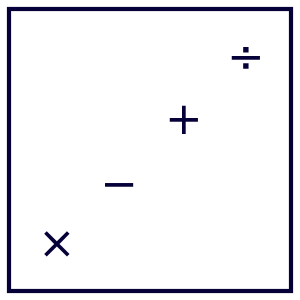
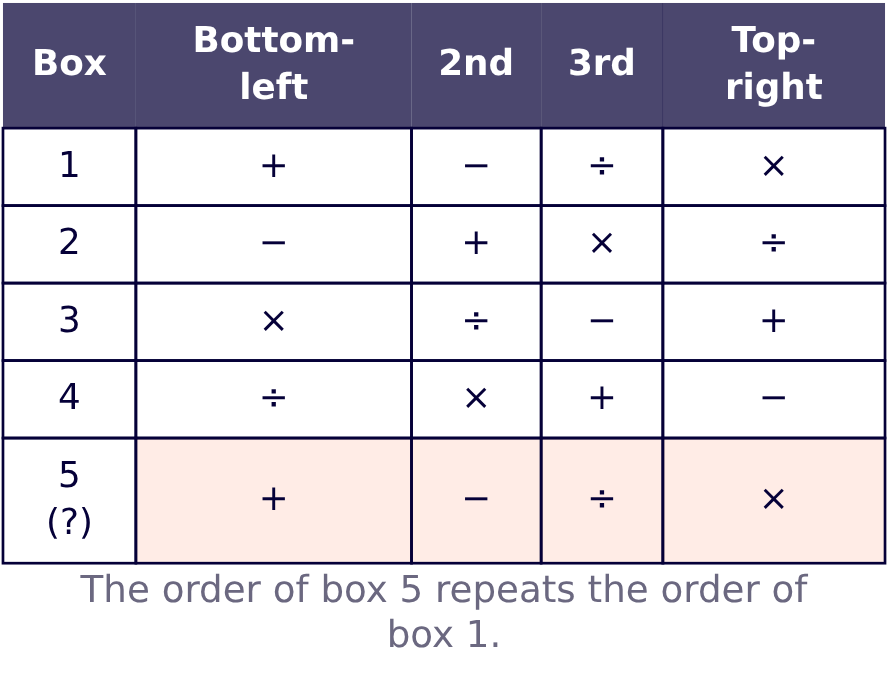
Every box carries the same four signs on the diagonal from its bottom-left corner to its top-right corner; only their order changes.
Reading each box from the bottom-left upwards: box 1 is ; box 2 is ; box 3 is ; box 4 is .
From box 1 to box 2 the signs swap inside each pair (1st with 2nd, 3rd with 4th); from box 2 to box 3 the first pair changes places with the second pair; from box 3 to box 4 they swap inside each pair again.
So box 4 to box 5 must exchange the two pairs once more: becomes .
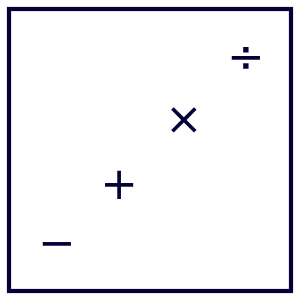
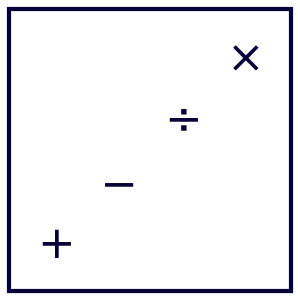
The missing box has + at the bottom-left, then -, then and at the top-right, so the correct option is (b).
18
What will come in the place of the question mark '(?)' in the following equation, if ' - ' and ' ' are interchanged and ' ' and ' + ' are interchanged? ?
A.225
B.228
C.227
D.226
Solution
Interchange of signs
Write down what each sign becomes before touching the numbers.
The given equation therefore becomes .
By BODMAS, do and from left to right: and .
Then 224+4-3=225.
Hence the correct option is (a).
19
Which of the following Venn diagrams indicates the best relation between Food, Bread and Wool ?
A.
B.
C.
D.
Solution
Venn diagram of classes
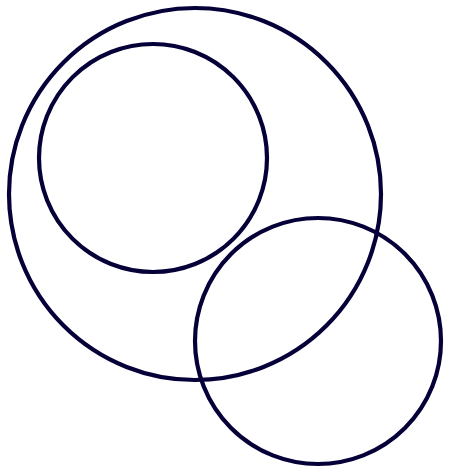
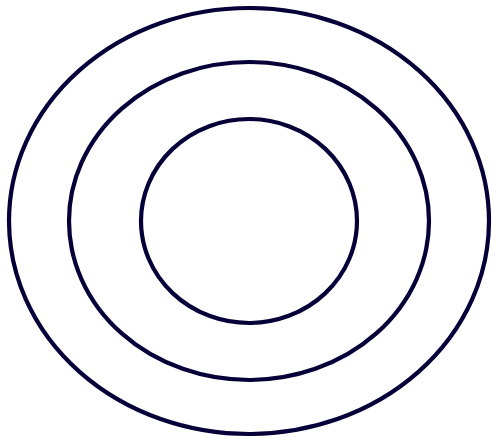
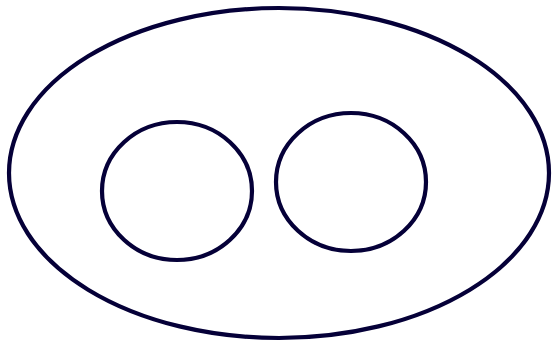
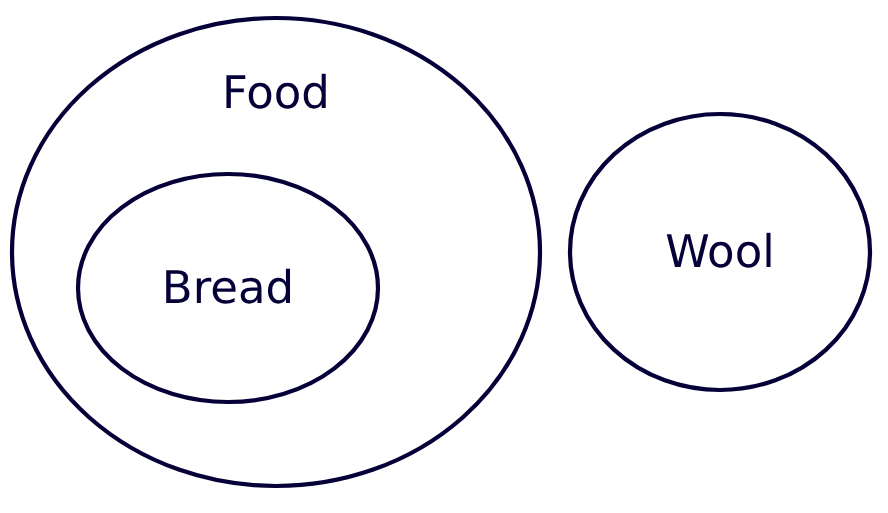
Bread is one kind of food, so every bread is a food and the whole 'Bread' region must lie inside 'Food'.
Wool is not a food and no food is wool, so 'Wool' must be drawn completely apart from 'Food'.
The diagram must therefore show one small closed figure inside a bigger one, plus a third figure that touches neither.
Option (a) is the only one of that shape - (b) makes wool partly food, (c) makes all three nested and (d) puts two separate kinds inside food - so the correct option is (a).
20
What should come in place of the question mark (?) in the given series?
36, 40, 48, 64, 96, ?
A.126
B.148
C.134
D.160
Solution
Number series
Take the difference between consecutive terms: 40-36=4, 48-40=8, 64-48=16, 96-64=32.
Each difference is double the one before it, so the next difference is .
Missing term =96+64=160.
Hence the correct option is (d).
Finished reading? Now test yourself.
The same 20 questions, but with a timer and the answers hidden — 15 minutes.

 Counting from the left of A, that is clockwise, the order is R, C, B, S, T.
So four people sit between A and T, and the correct option is (a).
Counting from the left of A, that is clockwise, the order is R, C, B, S, T.
So four people sit between A and T, and the correct option is (a).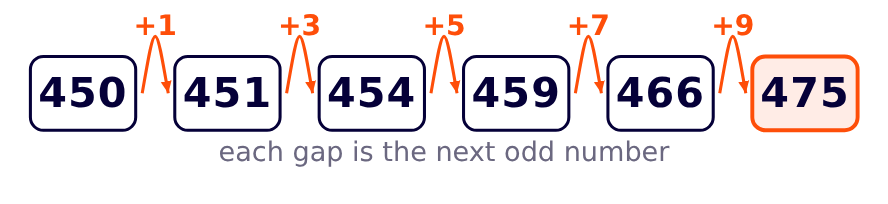 Missing term =466+9=475.
Hence the correct option is (b).
Missing term =466+9=475.
Hence the correct option is (b).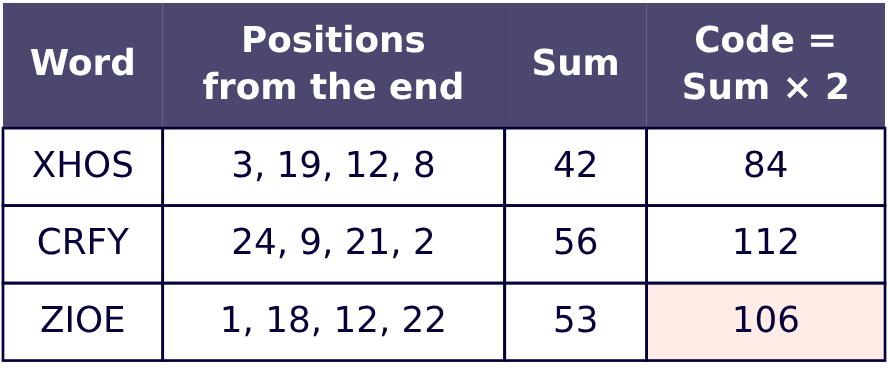 , so the code is .
Hence the correct option is (b).
, so the code is .
Hence the correct option is (b).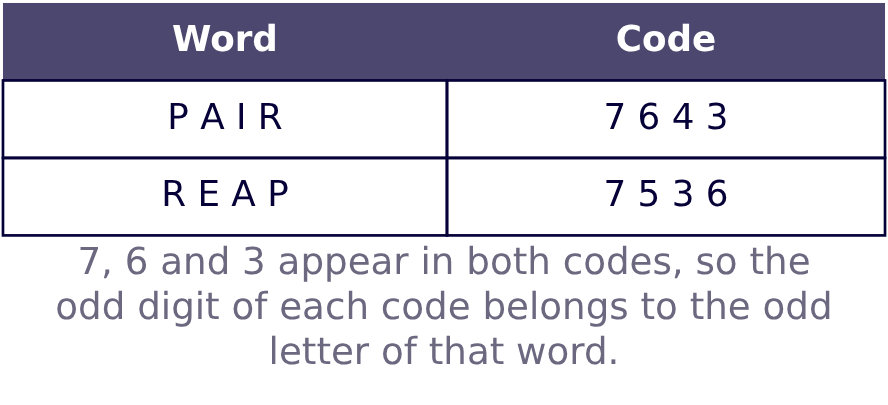 The digits common to 7643 and 7536 are 7, 6 and 3, so those three stand for P, A and R in some order.
The digit of 'PAIR' that is left over is 4, so I=4; the digit of 'REAP' that is left over is 5, so E=5.
Hence the correct option is (d).
The digits common to 7643 and 7536 are 7, 6 and 3, so those three stand for P, A and R in some order.
The digit of 'PAIR' that is left over is 4, so I=4; the digit of 'REAP' that is left over is 5, so E=5.
Hence the correct option is (d).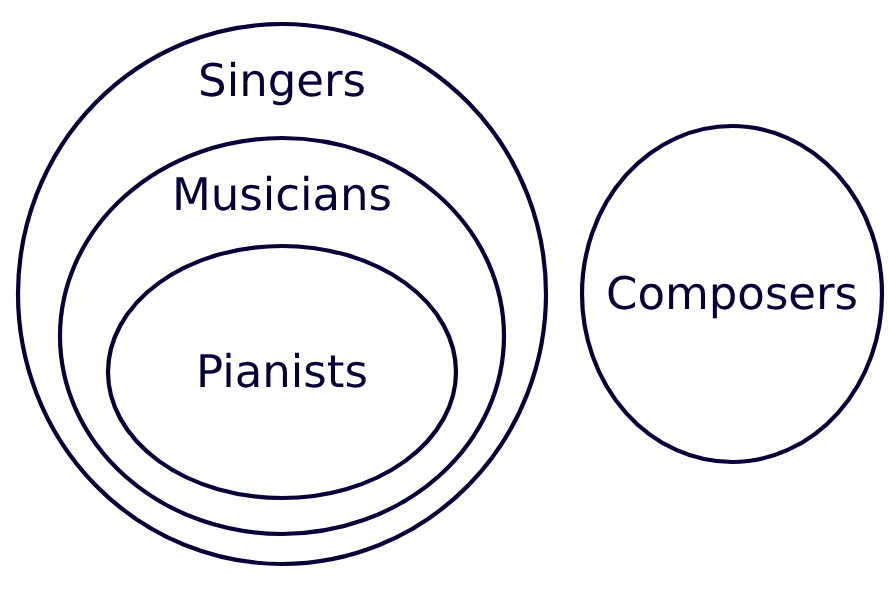 Conclusion (I): the pianists are inside the singers and no singer is a composer, so no pianist can be a composer - it follows.
Conclusion (II): every pianist is a singer, so those pianists are singers who are pianists, which makes 'Some singers are pianists' true - it follows as well.
Both conclusions follow, so the correct option is (b).
Conclusion (I): the pianists are inside the singers and no singer is a composer, so no pianist can be a composer - it follows.
Conclusion (II): every pianist is a singer, so those pianists are singers who are pianists, which makes 'Some singers are pianists' true - it follows as well.
Both conclusions follow, so the correct option is (b).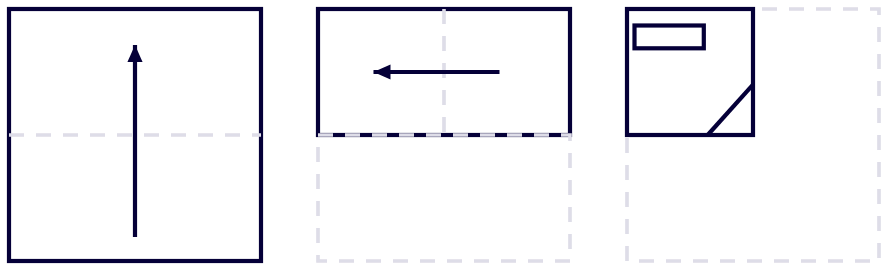
 Only the figure with four rectangles at the four outer corners and one full diamond at the centre matches, so the correct option is (c).
 UVQ: U+1=V and U-4=Q; WXS: W+1=X and W-4=S; IJE: I+1=J and I-4=E.
IMH does not obey it: I+4=M and I-1=H, so the two shifts are interchanged.
Hence the odd one out is IMH and the correct option is (b).
UVQ: U+1=V and U-4=Q; WXS: W+1=X and W-4=S; IJE: I+1=J and I-4=E.
IMH does not obey it: I+4=M and I-1=H, so the two shifts are interchanged.
Hence the odd one out is IMH and the correct option is (b).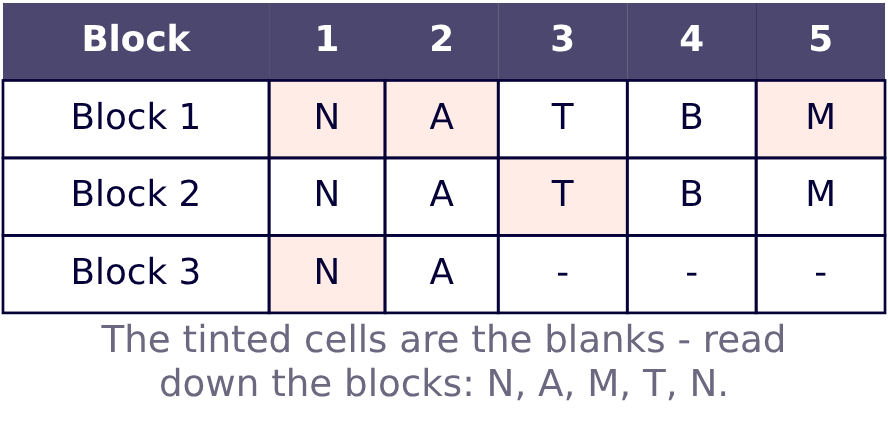 The repeating block is NATBM, so the series is NATBM / NATBM / NA.
The blanks at places 1, 2, 5, 8 and 11 therefore take N, A, M, T and N.
Hence the correct option is (a).
The repeating block is NATBM, so the series is NATBM / NATBM / NA.
The blanks at places 1, 2, 5, 8 and 11 therefore take N, A, M, T and N.
Hence the correct option is (a).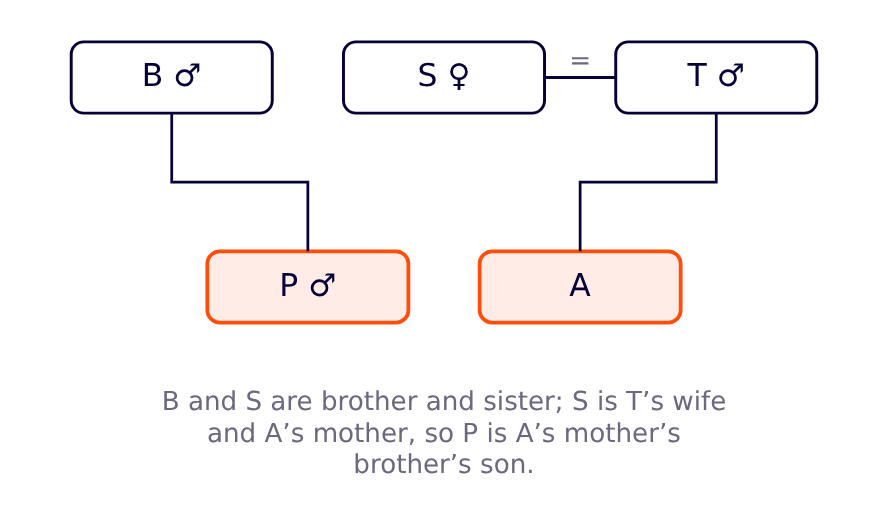 P is the son of B, so P is A's mother's brother's son.
Hence the correct option is (c).
P is the son of B, so P is A's mother's brother's son.
Hence the correct option is (c).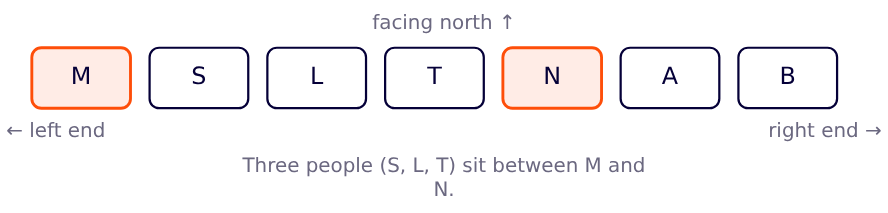 Between M (seat 1) and N (seat 5) sit S, L and T - three people, so the correct option is (a).
 The shifts are -3, +2, +2, -3, and the same four shifts turn RBUX into ODWU, which confirms the rule.
Apply them to NCTV: N-3=K, C+2=E, T+2=V, V-3=S.
So NCTV is related to KEVS and the correct option is (b).
The shifts are -3, +2, +2, -3, and the same four shifts turn RBUX into ODWU, which confirms the rule.
Apply them to NCTV: N-3=K, C+2=E, T+2=V, V-3=S.
So NCTV is related to KEVS and the correct option is (b).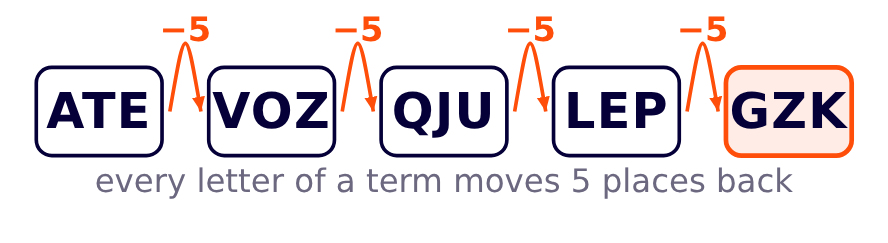 So from LEP: L-5=G, E-5=Z (from E, five steps back runs A, then wraps to Z) and P-5=K.
The missing term is GZK, so the correct option is (b).
So from LEP: L-5=G, E-5=Z (from E, five steps back runs A, then wraps to Z) and P-5=K.
The missing term is GZK, so the correct option is (b).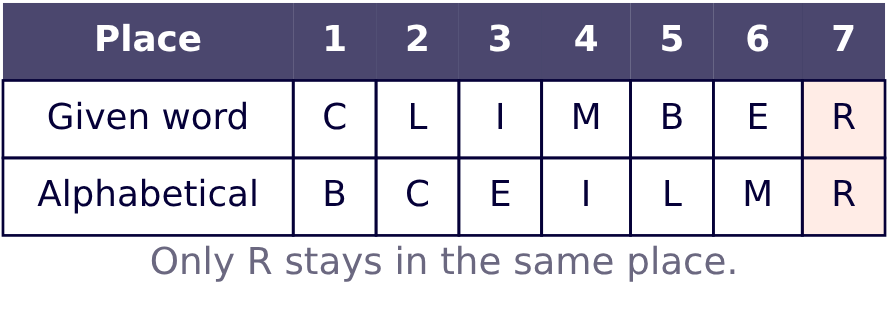 Compare the two rows place by place: C-B, L-C, I-E, M-I, B-L, E-M all differ.
Only the 7th place holds the same letter R in both rows.
So exactly one letter keeps its position and the correct option is (d).
Compare the two rows place by place: C-B, L-C, I-E, M-I, B-L, E-M all differ.
Only the 7th place holds the same letter R in both rows.
So exactly one letter keeps its position and the correct option is (d).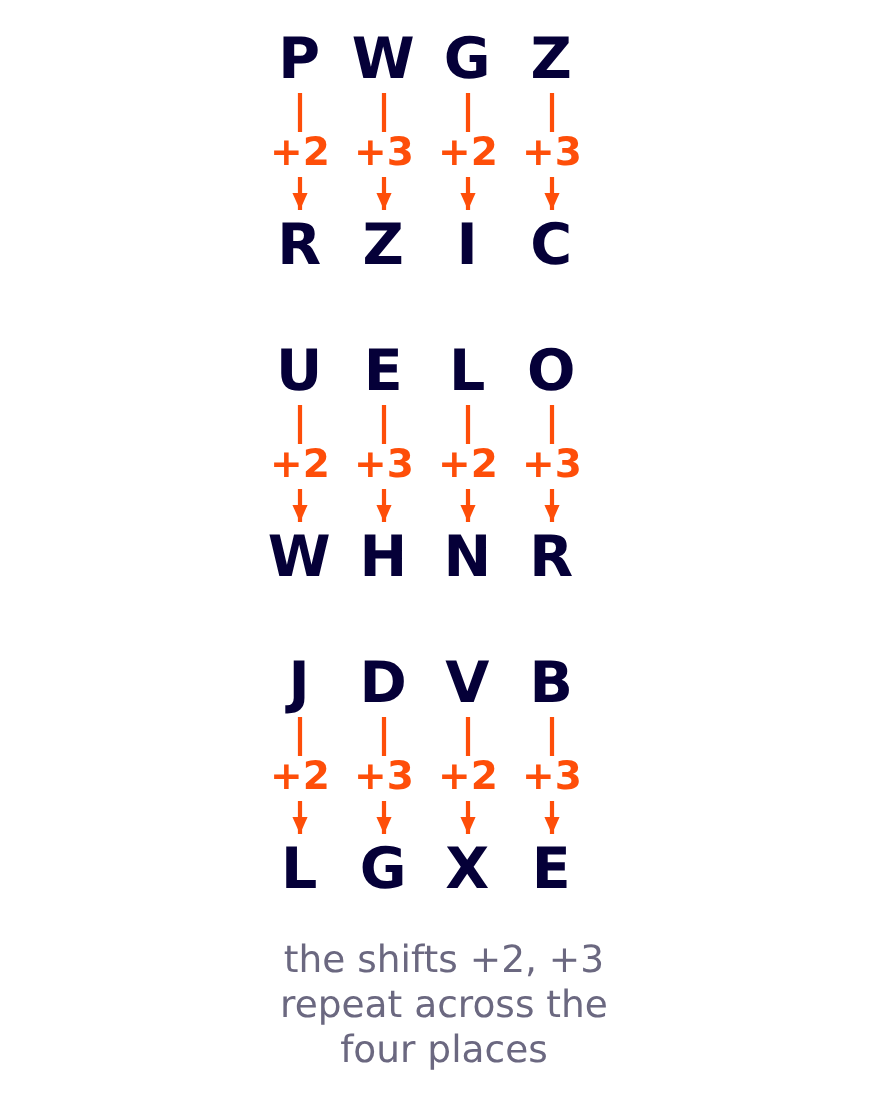 The shifts are +2, +3, +2, +3; they also turn UELO into WHNR, which confirms the rule.
Apply them to JDVB: J+2=L, D+3=G, V+2=X, B+3=E.
So JDVB is related to LGXE and the correct option is (c).
The shifts are +2, +3, +2, +3; they also turn UELO into WHNR, which confirms the rule.
Apply them to JDVB: J+2=L, D+3=G, V+2=X, B+3=E.
So JDVB is related to LGXE and the correct option is (c).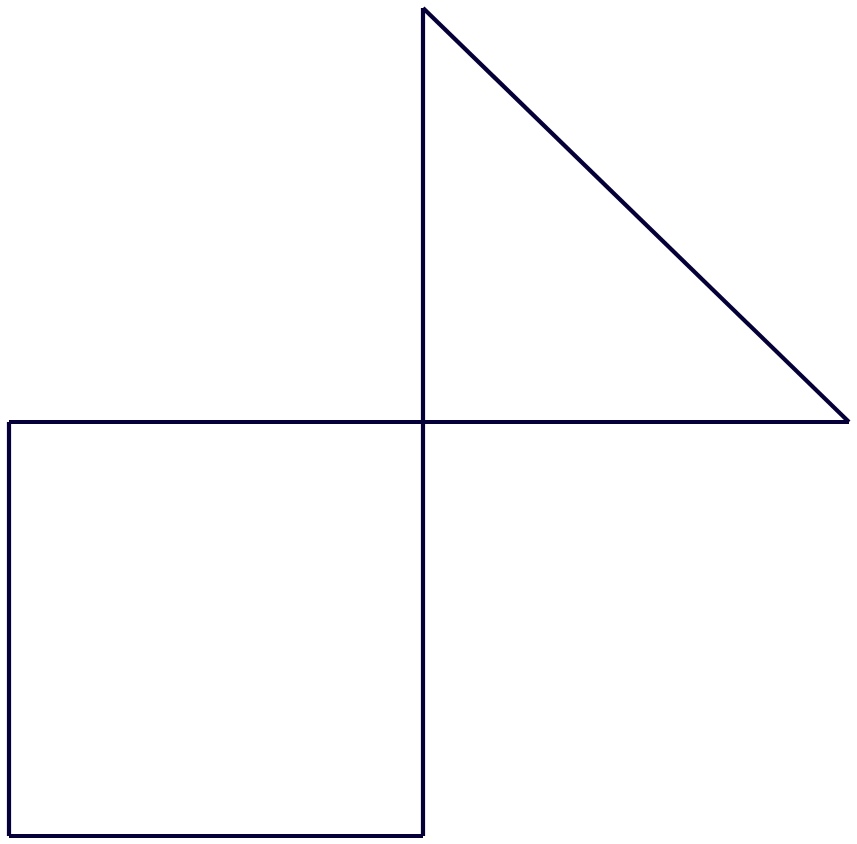 (X)
(X)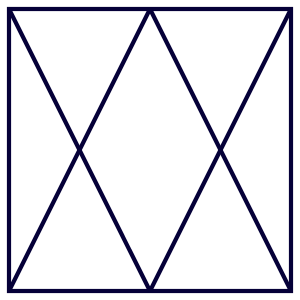
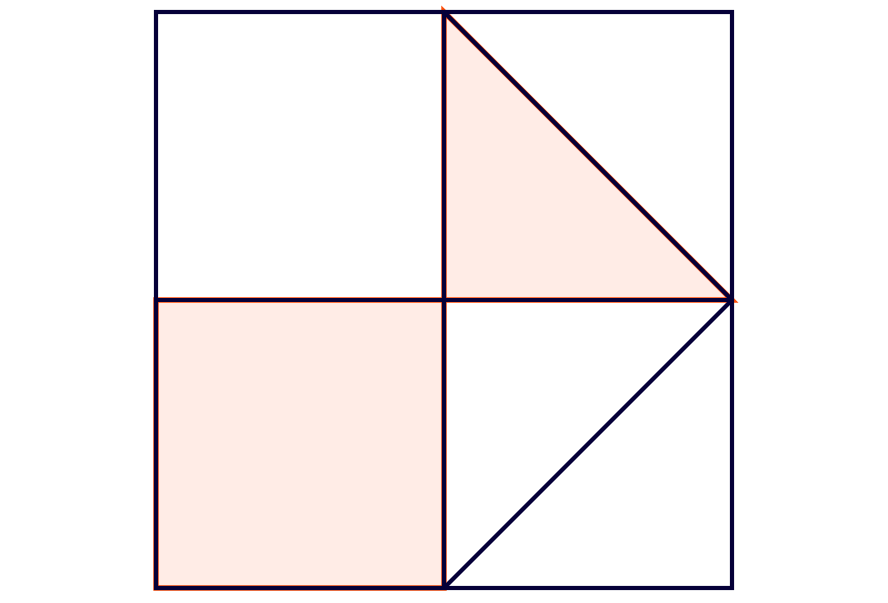 In option (c) the lower-left quarter of the big square is that square; the upper half of the vertical centre line is the upward leg, the right half of the horizontal centre line is the rightward leg, and the slant from the top of the centre line to the middle of the right edge closes the triangle.
In (a) and (b) no square has a right-angled triangle of the same size sitting on its top-right corner, and in (d) the horizontal lines do not pass through the corner of any such square.
Hence the correct option is (c).
In option (c) the lower-left quarter of the big square is that square; the upper half of the vertical centre line is the upward leg, the right half of the horizontal centre line is the rightward leg, and the slant from the top of the centre line to the middle of the right edge closes the triangle.
In (a) and (b) no square has a right-angled triangle of the same size sitting on its top-right corner, and in (d) the horizontal lines do not pass through the corner of any such square.
Hence the correct option is (c).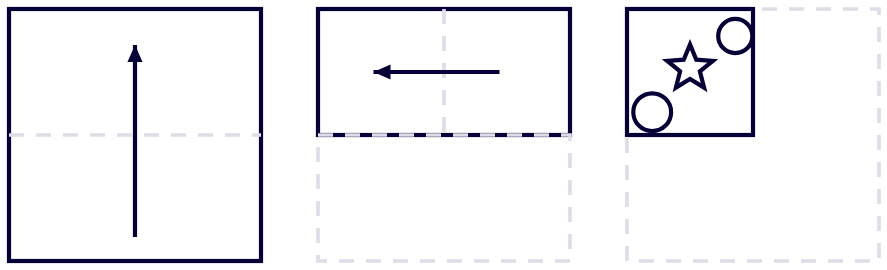


 So the circles open into a pair side by side at the top centre, a matching pair at the bottom centre and a pair one above the other at the middle of each side - none of them lands in a corner or at the centre of the sheet, which rules out (d).
Hence the correct option is (a).
So the circles open into a pair side by side at the top centre, a matching pair at the bottom centre and a pair one above the other at the middle of each side - none of them lands in a corner or at the centre of the sheet, which rules out (d).
Hence the correct option is (a).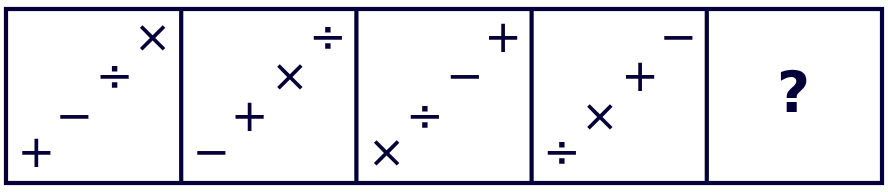
 From box 1 to box 2 the signs swap inside each pair (1st with 2nd, 3rd with 4th); from box 2 to box 3 the first pair changes places with the second pair; from box 3 to box 4 they swap inside each pair again.
So box 4 to box 5 must exchange the two pairs once more: becomes .
The missing box has + at the bottom-left, then -, then and at the top-right, so the correct option is (b).
From box 1 to box 2 the signs swap inside each pair (1st with 2nd, 3rd with 4th); from box 2 to box 3 the first pair changes places with the second pair; from box 3 to box 4 they swap inside each pair again.
So box 4 to box 5 must exchange the two pairs once more: becomes .
The missing box has + at the bottom-left, then -, then and at the top-right, so the correct option is (b).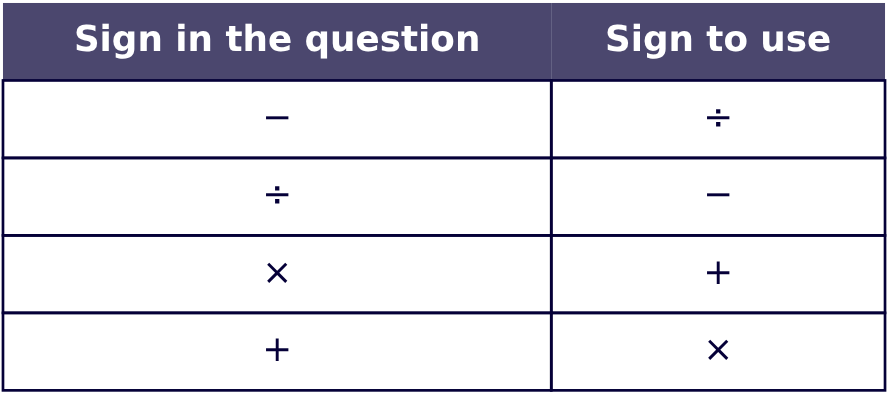 The given equation therefore becomes .
By BODMAS, do and from left to right: and .
Then 224+4-3=225.
Hence the correct option is (a).
The given equation therefore becomes .
By BODMAS, do and from left to right: and .
Then 224+4-3=225.
Hence the correct option is (a).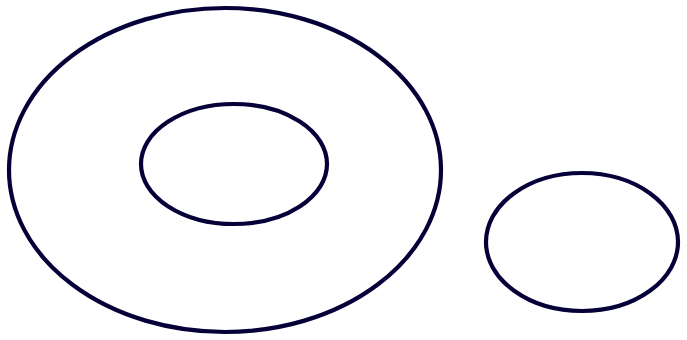
 The diagram must therefore show one small closed figure inside a bigger one, plus a third figure that touches neither.
Option (a) is the only one of that shape - (b) makes wool partly food, (c) makes all three nested and (d) puts two separate kinds inside food - so the correct option is (a).
The diagram must therefore show one small closed figure inside a bigger one, plus a third figure that touches neither.
Option (a) is the only one of that shape - (b) makes wool partly food, (c) makes all three nested and (d) puts two separate kinds inside food - so the correct option is (a).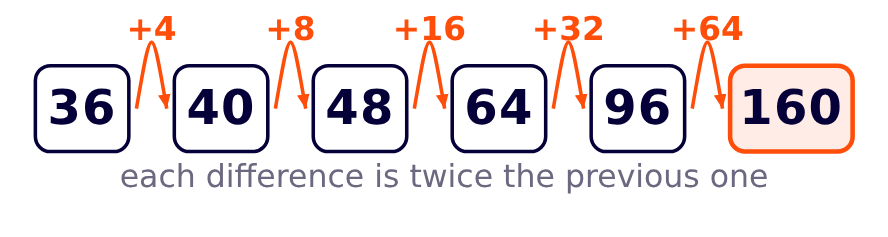 Missing term =96+64=160.
Hence the correct option is (d).
Missing term =96+64=160.
Hence the correct option is (d).