
1
Find the incorrect part in the given sentence.
"If I was the manager, I would change the policy.*
- A.If I
- B.was the manager
- C.I would
- D.change the policy
Solution
Conditional sentences
The sentence describes an imaginary situation — the speaker is not really the manager — so the if-clause must be in the subjunctive mood.
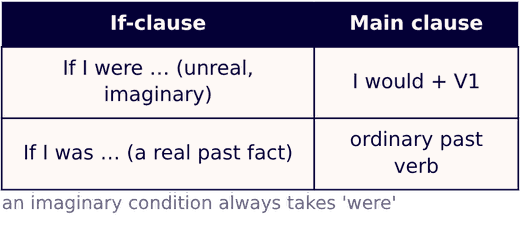 In the subjunctive, 'were' is used with every subject, so 'If I was the manager' must become 'If I were the manager'.
The pattern is: If + subject + were …, subject + would + V1, and 'I would change the policy' already follows it.
Hence the incorrect part is option (b).
In the subjunctive, 'were' is used with every subject, so 'If I was the manager' must become 'If I were the manager'.
The pattern is: If + subject + were …, subject + would + V1, and 'I would change the policy' already follows it.
Hence the incorrect part is option (b).
In the subjunctive, 'were' is used with every subject, so 'If I was the manager' must become 'If I were the manager'.
The pattern is: If + subject + were …, subject + would + V1, and 'I would change the policy' already follows it.
Hence the incorrect part is option (b).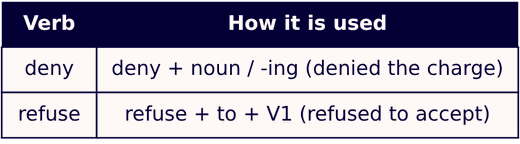 Here the cashier did not take the damaged note, so the idea is refusal, and 'refuse' is the verb that takes the infinitive.
So 'denied to' must be replaced by 'refused to', which makes part (b) the error.
Correct sentence: The cashier refused to accept the damaged note.
Here the cashier did not take the damaged note, so the idea is refusal, and 'refuse' is the verb that takes the infinitive.
So 'denied to' must be replaced by 'refused to', which makes part (b) the error.
Correct sentence: The cashier refused to accept the damaged note.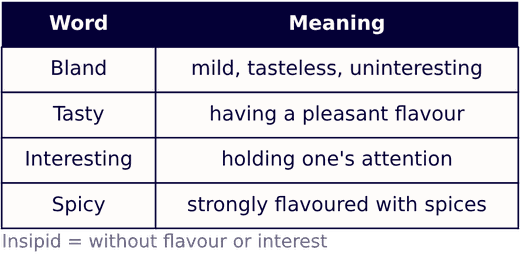 'Bland' carries the same sense — mild, tasteless and therefore uninteresting — so it is the closest synonym.
'Tasty' and 'Spicy' mean full of flavour, and 'Interesting' means attention-catching, so all three are opposite in sense.
Hence, option (b) is the most appropriate answer.
'Bland' carries the same sense — mild, tasteless and therefore uninteresting — so it is the closest synonym.
'Tasty' and 'Spicy' mean full of flavour, and 'Interesting' means attention-catching, so all three are opposite in sense.
Hence, option (b) is the most appropriate answer.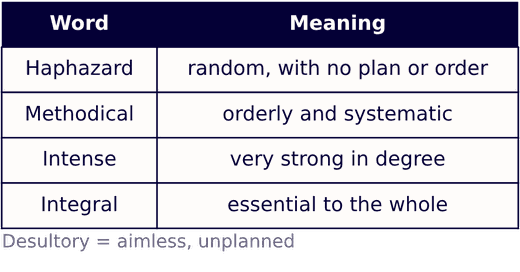 'Haphazard' means done at random, with no order or plan, so it matches 'desultory' most closely.
'Methodical' is its exact opposite, 'Intense' speaks of strength and 'Integral' of being essential, so none of them fits.
Hence, option (b) is the most appropriate answer.
'Haphazard' means done at random, with no order or plan, so it matches 'desultory' most closely.
'Methodical' is its exact opposite, 'Intense' speaks of strength and 'Integral' of being essential, so none of them fits.
Hence, option (b) is the most appropriate answer.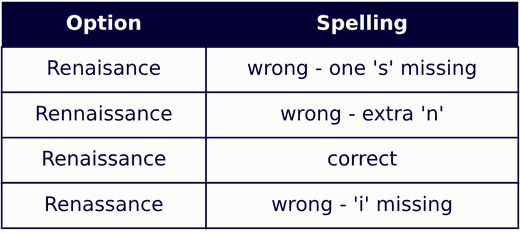 Option (a) drops one 's', option (b) doubles the 'n', and option (d) drops the 'i' of 'naissance'.
Hence, the correctly spelt word is option (c).
Option (a) drops one 's', option (b) doubles the 'n', and option (d) drops the 'i' of 'naissance'.
Hence, the correctly spelt word is option (c).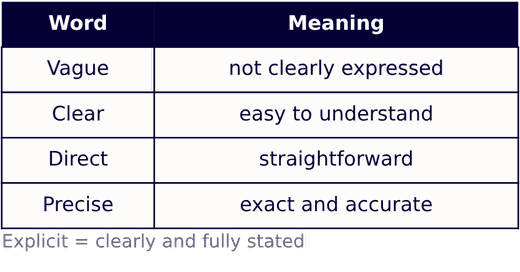 'Vague' means not clearly expressed, so that the meaning stays uncertain, which makes it the exact opposite.
'Clear', 'Direct' and 'Precise' all repeat the sense of 'explicit', so they are synonyms and cannot be the antonym.
Hence, option (b) is the most appropriate answer.
'Vague' means not clearly expressed, so that the meaning stays uncertain, which makes it the exact opposite.
'Clear', 'Direct' and 'Precise' all repeat the sense of 'explicit', so they are synonyms and cannot be the antonym.
Hence, option (b) is the most appropriate answer.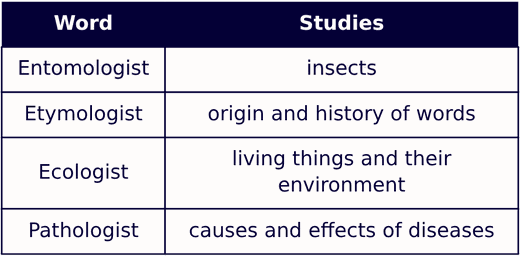 A person who studies insects is therefore an entomologist.
'Etymologist' is the tempting look-alike, but 'etymon' means the original form of a word, so he studies the origin of words.
Hence, option (b) is the most appropriate answer.
A person who studies insects is therefore an entomologist.
'Etymologist' is the tempting look-alike, but 'etymon' means the original form of a word, so he studies the origin of words.
Hence, option (b) is the most appropriate answer.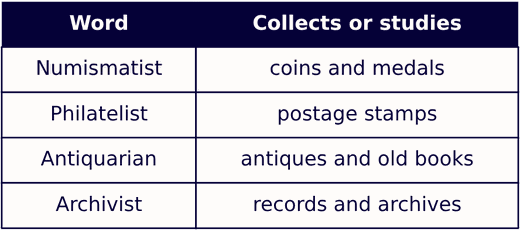 The person asked about in the question is therefore a numismatist.
A philatelist collects stamps, an antiquarian deals with old objects in general, and an archivist looks after records, so none of them is limited to coins.
Hence, option (b) is the most appropriate answer.
The person asked about in the question is therefore a numismatist.
A philatelist collects stamps, an antiquarian deals with old objects in general, and an archivist looks after records, so none of them is limited to coins.
Hence, option (b) is the most appropriate answer.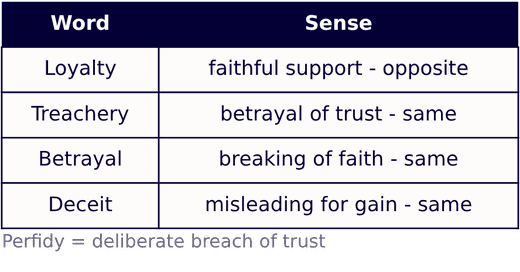 Its opposite is faithfulness to a person or a cause, which is 'Loyalty'.
'Treachery', 'Betrayal' and 'Deceit' merely repeat the sense of perfidy, so they are synonyms and cannot be the antonym.
Hence, option (b) is the most appropriate answer.
Its opposite is faithfulness to a person or a cause, which is 'Loyalty'.
'Treachery', 'Betrayal' and 'Deceit' merely repeat the sense of perfidy, so they are synonyms and cannot be the antonym.
Hence, option (b) is the most appropriate answer.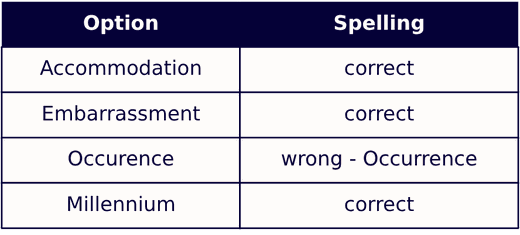 So the form given in option (c), with a single 'r', is misspelt.
'Accommodation' (double c, double m), 'Embarrassment' (double r, double s) and 'Millennium' (double l, double n) are all spelt correctly.
Hence, the incorrectly spelt word is option (c).
So the form given in option (c), with a single 'r', is misspelt.
'Accommodation' (double c, double m), 'Embarrassment' (double r, double s) and 'Millennium' (double l, double n) are all spelt correctly.
Hence, the incorrectly spelt word is option (c).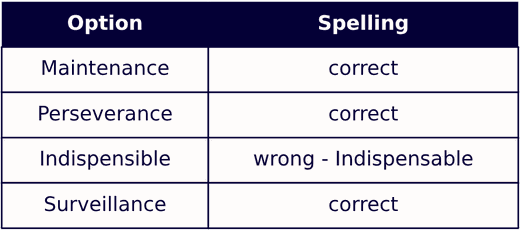 So option (c), written with '-ible', is the misspelt word.
'Maintenance', 'Perseverance' and 'Surveillance' are all spelt correctly; note the '-ance' ending in each of them.
Hence, the incorrectly spelt word is option (c).
So option (c), written with '-ible', is the misspelt word.
'Maintenance', 'Perseverance' and 'Surveillance' are all spelt correctly; note the '-ance' ending in each of them.
Hence, the incorrectly spelt word is option (c).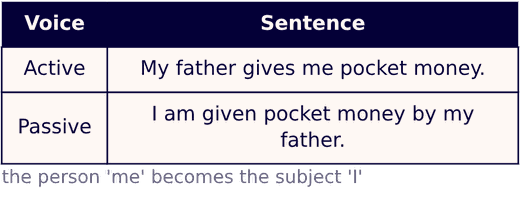 When a verb has two objects, the passive normally makes the person the new subject: person + am/is/are + V3 + the other object + by + agent.
The simple present passive is 'am/is/are + past participle', so 'gives' becomes 'am given' with the subject 'I'.
Option (a) shifts the tense to the past, (c) to the present perfect, and (d) uses the plural verb 'are' with the uncountable 'pocket money'.
Hence, option (b) is the most appropriate answer.
When a verb has two objects, the passive normally makes the person the new subject: person + am/is/are + V3 + the other object + by + agent.
The simple present passive is 'am/is/are + past participle', so 'gives' becomes 'am given' with the subject 'I'.
Option (a) shifts the tense to the past, (c) to the present perfect, and (d) uses the plural verb 'are' with the uncountable 'pocket money'.
Hence, option (b) is the most appropriate answer.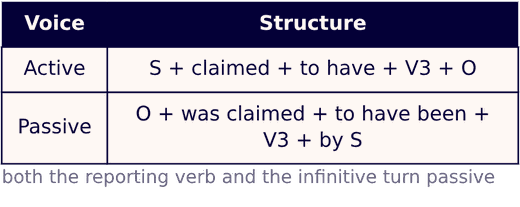 This gives: An ancient city was claimed to have been discovered by the archaeologists beneath the desert sands.
Option (b) replaces the infinitive with a that-clause and loses the perfect sense; (c) is still active; (d) leaves 'claimed' active, so the city itself appears to be doing the claiming.
Hence, option (a) is the most appropriate answer.
This gives: An ancient city was claimed to have been discovered by the archaeologists beneath the desert sands.
Option (b) replaces the infinitive with a that-clause and loses the perfect sense; (c) is still active; (d) leaves 'claimed' active, so the city itself appears to be doing the claiming.
Hence, option (a) is the most appropriate answer.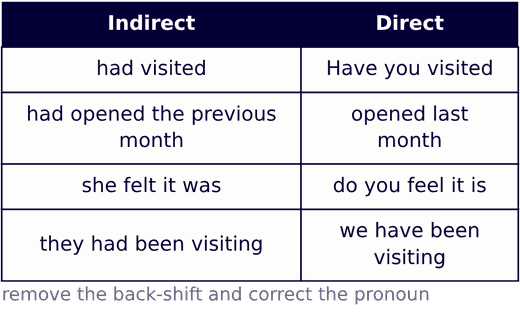 The gallery is one the speaker and the listener both visit, so the reported 'they' returns as 'we'.
Option (a) keeps 'whether' and the pronoun 'they'; (b) and (c) keep the back-shifted past forms 'had you visited / did you feel'.
Hence, option (d) is the most appropriate answer.
The gallery is one the speaker and the listener both visit, so the reported 'they' returns as 'we'.
Option (a) keeps 'whether' and the pronoun 'they'; (b) and (c) keep the back-shifted past forms 'had you visited / did you feel'.
Hence, option (d) is the most appropriate answer.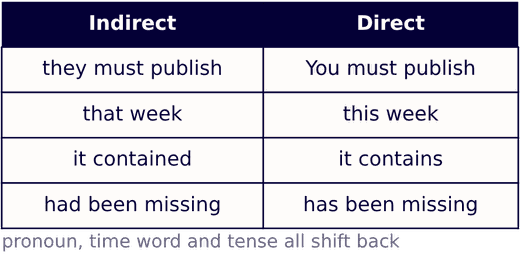 'That week' was the reporter's word for the professor's 'this week', so it must go back to 'this week'.
'They' stands for the listeners, and the professor addressing them would say 'you'.
Option (b) keeps 'that week' with the past forms; (c) wrongly uses 'we'; (d) turns the modal 'must' into 'had to'.
Hence, option (a) is the most appropriate answer.
'That week' was the reporter's word for the professor's 'this week', so it must go back to 'this week'.
'They' stands for the listeners, and the professor addressing them would say 'you'.
Option (b) keeps 'that week' with the past forms; (c) wrongly uses 'we'; (d) turns the modal 'must' into 'had to'.
Hence, option (a) is the most appropriate answer.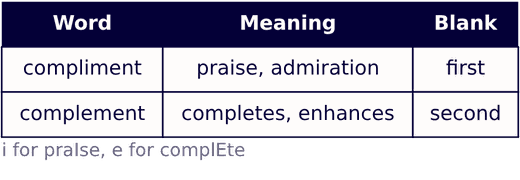 The second blank says the dress was chosen to go well with the colour of her eyes, which is the sense of 'complement'.
Hence, option (a) is the most appropriate answer.
The second blank says the dress was chosen to go well with the colour of her eyes, which is the sense of 'complement'.
Hence, option (a) is the most appropriate answer.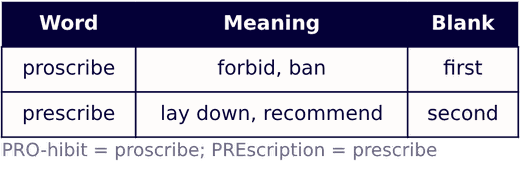 Safer manufacturing standards are being laid down, not banned, so the second blank needs 'prescribe'.
Hence, option (a) is the most appropriate answer.
Safer manufacturing standards are being laid down, not banned, so the second blank needs 'prescribe'.
Hence, option (a) is the most appropriate answer.