SSC CHSL 19 November 2025 · Shift 2 · Quantitative Aptitude — questions with answers · ShikshaSphere
Chapter 75 of 200
19 November 2025 · Shift 2
Quantitative Aptitude
25 questions ~25 min readFree
25 questions
A
51
If and , then find .
A.98
B.105
C.115
D.108
Solution
Algebraic identity
Identity: .
So .
Hence, option (c) is correct.
52
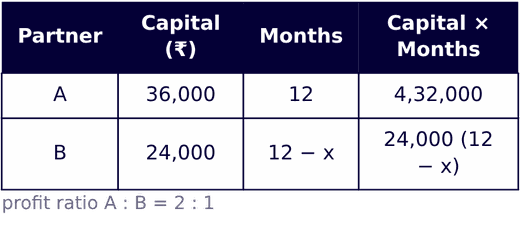
A started a business with ₹36,000. B joined after months with ₹ 24,000 . The profit ratio at the end of the year is 2 :1. What is the value of x ?
A.8 months
B.3 months
C.9 months
D.11 months
Solution
Partnership
In a partnership the profit is divided in the ratio of (capital × time).
A invests for the whole year: .
B joins after x months, so B's money works for (12-x) months: .
So B joined after 3 months, i.e. option (b).
53
If , then find the value of where .
A.
B.
C.
D.
Solution
Trigonometric ratios
with gives , i.e. .
Then .
Complementary angles: , so .
Hence, option (b) is correct.
54
A sum invested for 2 years at 15% compound interest becomes ₹26,450. Find the principal amount.
A.Rs. 20,000
B.Rs. 21,000
C.Rs. 25,000
D.Rs. 26,000
Solution
Compound interest
Formula: , where A is the amount and P the principal.
So the principal is ₹20,000, i.e. option (a).
55
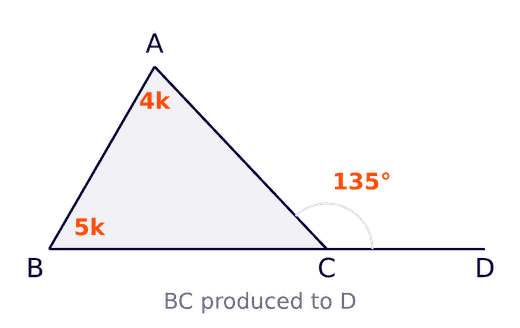
In a , side is extended to point ' D ', such that . If , then find the value of .
A.70°
B.60°
C.62°
D.68'
Solution
Angles of a triangle
BC is produced to D, so is the exterior angle of at C.
Exterior angle theorem: .
Let ; then .
Hence, option (b) is correct.
56
5 litres are drawn from a cask full of wine and are then filled with water.
This operation is performed two more times. The ratio of the quantity of wine now left in the cask to that of water is 27 . How much wine did the cask hold originally?
A.21 litres
B.26.88 litres
C.27.5 litres
D.20 litres
Solution
Replacement of mixture
Formula: if 5 litres are drawn out and replaced by water each time, then after n operations the wine left , where x litres is the capacity of the cask.
The operation is carried out three times in all, and the wine finally left is of the original quantity.
So the cask originally held 20 litres of wine, i.e. option (d).
57
If and is an acute angle, find the value of .
A.
B.
C.
D.
Solution
Trigonometric identities
means , i.e. .
, and as is acute, .
At , .
Hence, option (b) is correct.
58
Two friends, 'A' and 'B' started running along a circular track in the same direction at the same time at and , respectively. If the length of the circular track is 4,500 metres, then find the time after the start at which they will meet each other for the first time.
A.310 seconds
B.350 seconds
C.300 seconds
D.340 seconds
Solution
Races on a circular track
On a circular track two runners moving in the same direction meet for the first time when the faster one gains exactly one full lap on the slower one.
Relative speed =45-30=15 m/s.
Time of first meeting seconds.
Hence, option (c) is correct.
59
Simplify the expression.
A.3
B.5
C.7
D.4
Solution
Simplification of surds
Use the identity with and .
Numerator .
Denominator .
Hence, option (d) is correct.
60
Find the area of a trapezium whose parallel sides are 9.4 cm and 11.8 cm respectively, and the distance between the parallel sides is 8.5 cm .
A.
B.
C.
D.
Solution
Area of a trapezium
Formula: area of a trapezium (sum of the parallel sides) distance between them.
Area
So the required area is , i.e. option (b).
61
In a square, the length of the diagonal is . Find the side of the square and then calculate its exact area.
A. and
B. and
C. and
D.None of these
Solution
Square: diagonal and area
In a square of side a, the diagonal is .
So cm.
Area of the square sq cm.
A quicker route is to use the diagonal directly: area sq cm.
Hence, option (b) is the correct answer.
62
'P', 'Q', 'R' and 'S' have different amounts. ' ' has 3.5 times the amount ' ' has. ' S ' has less than ' Q '. The amount R is equal to the average of those three persons. If the sum of amounts 'P' and 'R' is Rs. 6000 , find the amount 'R' has.
A.Rs. 4554
B.Rs. 4154
C.Rs. 4054
D.Rs. 3654
Solution
Ratio and average of amounts
Let the amount with P be x.
Q has 3.5 times the amount of P, so Q=3.5x.
S has 50% less than Q, i.e. half of Q, so .
R equals the average of those three persons P, Q and S: .
Given P+R=6000, so , i.e. .
Hence R has about Rs. 4054, option (c).
63
A shopkeeper sells 12 kg of sugar for ₹576 and earns a profit equal to the selling price of 4 kg of sugar. What is the profit percentage?
A.40%
B.
C.45%
D.55%
Solution
Profit percentage
Selling price of 12 kg is ₹576, so the SP of 1 kg , i.e. ₹48.
Profit = SP of 4 kg , i.e. ₹192.
Cost price of 12 kg = SP − Profit = ₹576 − ₹192 = ₹384.
Profit % , i.e. 50%.
Shortcut: the profit on 12 kg equals the SP of 4 kg, so the CP of 12 kg equals the SP of 12-4=8 kg, giving profit % .
Hence, option (b) is the correct answer.
64
A person sells two items for ₹800 each. He gains 35% on one and loses 35% on the other. What is his total loss percentage in the entire transaction?
A.
B.12.25%
C.
D.11.00%
Solution
Equal gain and loss percent
When two articles are sold at the same price, one at a gain of x% and the other at a loss of the same x%, the deal always ends in a loss.
Loss % , i.e. 12.25%.
Check: and , so the total CP =1823.36 against a total SP of 1600.
Loss =1823.36-1600=223.36 and .
Hence, option (b) is the correct answer.
65
The profits of three partners are in the ratio 3 : 7 : 6. If their profits increase by 40%, 50%, and 60%, what is the new ratio of profits?
A.
B.14 : 35 : 32
C.14 : 45 : 22
D.12 : 35 : 22
Solution
Ratio after percentage change
New profit = old profit × (1 + rate of increase), applied term by term.
New ratio
=4.2:10.5:9.6
Multiplying every term by 10: 42:105:96.
Dividing every term by the common factor 3: 14:35:32.
Hence, option (b) is the correct answer.
66
The average age of 22 students is 16 years. If the teacher's age is included, the average rises by 2 year. Later, another teacher joins, and the average rises by 3 more years. What is the age of the second teacher?
A.92 years
B.94 years
C.90 years
D.96 years
Solution
Average age
Total age of the 22 students years.
With the first teacher there are 23 people and the average becomes 16+2=18 years, so the total years.
Age of the first teacher =414-352=62 years.
With the second teacher there are 24 people and the average rises by 3 more, to 18+3=21 years, so the total years.
Age of the second teacher =504-414=90 years.
Hence, option (c) is the correct answer.
67
A train travels from Station A to Station B. If it travels at , it reaches 2 minutes early. If it travels at 90 , it reaches 3 minutes late. What is the distance between the two stations?
A.36 km
B.40 km
C.30 km
D.50 km
Solution
Speed, time and distance
Let the distance between the two stations be d km.
At 120 km/h the train is 2 minutes early and at 90 km/h it is 3 minutes late, so the two journey times differ by 2+3=5 minutes hour.
Hence the distance between the two stations is 30 km, option (c).
68
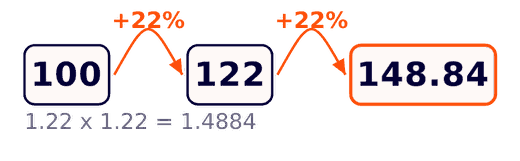
After two successive increments, a person's salary became 148.84% of the original salary. If the percentage increase in the second increment was equal to that in the first increment, then what was the percentage of each increment?
A.20%
B.32%
C.22%
D.31%
Solution
Successive percentage increase
Let the original salary be 100 and let each increment be r%.
Hence each increment was 22%, option (c).
69
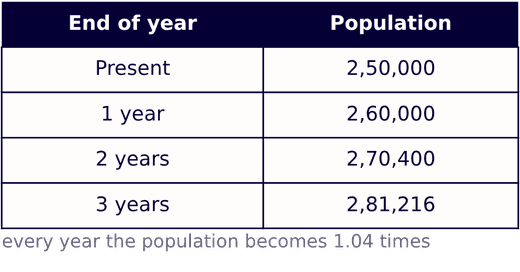
A town has a present population of . Every year the population increases by a birth rate of 20% and decreases by a death rate of 16%. Find the population of the town at the end of 3 years.
A.₹3,81,216
B.₹2,81,216
C.₹2,71,261
D.₹2,51,216
Solution
Population growth
The birth rate adds 20% and the death rate removes 16%, so the net growth is 20-16=4% per year.
Population after 3 years
=281216
Hence the population at the end of 3 years is 2,81,216, option (b).
70
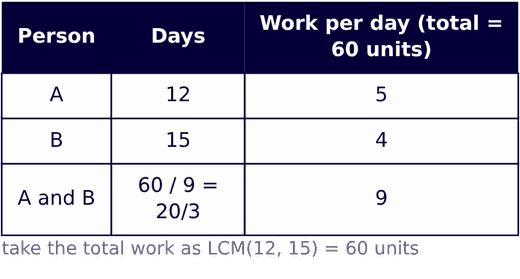
A can complete a work in 12 days, while can do it in 15 days. How many days will they take together?
A.5 days
B. days
C. days
D. days
Solution
Time and work together
A's one day's work and B's one day's work .
Working together, their one day's work .
Time taken together days.
Hence, option (c) is the correct answer.
71
A shopkeeper offers two successive discounts of 30% and 40% on an item. If the marked price of the item is ₹3,200, what is its final selling price?
A.₹1364
B.₹1344
C.₹1354
D.₹1374
Solution
Successive discounts
After a discount of 30% the price becomes of the marked price, and a further discount of 40% makes it of that.
SP
Hence the final selling price is ₹1,344, option (b).
72
A shopkeeper offers two successive discounts of and on an item with a marked price of ₹1,200. What is the effective discount percentage offered to the customer?
A.
B.48 %
C.38 %
D.28 %
Solution
Effective discount percent
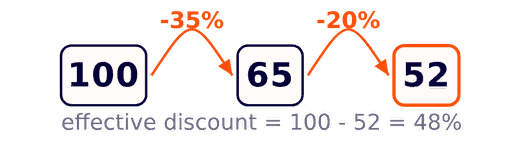
Take the marked price as 100. After 35% off it becomes 65, and after a further 20% off it becomes .
So 100 finally costs 52, and the effective discount =100-52=48, i.e. 48%.
By formula, effective discount .
The marked price ₹1,200 is not needed for the percentage; it only fixes the price paid, , i.e. ₹624.
Hence, option (b) is the correct answer.
73
An equilateral triangular plot of land has a side length of 85 meters. A landowner wants to put a rope around the entire plot. If the rope costs ₹20 per meter, what is the total expense?
A.₹5,125
B.₹5,250
C.₹5,375
D.₹5,100
Solution
Perimeter of equilateral triangle
The rope goes right round the plot, so the length of rope needed is the perimeter of the equilateral triangle.
Perimeter m.
Total expense , i.e. ₹5,100.
Hence, option (d) is the correct answer.
74
A milk seller claims to sell milk at its actual cost price, yet he secretly adds water to it and thus secures a 20% profit. In what proportion of water to milk must the mixture be prepared to yield this gain?
A.2 : 7
B.1 : 5
C.1 : 6
D.4 : 3
Solution
Mixture and profit
Let the milk cost ₹c per litre, and suppose m litres of milk are mixed with w litres of water.
The seller pays only for the milk, so CP =mc; he sells the whole (m+w) litres at the same ₹c per litre, so SP =(m+w)c.
Profit =(m+w)c-mc=wc, which is exactly the value of the free water.
Profit %
Hence water : milk =1:5, option (b).
75
Arrange in descending order: .
A.
B.
C.
D.
Solution
Comparing surds
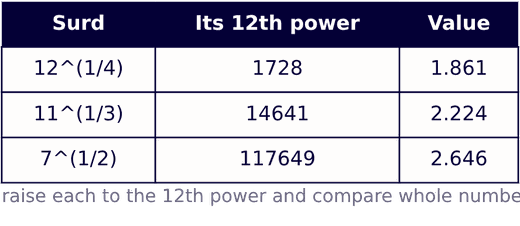
To compare surds of different orders, bring them to a common index. The LCM of 3, 2 and 4 is 12.
Since 1728<14641<117649, we get , which the decimal values confirm: 1.86<2.22<2.65.
So the three surds line up as .
Hence, option (b) is the correct answer.
Finished reading? Now test yourself.
The same 25 questions, but with a timer and the answers hidden — 15 minutes.

 A invests for the whole year: .
B joins after x months, so B's money works for (12-x) months: .
So B joined after 3 months, i.e. option (b).
A invests for the whole year: .
B joins after x months, so B's money works for (12-x) months: .
So B joined after 3 months, i.e. option (b).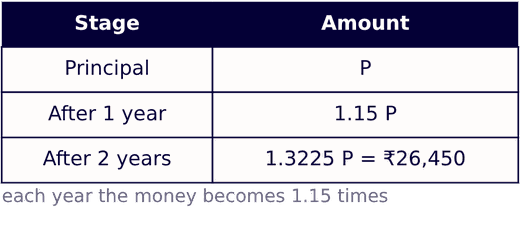 So the principal is ₹20,000, i.e. option (a).
 BC is produced to D, so is the exterior angle of at C.
Exterior angle theorem: .
Let ; then .
Hence, option (b) is correct.
BC is produced to D, so is the exterior angle of at C.
Exterior angle theorem: .
Let ; then .
Hence, option (b) is correct.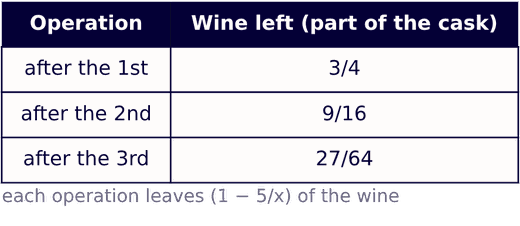 The operation is carried out three times in all, and the wine finally left is of the original quantity.
So the cask originally held 20 litres of wine, i.e. option (d).
The operation is carried out three times in all, and the wine finally left is of the original quantity.
So the cask originally held 20 litres of wine, i.e. option (d).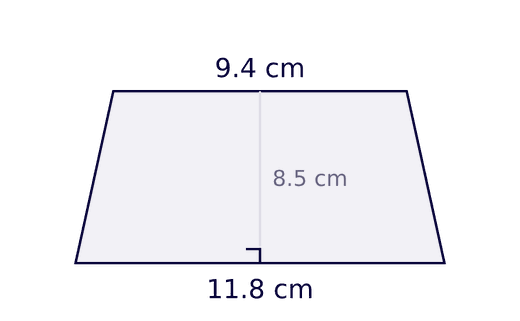 Area
So the required area is , i.e. option (b).
Area
So the required area is , i.e. option (b).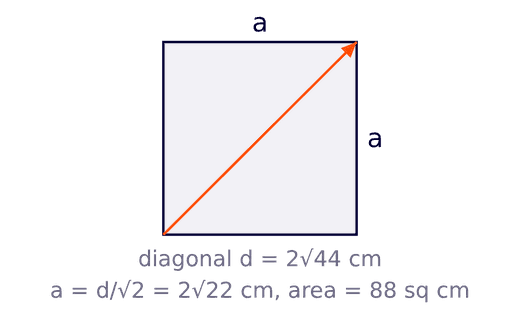 Area of the square sq cm.
A quicker route is to use the diagonal directly: area sq cm.
Hence, option (b) is the correct answer.
Area of the square sq cm.
A quicker route is to use the diagonal directly: area sq cm.
Hence, option (b) is the correct answer.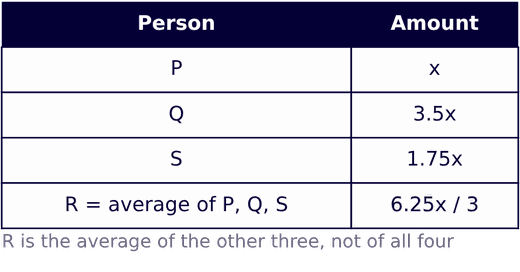 Given P+R=6000, so , i.e. .
Hence R has about Rs. 4054, option (c).
Given P+R=6000, so , i.e. .
Hence R has about Rs. 4054, option (c).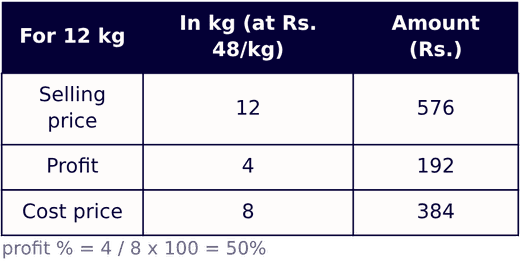 Profit % , i.e. 50%.
Shortcut: the profit on 12 kg equals the SP of 4 kg, so the CP of 12 kg equals the SP of 12-4=8 kg, giving profit % .
Hence, option (b) is the correct answer.
Profit % , i.e. 50%.
Shortcut: the profit on 12 kg equals the SP of 4 kg, so the CP of 12 kg equals the SP of 12-4=8 kg, giving profit % .
Hence, option (b) is the correct answer.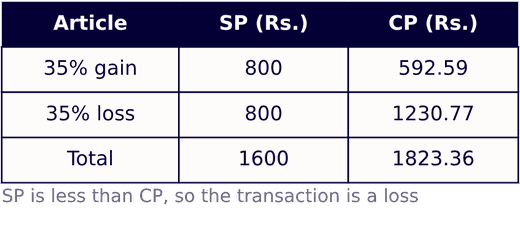 Check: and , so the total CP =1823.36 against a total SP of 1600.
Loss =1823.36-1600=223.36 and .
Hence, option (b) is the correct answer.
Check: and , so the total CP =1823.36 against a total SP of 1600.
Loss =1823.36-1600=223.36 and .
Hence, option (b) is the correct answer.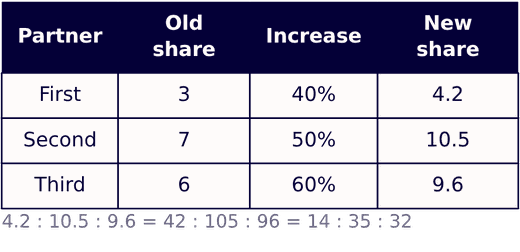 Multiplying every term by 10: 42:105:96.
Dividing every term by the common factor 3: 14:35:32.
Hence, option (b) is the correct answer.
Multiplying every term by 10: 42:105:96.
Dividing every term by the common factor 3: 14:35:32.
Hence, option (b) is the correct answer.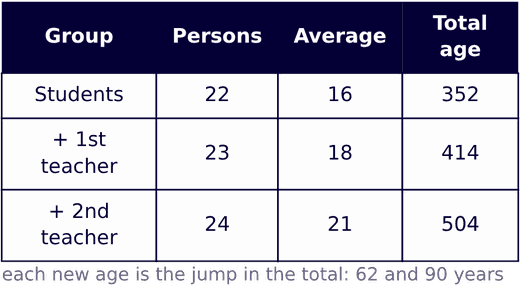 With the second teacher there are 24 people and the average rises by 3 more, to 18+3=21 years, so the total years.
Age of the second teacher =504-414=90 years.
Hence, option (c) is the correct answer.
With the second teacher there are 24 people and the average rises by 3 more, to 18+3=21 years, so the total years.
Age of the second teacher =504-414=90 years.
Hence, option (c) is the correct answer.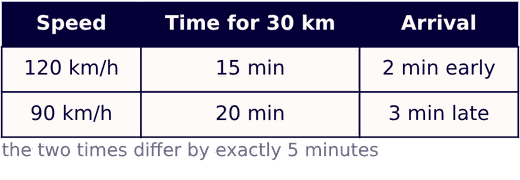 Hence the distance between the two stations is 30 km, option (c).
 Hence each increment was 22%, option (c).
 Hence the population at the end of 3 years is 2,81,216, option (b).
 Time taken together days.
Hence, option (c) is the correct answer.
Time taken together days.
Hence, option (c) is the correct answer.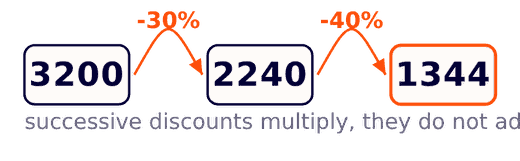 Hence the final selling price is ₹1,344, option (b).
 By formula, effective discount .
The marked price ₹1,200 is not needed for the percentage; it only fixes the price paid, , i.e. ₹624.
Hence, option (b) is the correct answer.
By formula, effective discount .
The marked price ₹1,200 is not needed for the percentage; it only fixes the price paid, , i.e. ₹624.
Hence, option (b) is the correct answer.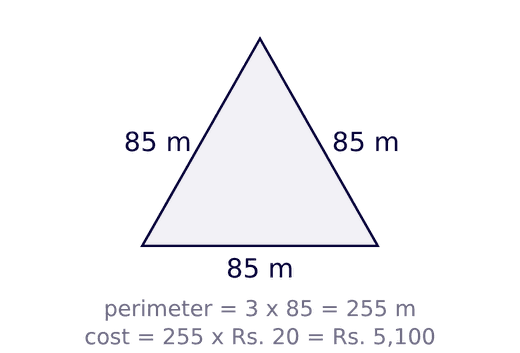 Total expense , i.e. ₹5,100.
Hence, option (d) is the correct answer.
Total expense , i.e. ₹5,100.
Hence, option (d) is the correct answer.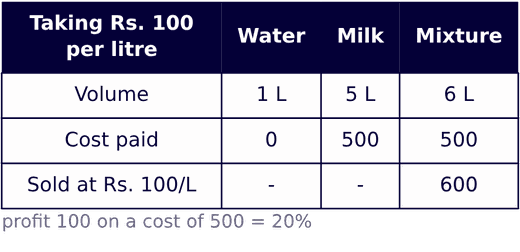 Hence water : milk =1:5, option (b).
 Since 1728<14641<117649, we get , which the decimal values confirm: 1.86<2.22<2.65.
So the three surds line up as .
Hence, option (b) is the correct answer.
Since 1728<14641<117649, we get , which the decimal values confirm: 1.86<2.22<2.65.
So the three surds line up as .
Hence, option (b) is the correct answer.