SSC CHSL 20 November 2025 · Shift 3 · English Language — questions with answers · ShikshaSphere
Chapter 92 of 200
20 November 2025 · Shift 3
English Language
25 questions ~25 min readFree
25 questions
A
1
Select the most appropriate synonym of the word :
ESOTERIC
A.Obvious
B.Abstruse
C.Public
D.Simple
Solution
Synonym of ESOTERIC
ESOTERIC means meant for, or understood by, only a small circle of specially initiated people — and therefore obscure to the ordinary reader.
Abstruse means difficult to understand, hard to grasp; it carries the same sense of lying beyond common comprehension, so it is the closest synonym.
Obvious, Public and Simple all describe something clear, open to everybody or easy — the exact opposite of esoteric.
Hence the correct option is (b).
2
Choose the correct meaning of the idiom:
Play it by ear
A.To do something by special preparation
B.To plan
C.To listen carefully
D.To improve
Solution
Idiom: Play it by ear
'Play it by ear' is used when a person handles a situation as it develops, deciding on the spot rather than following a rigid plan made in advance.
E.g. We have booked no hotel in Manali; we shall reach there and play it by ear.
(b) 'To plan' is the opposite of the idiom, and (c) 'To listen carefully' takes the word 'ear' in its literal sense.
(d) 'To improve' confuses the idiom with the similar-looking word 'improvise', so it too is ruled out.
Hence the correct option is (a).
3
Choose the correct meaning of the idiom:
Go with the flow
A.Swim in the river
B.Accept things as they happen
C.Follow the rules strictly
D.Argue against the crowd
Solution
Idiom: Go with the flow
'Go with the flow' means to accept things as they happen and move along with the situation instead of resisting or fighting it.
E.g. The itinerary changed at the last minute, but she decided to go with the flow and enjoyed the trip.
(a) takes 'flow' literally as the current of a river, (c) speaks of obeying rules and (d) is the very opposite — arguing against the crowd.
Hence the correct option is (b).
4
Which of the following sentences uses the word "watch" with a different meaning from the others?
A.We like to watch the birds in the garden.
B.He glanced at his gold watch to check the time.
C.The fans gathered to watch the game on the big screen.
D.Please watch the children while I cook dinner.
Solution
Word with different meaning
In (a), (c) and (d) 'watch' is a verb — to look at something attentively (the birds, the game) or to keep an eye on somebody (the children).
In (b) 'watch' is a noun: a small timepiece worn on the wrist, as the words 'gold' and 'to check the time' make clear.
So (b) alone changes both the part of speech and the meaning of the word.
Hence the correct option is (b).
5
Select the sentence containing the homonym of the highlighted word:
The children love to play in the park.
A.The park has many large trees.
B.We went for a walk in the park.
C.You can park your car in the driveway.
D.The national park is very beautiful.
Solution
Homonyms
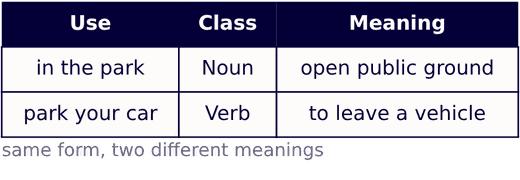
In the given sentence 'park' is a noun — a public open space meant for recreation.
A homonym has the same spelling and the same pronunciation but a completely different meaning; the other sense of 'park' is the verb 'to leave a vehicle in a place'.
Options (a), (b) and (d) again use 'park' as the same noun, so they repeat the meaning instead of changing it.
Hence the correct option is (c).
6
Change the following sentence into the Active form.
The old beggar was seen to be sitting by the road.
A.Someone saw the old beggar sitting by the road.
B.The old beggar sat by the road and was seen.
C.The road was where the old beggar was seen sitting.
D.Someone has seen the old beggar sitting by the road.
Solution
Passive to active voice
The given sentence is passive — 'was seen to be sitting' — and the doer is not named, so in the active form an indefinite subject 'Someone' must be supplied.
With verbs of perception (see, hear, watch, observe) the 'to' of the infinitive is used only in the passive; in the active it is dropped, so 'was seen to be sitting' becomes 'saw … sitting'.
The tense is simple past, so 'was seen' turns into 'saw'.
(b) and (c) merely rearrange the passive without giving a doer, and (d) shifts the tense to the present perfect 'has seen'.
Hence the correct option is (a).
7
Change the following sentence into the Active form.
It was believed that a precious artifact had been stolen.
A.A precious artifact had been stolen, it was believed.
B.They believed that a precious artifact had been stolen.
C.It was believed that they stole a precious artifact.
D.A precious artifact was stolen, as they believed.
Solution
Impersonal passive to active
'It was believed that …' is the impersonal passive; its active form takes the general agent 'They' as subject — 'They believed that …'.
The inner clause 'a precious artifact had been stolen' is a separate passive whose doer is unknown, so it is carried over unchanged.
(a) and (d) leave the main clause in the passive, while (c) wrongly converts the inner clause instead of the outer one.
Hence the correct option is (b).
8
Choose the correct spelling to complete the sentence:
"We ate at a fancy downtown."
A.restaraunt
B.restuarant
C.restaurant
D.resturant
Solution
Correct spelling
The correct spelling is 'restaurant', a French loan word that keeps its French vowel order: rest + au + rant.
The trap options shuffle those vowels — 'restaraunt' and 'resturant' put the a before the u wrongly or drop it, and 'restuarant' swaps 'au' into 'ua'.
Hence the correct option is (c).
9
Choose the correct spelling to complete the sentence:
"Through sheer she finally finished the marathon."
A.perserverance
B.perseverence
C.perseverance
D.perserverence
Solution
Correct spelling
The correct spelling is 'perseverance' — formed from the verb 'persevere' by adding '-ance', so it keeps a single 'r' after 'pe' and ends in '-ance', not '-ence'.
A quick check: the word hides 'severe' inside it — per + severe + ance, with the final 'e' of severe absorbed.
Hence the correct option is (c).
10
Select the option that expresses the given sentence in indirect voice.
The scientist said, "Even if the data had been collected sooner, the final outcome would have remained the same for the project.*
A.The scientist said that even if the data would have been collected sooner, the final outcome would have remained the same for the project.
B.The scientist said that even if the data had been collected sooner, the final outcome would have remained the same for the project.
C.The scientist said that even if the data was collected sooner, the final outcome would have remained the same for the project.
D.The scientist said that even if the data had been collected sooner, the final outcome will have remained the same for the project.
Solution
Direct to indirect speech
The reported words form an unreal past (third conditional): 'Even if the data had been collected sooner, the final outcome would have remained the same.'
Rule: a hypothetical or unreal past does not shift any further back in indirect speech, so 'had been collected' and 'would have remained' are carried over exactly as they are.
Only the mechanical changes are made — the inverted commas go and 'said' is followed by the conjunction 'that'; there is no first-person pronoun to alter.
(a) turns the if-clause into 'would have been collected' and (c) into 'was collected', both of which break the conditional, while (d) replaces 'would' with 'will'.
Hence the correct option is (b).
11
Identify the misspelled word:
A.Harassment
B.Consensus
C.Privelege
D.Rhythm
Solution
Misspelled word
'Privelege' is wrong; the correct spelling is 'Privilege'.
The word comes from Latin privus (private) + lex, leg- (law), so both of the first two vowels are 'i' — pri-vi-lege — and there is no 'e' before the 'l'.
Harassment, Consensus and Rhythm are all spelt correctly, so option (c) is the misspelt word.
12
Identify the misspelled word:
A.Surveillance
B.Ommission
C.Prerogative
D.Guarantee
Solution
Misspelled word
'Ommission' is wrong; the correct spelling is 'Omission'.
It is formed from the verb 'omit', which has a single 'm'; the noun ending '-ssion' then supplies the double 's' — o-mis-sion, one m and two s's.
Surveillance, Prerogative and Guarantee are all spelt correctly, so option (b) is the misspelt word.
13
Select the option that expresses the given sentence in indirect voice.
The student said to the teacher, "I must explain that I was not the one who started the rumor, as I was not even at school when it began.'
A.The student told the teacher that he must explain that he was not the one who started the rumor, as he was not even at school when it began.
B.The student told the teacher that he had to explain that he had not been the one who had started the rumor, as he had not even been at school when it had begun.
C.The student told the teacher that he had to explain that he was not the one who had started the rumor, as he was not even at school when it began.
D.The student told the teacher that he must explain that he had not been the one who started the rumor, as he had not even been at school when it had begun.
Solution
Direct to indirect speech
'said to the teacher' becomes 'told the teacher', and the pronoun 'I' changes to 'he' because the speaker is the student.
'Must' here expresses obligation, and obligation-'must' becomes 'had to' in a past report.
Since the reporting verb is in the past, every simple past verb inside the speech moves one step back into the past perfect.
(a) and (d) keep 'must' unchanged, and (c) leaves 'was not' and 'began' unshifted, so only (b) applies the rule throughout.
Hence the correct option is (b).
14
Select the option that expresses the given sentence in direct voice.
The weary traveler complained with a groan that he was feeling exhausted and could not walk another mile.
A."I am feeling exhausted," he said, "and I cannot walk another mile."
B.The weary traveler said, "I am feeling exhausted and I cannot walk another mile."
C.He said, 'I was feeling exhausted and I could not walk another mile."
D.He complained, 'I am feeling exhausted, I cannot walk another mile."
Solution
Indirect to direct speech
In direct speech the doer is named first, the reporting verb is followed by a comma, and the actual words stand inside double inverted commas beginning with a capital letter.
The back-shifted verbs must be brought one step forward again: 'he was feeling' → 'I am feeling' and 'could not walk' → 'I cannot walk'.
The third-person pronoun 'he' therefore becomes the first-person 'I' inside the quotation.
(a) and (d) split or crowd the quotation and mix single with double quotes, while (c) keeps the reported forms 'was feeling' and 'could not' inside direct speech.
Hence the correct option is (b).
15
Select the option that expresses the given sentence in direct voice.
The athlete, after a tough race, exclaimed with joy that she had won the gold medal.
A.The athlete said, 'I have won the gold medal!"
B.The athlete exclaimed with joy, 'I finally won the gold medal!"
C.The athlete exclaimed with joy, "I have finally won the gold medal!"
D.The athlete said with joy, 'She won the gold medal!"
Solution
Indirect to direct speech
'exclaimed with joy' shows that the report is exclamatory, so the direct form keeps 'exclaimed with joy' and the quotation ends with an exclamation mark inside double inverted commas.
The past perfect 'she had won' comes one step forward to the present perfect 'I have won', and 'she' becomes 'I'; the adverb 'finally' stays with the verb.
(a) drops 'exclaimed with joy' and 'finally', (b) writes 'I finally won' without 'have', and (d) keeps the third person 'She' inside the speaker's own words.
Hence the correct option is (c).
16
Choose the correct passive voice transformation of the sentence:
Why did the committee have to cancel the annual sports event due to the rain?
A.Why the annual sports event had to be cancelled due to the rain by the committee?
B.Why the annual sports event was cancelled due to the rain?
C.Why had the annual sports event to be cancelled due to the rain by them?
D.Why did the annual sports event have to be cancelled due to the rain?
Solution
Active to passive voice
The active sentence is a wh-question built on the semi-modal 'have to': 'Why did the committee have to cancel …?'
In the passive the semi-modal is kept exactly as it is and only the main verb changes to 'be + past participle', so 'have to cancel' becomes 'have to be cancelled'.
The object 'the annual sports event' moves up to become the subject, while the interrogative frame 'Why did … ?' is retained.
(a) and (c) destroy the question order by putting the subject before the auxiliary, and (b) drops 'have to' altogether, which changes the sense.
Hence the correct option is (d).
17
Choose the correct passive voice transformation of the sentence:
The guards observed the stranger open the main gate just as the shift was about to change.
A.The stranger was observed opening the main gate just as the shift was about to by them.
B.The stranger was observed to open the main gate just as the shift was about to change by the guards.
C.The stranger was observed open the main gate just as the shift was about to change by the guards.
D.The stranger had been observed to open the main gate just as the shift was about to change.
Solution
Active to passive voice
Verbs of perception — see, hear, watch, observe — take a bare infinitive in the active: 'observed the stranger open the main gate'.
When such a sentence is made passive, the bare infinitive must take 'to', so 'observed … open' becomes 'was observed to open'.
The object 'the stranger' becomes the subject, the tense stays simple past, and the agent 'by the guards' is placed at the end.
(c) keeps the bare 'open' without 'to', (a) mutilates the time clause by dropping 'change', and (d) shifts the tense to the past perfect.
Hence the correct option is (b).
18
Directions (Qs. 18-22): Read the following passage carefully and answer the questions that follow.
In modern business, the traditional office has long been viewed as the essential hub for productivity and team collaboration. These workspaces, which require strict and constant supervision, are designed to ensure direct oversight of employees. However, in recent times, their absolute necessity seems to be diminishing for various reasons.
Firstly, a growing number of employees and managers claim that physical presence prioritizes attendance rather than true output or efficiency. Furthermore, the fatigue and expense associated with daily commuting often affect workers' work-life balance poorly. With the adoption of digital tools, like video conferencing and cloud platforms, many companies are rethinking their dependence on central headquarters.
Additionally, the rapid expansion of global internet access has offered professionals flexible options for employment. Today, leaders are placing higher value on autonomous work, deliverables, and digital adaptability rather than solely on desk time. While physical offices still possess utility, their dominance is gradually waning as the economy shifts towards more flexible ways of operating.
In the sentence "These workspaces, which require strict and constant supervision, are designed to ensure direct oversight of employees," what is the part of speech of the word "constant"?
A.Verb
B.Adjective
C.Noun
D.Adverb
Solution
Parts of speech
In 'strict and constant supervision', the word 'constant' stands before the noun 'supervision' and is joined by 'and' to another describing word, 'strict'.
A word that qualifies or describes a noun is an adjective; the adverb form would be 'constantly', which would have to modify a verb instead.
Hence the correct option is Adjective, i.e. (b).
19
Directions (Qs. 18-22): Read the following passage carefully and answer the questions that follow.
In modern business, the traditional office has long been viewed as the essential hub for productivity and team collaboration. These workspaces, which require strict and constant supervision, are designed to ensure direct oversight of employees. However, in recent times, their absolute necessity seems to be diminishing for various reasons.
Firstly, a growing number of employees and managers claim that physical presence prioritizes attendance rather than true output or efficiency. Furthermore, the fatigue and expense associated with daily commuting often affect workers' work-life balance poorly. With the adoption of digital tools, like video conferencing and cloud platforms, many companies are rethinking their dependence on central headquarters.
Additionally, the rapid expansion of global internet access has offered professionals flexible options for employment. Today, leaders are placing higher value on autonomous work, deliverables, and digital adaptability rather than solely on desk time. While physical offices still possess utility, their dominance is gradually waning as the economy shifts towards more flexible ways of operating.
Identify the voice (active or passive) and tense of the verb phrase "are designed" in the sentence:
"These workspaces, which require strict and constant supervision, are designed to ensure direct oversight of employees."
A.Active voice, simple present
B.Passive voice, present perfect
C.Passive voice, simple present
D.Active voice, past perfect
Solution
Voice and tense of verb
The subject 'These workspaces' does not design anything; it receives the action of designing, so the verb phrase is in the passive voice.
A passive verb is 'be + past participle'; here the auxiliary is 'are', which is the simple present form of 'be', and the participle is 'designed'.
A present perfect passive would require 'have been designed', which is not what the sentence uses, so (b) is ruled out along with the two active options.
Hence the correct option is (c).
20
Directions (Qs. 18-22): Read the following passage carefully and answer the questions that follow.
In modern business, the traditional office has long been viewed as the essential hub for productivity and team collaboration. These workspaces, which require strict and constant supervision, are designed to ensure direct oversight of employees. However, in recent times, their absolute necessity seems to be diminishing for various reasons.
Firstly, a growing number of employees and managers claim that physical presence prioritizes attendance rather than true output or efficiency. Furthermore, the fatigue and expense associated with daily commuting often affect workers' work-life balance poorly. With the adoption of digital tools, like video conferencing and cloud platforms, many companies are rethinking their dependence on central headquarters.
Additionally, the rapid expansion of global internet access has offered professionals flexible options for employment. Today, leaders are placing higher value on autonomous work, deliverables, and digital adaptability rather than solely on desk time. While physical offices still possess utility, their dominance is gradually waning as the economy shifts towards more flexible ways of operating.
The word "autonomous" means:
A.Dependent on a group
B.Strictly supervised
C.Independent and self-governing
D.Slow and steady
Solution
Meaning from context
'Autonomous' comes from Greek autos (self) and nomos (law), i.e. one who is governed by his own rules.
In the passage 'autonomous work' is valued in place of desk time, so it means work carried out independently, without the 'strict and constant supervision' described earlier.
(a) 'Dependent on a group' and (b) 'Strictly supervised' state the exact opposite, and (d) talks about speed, not independence.
Hence the correct option is (c).
21
Directions (Qs. 18-22): Read the following passage carefully and answer the questions that follow.
In modern business, the traditional office has long been viewed as the essential hub for productivity and team collaboration. These workspaces, which require strict and constant supervision, are designed to ensure direct oversight of employees. However, in recent times, their absolute necessity seems to be diminishing for various reasons.
Firstly, a growing number of employees and managers claim that physical presence prioritizes attendance rather than true output or efficiency. Furthermore, the fatigue and expense associated with daily commuting often affect workers' work-life balance poorly. With the adoption of digital tools, like video conferencing and cloud platforms, many companies are rethinking their dependence on central headquarters.
Additionally, the rapid expansion of global internet access has offered professionals flexible options for employment. Today, leaders are placing higher value on autonomous work, deliverables, and digital adaptability rather than solely on desk time. While physical offices still possess utility, their dominance is gradually waning as the economy shifts towards more flexible ways of operating.
In the sentence:
"Furthermore, the fatigue and expense associated with daily commuting often affect workers' work-life balance poorly," which of the following is the closest synonym for the phrase "associated with" as used in the sentence?
A.disconnected from
B.hidden by
C.connected to
D.improved by
Solution
Synonym in context
'Associated with' joins two things together — it tells us that the fatigue and the expense belong to, or come out of, the daily commute.
'Connected to' carries exactly this idea of a link between two things, so it can replace the phrase without changing the sense of the sentence.
(a) 'disconnected from' says the very opposite, that the two are not linked at all.
(b) 'hidden by' and (d) 'improved by' bring in concealment and improvement, ideas the passage never expresses.
Hence the correct option is (c).
22
Directions (Qs. 18-22): Read the following passage carefully and answer the questions that follow.
In modern business, the traditional office has long been viewed as the essential hub for productivity and team collaboration. These workspaces, which require strict and constant supervision, are designed to ensure direct oversight of employees. However, in recent times, their absolute necessity seems to be diminishing for various reasons.
Firstly, a growing number of employees and managers claim that physical presence prioritizes attendance rather than true output or efficiency. Furthermore, the fatigue and expense associated with daily commuting often affect workers' work-life balance poorly. With the adoption of digital tools, like video conferencing and cloud platforms, many companies are rethinking their dependence on central headquarters.
Additionally, the rapid expansion of global internet access has offered professionals flexible options for employment. Today, leaders are placing higher value on autonomous work, deliverables, and digital adaptability rather than solely on desk time. While physical offices still possess utility, their dominance is gradually waning as the economy shifts towards more flexible ways of operating.
What is the main idea of the passage ?
A.Traditional offices are being banned by the government
B.Remote work is lazy and unproductive
C.The dominance of traditional offices is fading due to new work flexibility
D.Employees should never go into an office again
Solution
Main idea of the passage
The passage opens by saying that the traditional office was long seen as essential, and then gives reason after reason why that necessity is shrinking.
Attendance is valued over real output, commuting costs time and money, digital tools and global internet access allow work from anywhere.
The closing line — 'their dominance is gradually waning as the economy shifts towards more flexible ways of operating' — states the theme in the writer's own words.
(a) speaks of a government ban and (d) of never entering an office again; neither claim appears anywhere in the passage.
(b) calls remote work lazy and unproductive, while the passage in fact praises output and flexibility.
Hence the correct option is (c).
23
Which word is closest in meaning to knack ?
She had a special knack for fixing broken engines easily.
A.Inability
B.Doubt
C.Skill
D.Mistake
Solution
Synonym: knack
'Knack' means a special or natural ability to do something easily and well, usually picked up by practice rather than by formal training.
In the sentence she mends broken engines with ease, so the word is describing her ability — 'Skill' therefore comes closest in meaning.
'Inability' is its exact opposite, while 'Doubt' and 'Mistake' speak of uncertainty and error, which the sentence does not suggest at all.
Hence the correct option is (c).
24
What is the term for an object through which light cannot pass ?
A.Transparent
B.Opaque
C.Translucent
D.Luminous
Solution
One-word substitution: opaque
An opaque body stops light completely — no light passes through it, so nothing can be seen on the other side; a wooden door or a brick wall, for example.
A transparent body such as clear glass lets light pass through fully, and a translucent body such as frosted glass or oiled paper lets only a part of it through.
'Luminous' describes a body that gives out light of its own, like the Sun, which is a different idea altogether.
Hence the correct option is (b).
25
What is the term for a government controlled by the wealthy ?
A.Plutocracy
B.Aristocracy
C.Theocracy
D.Bureaucracy
Solution
One-word substitution: plutocracy
'Plutocracy' comes from the Greek 'ploutos' (wealth) and 'kratos' (rule), so it is rule by the rich — a government controlled by the wealthy class.
'Aristocracy' is rule by a hereditary noble class, and 'Theocracy' is rule by priests in the name of God.
'Bureaucracy' is administration carried on by appointed officials, which is a system of office work, not ownership of power by the wealthy.
Hence the correct option is (a).
Finished reading? Now test yourself.
The same 25 questions, but with a timer and the answers hidden — 15 minutes.

 Options (a), (b) and (d) again use 'park' as the same noun, so they repeat the meaning instead of changing it.
Hence the correct option is (c).
Options (a), (b) and (d) again use 'park' as the same noun, so they repeat the meaning instead of changing it.
Hence the correct option is (c).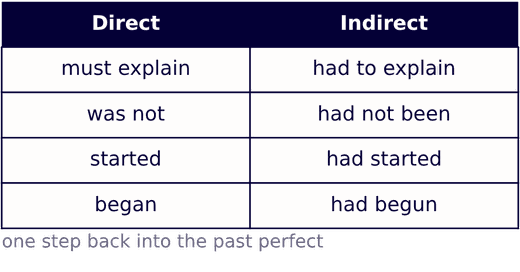 (a) and (d) keep 'must' unchanged, and (c) leaves 'was not' and 'began' unshifted, so only (b) applies the rule throughout.
Hence the correct option is (b).
(a) and (d) keep 'must' unchanged, and (c) leaves 'was not' and 'began' unshifted, so only (b) applies the rule throughout.
Hence the correct option is (b).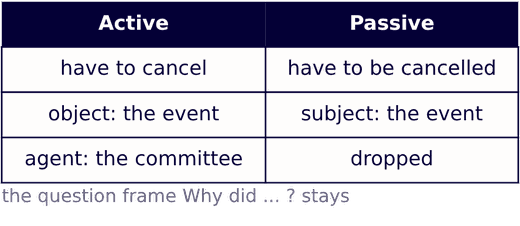 (a) and (c) destroy the question order by putting the subject before the auxiliary, and (b) drops 'have to' altogether, which changes the sense.
Hence the correct option is (d).
(a) and (c) destroy the question order by putting the subject before the auxiliary, and (b) drops 'have to' altogether, which changes the sense.
Hence the correct option is (d).