SSC CHSL 20 November 2025 · Shift 3 · Quantitative Aptitude — questions with answers · ShikshaSphere
Chapter 91 of 200
20 November 2025 · Shift 3
Quantitative Aptitude
25 questions ~25 min readFree
25 questions
A
51
If the square of 27 is 729 , then find the square of 175 .
A.30625
B.34625
C.35625
D.36625
Solution
Square of a number
For any number that ends in 5 there is a one-line rule: drop the 5, multiply what is left by the next whole number, and write 25 after the product.
In 175 the part left after dropping the 5 is 17, and the next whole number is 18.
, so .
Check by expanding: .
=28900+1700+25=30625.
Hence the correct option is (a).
52
Find the value of .
A.
B.
C.
D.
Solution
Trigonometric ratios
Put in the standard values: , , , and .
First term: .
Second term: .
Third term: .
Adding, the value .
Hence the correct option is (b).
53
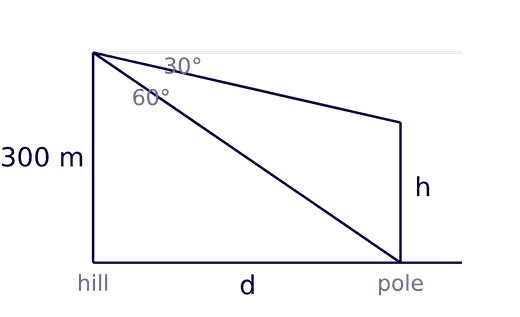
From the top of a hill 300 metres high, the angles of elevation of the top and bottom of a pole are 30° and 60°, respectively. The difference (in metres) between the height of the pole and its distance from the hill is:
A.
B.
C.
D.
Solution
Heights and distances
Let the pole stand at a horizontal distance d metres from the hill and let its height be h metres.
From the top of the hill the line of sight to the foot of the pole makes with the horizontal, and the whole 300 m of the hill lies below it.
.
The line of sight to the top of the pole makes , and the drop to that point is only 300-h.
.
So h=200 m and m.
Required difference metres.
Hence the correct option is (d).
54
A cube-shaped container with a side length of 12 cm is filled with water. A solid metal sphere with a radius of 6 cm is then submerged into the container. How much water, in cubic centimeters, will overflow ?
A.
B.
C.
D.
Solution
Volume of a sphere
The container is already full, so the water that spills out is exactly equal to the volume of the solid that goes in.
The sphere has diameter cm, the same as the side of the cube, so the whole sphere is submerged.
Volume of the sphere .
cubic centimetres.
The cube itself holds cubic centimetres, which is more than , so the sphere really does fit.
Hence the correct option is (a).
55
In triangle , side lengths are , and . Let M be the midpoint of side CA . Find the length of BM.
A.53.5 cm
B.72.5 cm
C.66.5 cm
D.89.2 cm
Solution
Median to the hypotenuse
In the longest side is CA=145 cm, so CA is the hypotenuse and the right angle is the one at B.
M is the midpoint of this hypotenuse, and BM is the median drawn from the right angle to the hypotenuse.
The midpoint of the hypotenuse of a right-angled triangle is the centre of its circumcircle, so it is the same distance from all three vertices: MA=MC=MB.
Hence cm.
Hence the correct option is (b).
56
What is the degree measure of radians ?
A.-240°0'0"
B.200°0'0'
C.-180°0'0*
D.-100°0'0"
Solution
Radian to degree
radians , so to change radians into degrees multiply by .
radians .
The cancels and , so the value .
, and since the answer is a whole number of degrees it is written .
Hence the correct option is (a).
57
Which of the following set can never form the sides of a triangle ?
A.2 cm, 4 cm, 5 cm
B.6 cm, 6 cm, 6 cm
C.
D.
Solution
Triangle inequality
Three lengths can close up into a triangle only if the sum of the two shorter ones is greater than the longest one.
(a) 2+4=6, which is greater than 5 — a triangle is possible.
(b) 6+6=12, which is greater than 6 — this is an equilateral triangle.
(d) 6+8=14, which is greater than 11 — a triangle is possible.
(c) 3+2=5, which is less than 7, so the two shorter sticks can never meet over the longest one.
Hence the correct option is (c).
58
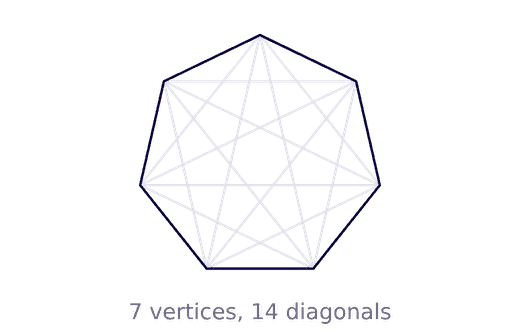
How many diagonals does a regular heptagon have ?
A.7
B.14
C.10
D.18
Solution
Diagonals of a polygon
From each vertex of an n-sided polygon you can draw a line to n-3 other vertices — all except the vertex itself and its two neighbours.
That gives n(n-3) lines, but every diagonal has been counted from both of its ends, so the number of diagonals is .
A heptagon has n=7.
Number of diagonals .
Hence the correct option is (b).
59
At a specific rate of simple interest, a sum of money becomes ₹20,500 after four years and ₹21,800 after six. Calculate the simple interest rate at 10% annually for five years on the same amount.
A.₹9,540
B.₹7,140
C.₹8,950
D.₹8,440
Solution
Simple interest
Under simple interest the amount grows by the same sum every year, so the growth between two years tells us the yearly interest.
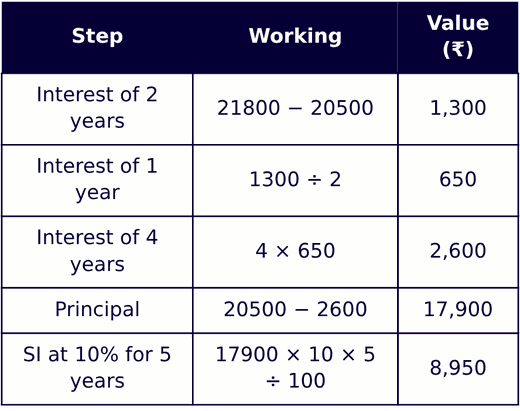
Interest of the 4th to the 6th year =21800-20500=1300, i.e. ₹1,300 for 2 years.
Interest for one year , i.e. ₹650, so the interest of the first 4 years , i.e. ₹2,600.
Principal =20500-2600=17900, i.e. ₹17,900.
Now use with P=17900, R=10 and T=5.
, i.e. ₹8,950.
Hence the correct option is (c).
60
A specific amount of principal is invested by an individual. The annual simple interest rate is 7% for the first two years, 10% for the following four, and for the remaining time. The total interest earned after nine years is ₹8,100. How much was invested initially?
A.₹9,500
B.₹8,000
C.₹9,000
D.₹9,800
Solution
Simple interest
Let the principal be P. The nine years split as 2 years, 4 years and the rest.
Remaining time =9-2-4=3 years, which carries the rate of .
Interest of the first 2 years at .
Interest of the next 4 years at .
Interest of the last 3 years at .
Total interest .
, i.e. ₹9,000.
Hence the correct option is (c).
61
A person takes a loan of ₹45,000 for 3 years at a rate of interest of 10%. What will be the total amount to be paid after 3 years?
A.₹58,500
B.₹58,000
C.₹59,000
D.₹50,000
Solution
Simple interest
The loan is repaid with simple interest, so first work out the interest for the whole period.
Simple interest
, i.e. ₹13,500.
Amount to be paid = principal + interest =45000+13500=58500.
So ₹58,500 has to be repaid after 3 years.
Hence the correct option is (a).
62
In two concentric circles, the radius of circle is less than the radius of circle . If PQ is a chord of circle of length 20 cm , touching circle at point M , find the length of MQ .
A.40 cm
B.15 cm
C.10 cm
D.8 cm
Solution
Tangent and chord
Let O be the common centre of the two circles.
PQ touches the smaller circle at M, and the radius drawn to the point of contact is perpendicular to the tangent, so .
But OM is now the perpendicular dropped from the centre of the bigger circle on to its chord PQ, and such a perpendicular bisects the chord.
cm
Hence the correct option is (c).
63
In a circle, there are two parallel chords of lengths 16 cm and 30 cm. Both chords are situated on the same side of the center. If the distance between them is 7 cm , find the area of the circle.
A. square cm
B. square cm
C. square cm
D. square cm
Solution
Parallel chords of a circle
The perpendicular from the centre bisects a chord, so the half-chords are cm and cm.
Of two chords the shorter one is farther from the centre, so the 16 cm chord is the farther of the two.
Let the 30 cm chord be at a distance d cm from the centre; then the 16 cm chord is at (d+7) cm.
Both distances belong to the same radius r:
Area square cm.
Hence the correct option is (a).
64
When the radius of a hemisphere is increased by 14 cm , its surface area increases by . Find the volume (in ) of the original hemisphere. (Take )
A.
B.
C.
D.
Solution
Surface area and volume of a hemisphere
A solid hemisphere has a curved surface and a flat circular face , so its total surface area is .
cm
Volume of the original hemisphere
So the volume is 19404 cubic cm.
Hence the correct option is (c).
65
A rope is cut into two pieces. The first piece is of the total length. The second piece is 10 meters long. What was the original length of the rope?
A.45 meters
B.25 meters
C.50 meters
D.35 meters
Solution
Fractions of a whole
Let the original length of the rope be L metres.
The first piece is , so the second piece is .
The second piece measures 10 metres, so .
So the rope was 35 metres long.
Hence the correct option is (d).
66
Triangle has an area of 13 . A similar triangle, , has a perimeter that is twice the perimeter of Triangle ABC. What is the area of Triangle ?
A.
B.
C.
D.
Solution
Similar triangles
In two similar triangles the perimeters are in the same ratio as the corresponding sides.
Here the perimeter is doubled, so the corresponding sides are in the ratio 2:1.
The areas of similar triangles are in the ratio of the squares of the corresponding sides, i.e. .
Area of
So the larger triangle has an area of 52 square cm.
Hence the correct option is (c).
67
In a circle with radius of 15 cm, a chord forms a central angle of . What is the length of the chord?
A.10 cm
B.15 cm
C.13 cm
D.16 cm
Solution
Chord and central angle
Let AB be the chord and O the centre, so that .
OA and OB are radii of the same circle, so OA=OB=15 cm and is isosceles.
The two base angles are therefore equal: .
All three angles are , so is equilateral and the chord equals the radius.
AB=15 cm
Hence the correct option is (b).
68
In a circle with center O, points P, Q, and R are on the circumference. If the angle , what is the measure of the angle ?
A.50°
B.55*
C.60°
D.45°
Solution
Angle at centre and circumference
The arc PQ subtends at the centre and at the point R on the remaining part of the circle.
By the angle-at-the-centre theorem, the angle at the centre is twice the angle at any point of the remaining arc.
Hence the correct option is (a).
69
If two circles touch each other internally, what is the number of internal common tangents that can be drawn ?
A.3
B.4
C.1
D.0
Solution
Common tangents to circles
An internal (transverse) common tangent is one that passes between the two circles and cuts the line joining their centres.
Such a tangent exists only when neither circle lies inside the other, that is when the distance between the centres is at least the sum of the radii.
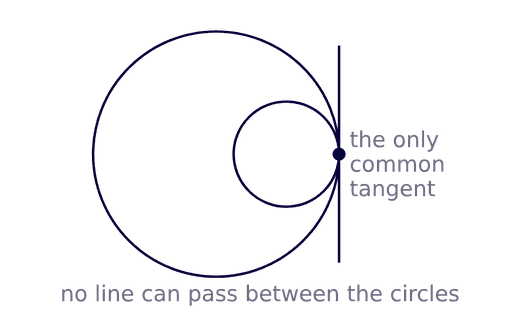
When two circles touch internally, the smaller one lies completely inside the larger and they meet at a single point.
No straight line can then pass between them, so the number of internal common tangents is 0.
Such a pair has only one common tangent altogether, the one drawn at the point of contact, and that is a direct (external) tangent.
Hence the correct option is (d).
70
How many common tangents do two circles have when the distance between their centers equals the sum of their radii ?
A.4
B.1
C.5
D.3
Solution
Number of common tangents
Let d be the distance between the centres and the radii.
is exactly the condition for the two circles to touch each other externally.
Two direct (external) common tangents can be drawn, one on either side of the pair.
At the single point of contact one more tangent is common to both circles, and it is the only transverse one.
Total number of common tangents =2+1=3.
Hence the correct option is (d).
71
Two circles with radii of 3 cm and 5 cm have a distance of 17 cm between their centers. What is the length of the common internal tangent between the two circles?
A.12cm
B.16 cm
C.15 cm
D.13 cm
Solution
Length of internal tangent
For two circles that lie outside each other, the length of a common internal (transverse) tangent is , where d is the distance between the centres.
Here d=17 cm, cm and cm, so cm.
Length
cm
Hence the correct option is (c).
72
Two circles have radii 10 cm and 8 cm . The distance between their centers is 20 cm . What is the length of their common internal tangent segment?
A.
B.
C.19 cm
D.
Solution
Length of internal tangent
Length of a common internal tangent .
Here cm and d=20 cm, and since 20>18 the circles lie apart, so the tangent exists.
Length
cm
Hence the correct option is (a).
73
The lengths of a common external tangent and a common internal tangent to two circles are 12 cm and 5 cm , respectively. If the distance between the centers of the circles is 13 cm , find the radii of the two circles.
A.5.5 cm and 3.5 cm
B.7.5 cm and 1.5 cm
C.8 cm and 4 cm
D.8.5 cm and 3.5 cm
Solution
External and internal tangents
Common external tangent and common internal tangent , with d=13 cm.
From the external tangent:
From the internal tangent:
Adding the two results: cm
cm
So the radii are 8.5 cm and 3.5 cm.
Hence the correct option is (d).
74
A person walks at 7 km/h. If he increases his speed to , he takes 36 minutes less to cover a distance. What is the distance?
A.2.0 km
B.2.4 km
C.1.4 km
D.3.5 km
Solution
Speed, time and distance
For a fixed distance the time taken is inversely proportional to the speed.
The speeds are in the ratio 7:10, so the times are in the ratio 10:7.
The difference of 10-7=3 parts stands for the 36 minutes saved, so 1 part =12 minutes.
Time at 7 km/h minutes =2 hours.
Distance = speed time km.
Hence the correct option is (c).
75
A 5 : 3 mixture of juice and soda is contained in a vessel. The ratio of juice to soda becomes when 8 litres of the mixture is removed and the same volume of soda is added to the vessel.How much juice was there in the vessel at the beginning ?
A.12 litres
B.15 litres
C.18 litres
D.20 litres
Solution
Mixture and alligation
Let the vessel hold 5x litres of juice and 3x litres of soda, that is 8x litres in all.
The 8 litres taken out is mixture, so it carries juice and soda in the ratio 5:3, i.e. 5 litres of juice and 3 litres of soda.
Juice left =5x-5; soda left =3x-3, and adding 8 litres of soda makes it 3x-3+8=3x+5.
7(5x-5)=5(3x+5)
35x-35=15x+25
Juice at the beginning litres.
Hence the correct option is (b).
Finished reading? Now test yourself.
The same 25 questions, but with a timer and the answers hidden — 15 minutes.

 From the top of the hill the line of sight to the foot of the pole makes with the horizontal, and the whole 300 m of the hill lies below it.
.
The line of sight to the top of the pole makes , and the drop to that point is only 300-h.
.
So h=200 m and m.
Required difference metres.
Hence the correct option is (d).
From the top of the hill the line of sight to the foot of the pole makes with the horizontal, and the whole 300 m of the hill lies below it.
.
The line of sight to the top of the pole makes , and the drop to that point is only 300-h.
.
So h=200 m and m.
Required difference metres.
Hence the correct option is (d).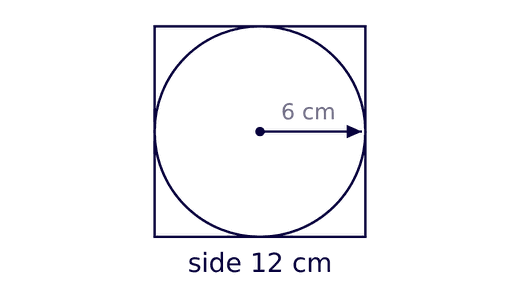 Volume of the sphere .
cubic centimetres.
The cube itself holds cubic centimetres, which is more than , so the sphere really does fit.
Hence the correct option is (a).
Volume of the sphere .
cubic centimetres.
The cube itself holds cubic centimetres, which is more than , so the sphere really does fit.
Hence the correct option is (a).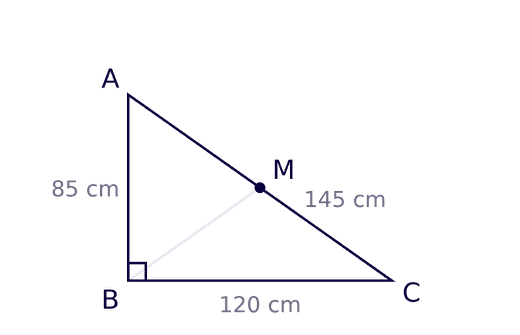 The midpoint of the hypotenuse of a right-angled triangle is the centre of its circumcircle, so it is the same distance from all three vertices: MA=MC=MB.
Hence cm.
Hence the correct option is (b).
The midpoint of the hypotenuse of a right-angled triangle is the centre of its circumcircle, so it is the same distance from all three vertices: MA=MC=MB.
Hence cm.
Hence the correct option is (b).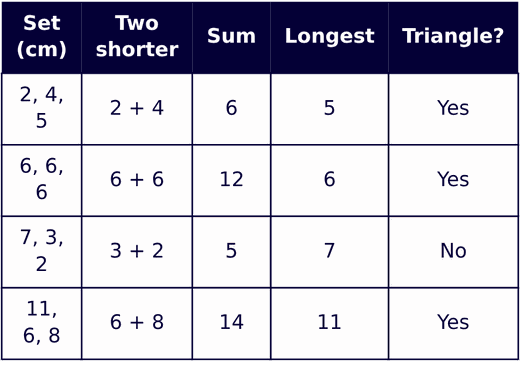 Hence the correct option is (c).
 Hence the correct option is (b).
 Now use with P=17900, R=10 and T=5.
, i.e. ₹8,950.
Hence the correct option is (c).
Now use with P=17900, R=10 and T=5.
, i.e. ₹8,950.
Hence the correct option is (c).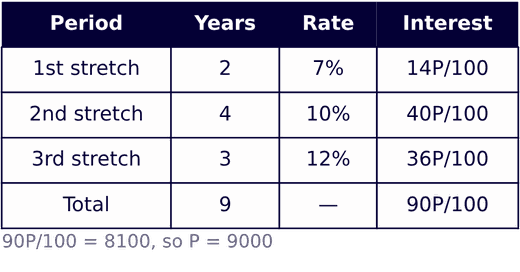 Total interest .
, i.e. ₹9,000.
Hence the correct option is (c).
Total interest .
, i.e. ₹9,000.
Hence the correct option is (c).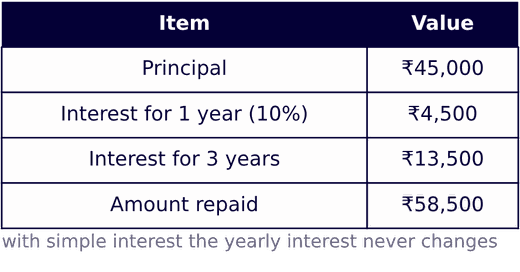 Amount to be paid = principal + interest =45000+13500=58500.
So ₹58,500 has to be repaid after 3 years.
Hence the correct option is (a).
Amount to be paid = principal + interest =45000+13500=58500.
So ₹58,500 has to be repaid after 3 years.
Hence the correct option is (a).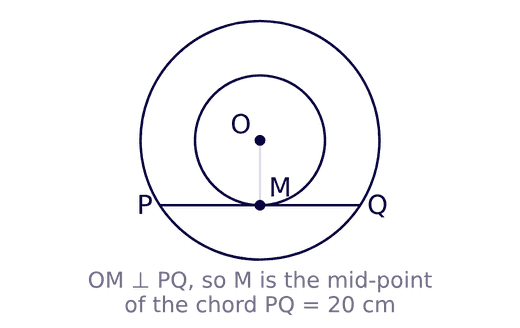 But OM is now the perpendicular dropped from the centre of the bigger circle on to its chord PQ, and such a perpendicular bisects the chord.
cm
Hence the correct option is (c).
But OM is now the perpendicular dropped from the centre of the bigger circle on to its chord PQ, and such a perpendicular bisects the chord.
cm
Hence the correct option is (c).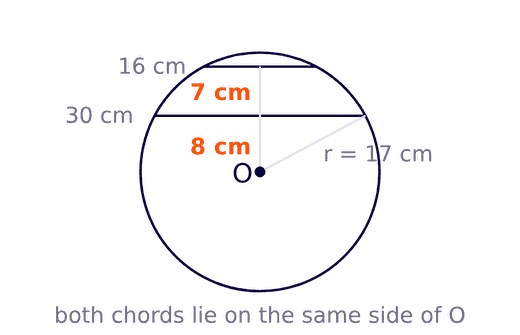 Both distances belong to the same radius r:
Area square cm.
Hence the correct option is (a).
Both distances belong to the same radius r:
Area square cm.
Hence the correct option is (a).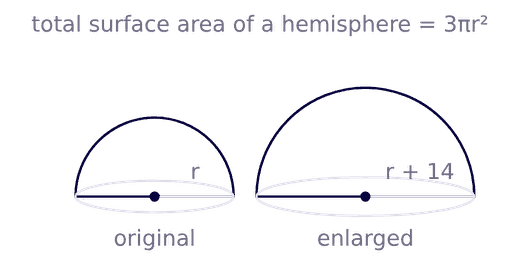 cm
Volume of the original hemisphere
So the volume is 19404 cubic cm.
Hence the correct option is (c).
cm
Volume of the original hemisphere
So the volume is 19404 cubic cm.
Hence the correct option is (c).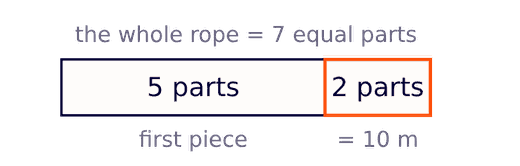 The second piece measures 10 metres, so .
So the rope was 35 metres long.
Hence the correct option is (d).
The second piece measures 10 metres, so .
So the rope was 35 metres long.
Hence the correct option is (d).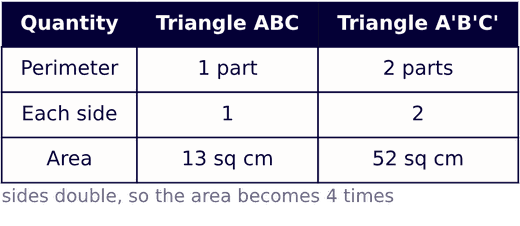 Area of
So the larger triangle has an area of 52 square cm.
Hence the correct option is (c).
Area of
So the larger triangle has an area of 52 square cm.
Hence the correct option is (c).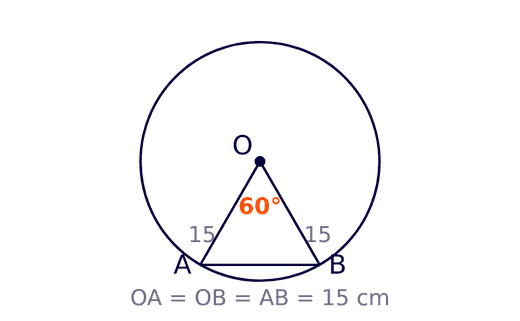 All three angles are , so is equilateral and the chord equals the radius.
AB=15 cm
Hence the correct option is (b).
All three angles are , so is equilateral and the chord equals the radius.
AB=15 cm
Hence the correct option is (b).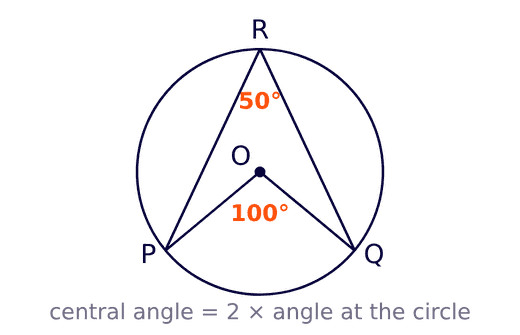 Hence the correct option is (a).
 No straight line can then pass between them, so the number of internal common tangents is 0.
Such a pair has only one common tangent altogether, the one drawn at the point of contact, and that is a direct (external) tangent.
Hence the correct option is (d).
No straight line can then pass between them, so the number of internal common tangents is 0.
Such a pair has only one common tangent altogether, the one drawn at the point of contact, and that is a direct (external) tangent.
Hence the correct option is (d).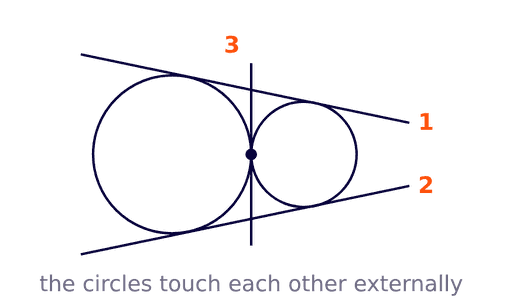 Two direct (external) common tangents can be drawn, one on either side of the pair.
At the single point of contact one more tangent is common to both circles, and it is the only transverse one.
Total number of common tangents =2+1=3.
Hence the correct option is (d).
Two direct (external) common tangents can be drawn, one on either side of the pair.
At the single point of contact one more tangent is common to both circles, and it is the only transverse one.
Total number of common tangents =2+1=3.
Hence the correct option is (d).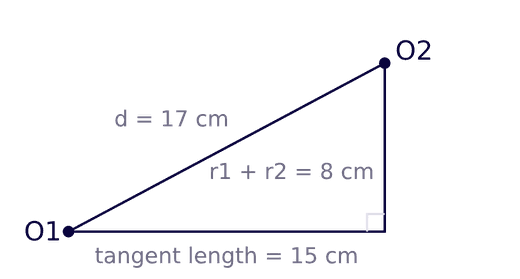 Length
cm
Hence the correct option is (c).
Length
cm
Hence the correct option is (c).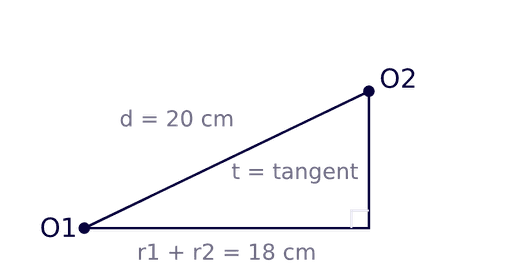 Length
cm
Hence the correct option is (a).
Length
cm
Hence the correct option is (a).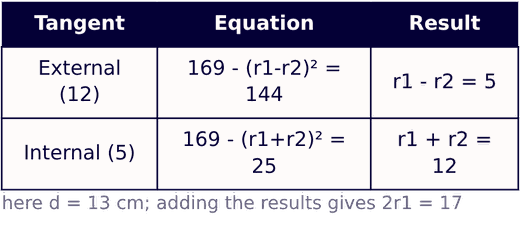 Adding the two results: cm
cm
So the radii are 8.5 cm and 3.5 cm.
Hence the correct option is (d).
Adding the two results: cm
cm
So the radii are 8.5 cm and 3.5 cm.
Hence the correct option is (d).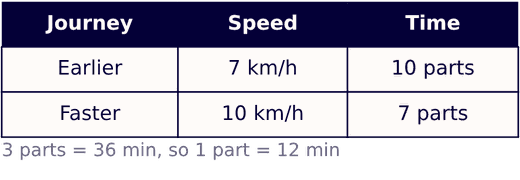 The difference of 10-7=3 parts stands for the 36 minutes saved, so 1 part =12 minutes.
Time at 7 km/h minutes =2 hours.
Distance = speed time km.
Hence the correct option is (c).
The difference of 10-7=3 parts stands for the 36 minutes saved, so 1 part =12 minutes.
Time at 7 km/h minutes =2 hours.
Distance = speed time km.
Hence the correct option is (c).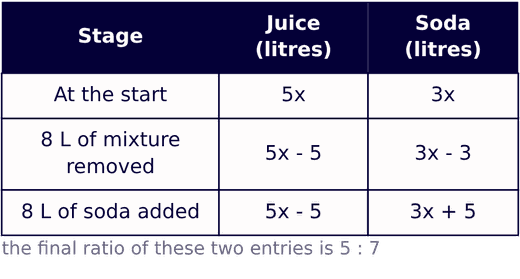 7(5x-5)=5(3x+5)
35x-35=15x+25
Juice at the beginning litres.
Hence the correct option is (b).
7(5x-5)=5(3x+5)
35x-35=15x+25
Juice at the beginning litres.
Hence the correct option is (b).