SSC CHSL 20 November 2025 · Shift 3 · General Awareness — questions with answers · ShikshaSphere
Chapter 90 of 200
20 November 2025 · Shift 3
General Awareness
25 questions ~25 min readFree
25 questions
A
76
Which Delhi Sultan is known for appointing people from humble and low social backgrounds to high administrative positions ?
A.Muhammad bin Tughlaq
B.Alauddin Khalji
C.Firoz Shah Tughlaq
D.Sikandar Lodi
Solution
Delhi Sultanate administration
Muhammad bin Tughlaq (1325-1351) is the Delhi Sultan remembered for raising men of humble birth to the highest offices of the state.
Chroniclers name a wine-distiller (Aziz Khummar), a barber (Firuz Hajjam), a cook (Manka Tabbakh) and gardeners such as Ladha and Pira among those he made governors and revenue officers.
The court historian Ziauddin Barani, himself of noble descent, attacked these appointments in his Tarikh-i-Firoz Shahi as proof of the Sultan's poor political judgement.
The Sultan's aim was to build a bureaucracy loyal to him alone and to loosen the grip of the old Turkish nobility, judging men by ability rather than by lineage.
Alauddin Khalji is remembered for his market regulations, Firoz Shah Tughlaq for canals and public works, and Sikandar Lodi for founding Agra.
Hence the correct option is (a).
77
Which of the following regions was annexed by Emperor Akbar in 1568, marking a major milestone in Mughal expansion?
A.Malwa
B.Sindh
C.Chittor
D.Kashmir
Solution
Mughal expansion under Akbar
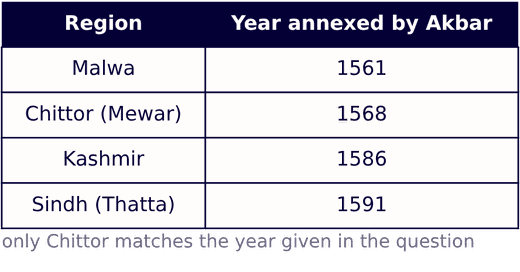
Akbar laid siege to the fort of Chittor in October 1567 and took it in February 1568, annexing the territory that same year.
Chittor was the stronghold of the Sisodia Rajputs of Mewar; Rana Udai Singh II withdrew to the hills, leaving Jaimal and Patta to lead the celebrated defence, and Akbar later placed their statues at the Agra fort gate.
The fall of Chittor secured the road from Agra to Gujarat and announced Mughal supremacy in Rajputana, so it is treated as a landmark of Mughal expansion.
Malwa had already been taken in 1561, while Kashmir was annexed in 1586 and Sindh in 1591, so none of them belongs to 1568.
Hence the correct option is (c).
78
Which of the following features of the Indian Constitution has been borrowed from the Constitution of Japan?
A.Concept of "procedure established by Law*
B.Doctrine of separation of powers
C.Federal system with strong Centre
D.Parliamentary form of government
Solution
Sources of the Indian Constitution
The expression "procedure established by law", used in Article 21, was taken from the Constitution of Japan.
It means that a person may be deprived of life or personal liberty only by following a procedure laid down in a law duly enacted by the legislature.
The American phrase "due process of law", under which a court may also test whether the law itself is just, was deliberately not adopted, although Maneka Gandhi v. Union of India (1978) read much of that fairness into Article 21.
The parliamentary form of government comes from the United Kingdom, the doctrine of separation of powers from the United States, and the federation with a strong Centre from Canada.
Hence the correct option is (a).
79
Which of the following countries is a founding member of the Shanghai Cooperation Organisation (SCO), established in 2001?
A.Afghanistan
B.Sri Lanka
C.Nepal
D.Kazakhstan
Solution
Shanghai Cooperation Organisation
The Shanghai Cooperation Organisation was set up at Shanghai on 15 June 2001 by six countries: China, Russia, Kazakhstan, Kyrgyzstan, Tajikistan and Uzbekistan.
Of the four options only Kazakhstan is among these six founding members.
The body grew out of the "Shanghai Five" grouping of 1996, which had the same members except Uzbekistan.
India and Pakistan became full members in 2017 and Iran in 2023; Afghanistan holds only observer status, while Nepal and Sri Lanka are dialogue partners.
Hence the correct option is (d).
80
The International Court of Justice (ICJ), the principal judicial organ of the United Nations, is headquartered at :
A.Hague
B.Geneva
C.Vienna
D.Rome
Solution
Headquarters of the ICJ
The International Court of Justice sits in the Peace Palace at The Hague in the Netherlands.
Created in 1945 by the Charter of the United Nations, it settles disputes between states and gives advisory opinions to UN organs.
It is the only one of the six principal organs of the United Nations that does not sit in New York.
Geneva houses the WHO, the ILO and the WTO, Vienna the IAEA, and Rome the FAO, so the other options belong to different bodies.
Hence the correct option is (a).
81
Harmanpreet Singh, who received the Major Dhyan Chand Khel Ratna Award 2024, is associated with which sport?
A.Badminton
B.Hockey
C.Wrestling
D.Athletics
Solution
Khel Ratna Award 2024
Harmanpreet Singh is the captain and drag-flick specialist of the Indian men's national hockey team, so the sport asked for is hockey.
He received the Major Dhyan Chand Khel Ratna Award 2024 for leading India to a second successive Olympic bronze medal at Paris 2024, where he finished as the tournament's highest scorer with 10 goals.
The award itself is named after Major Dhyan Chand, the hockey legend, and is the highest sporting honour of the country.
The other Khel Ratna awardees of 2024 were Manu Bhaker (shooting), D Gukesh (chess) and Praveen Kumar (para-athletics), so badminton, wrestling and athletics do not fit.
Hence option (b) is correct.
82
In September 2024, the Supreme Court reaffirmed that the Protection of Women from Domestic Violence Act,
is applicable to all women in India irrespective of religion or social background.
A.2002
B.2004
C.2005
D.2008
Solution
Domestic Violence Act
The year that completes the title is 2005 — the law is the Protection of Women from Domestic Violence Act, 2005, which came into force on 26 October 2006.
It is a civil law. It defines domestic violence widely enough to cover physical, sexual, verbal, emotional and economic abuse, and gives an aggrieved woman the right to reside in the shared household along with protection, residence, monetary and custody orders.
In September 2024 a Supreme Court bench led by Justice B.V. Nagarathna described the Act as a piece of civil code that applies to every woman in India, whatever her religion or social background.
The Act works through Protection Officers and service providers appointed by the State Governments, and the magistrate is expected to dispose of an application normally within 60 days.
Hence option (c) is correct.
83
Launched in 2025, the Gyan Bharatam Mission primarily focuses on which of the following objectives?
A.To digitally archive ancient sculptures
B.To survey, document, and conserve India's manuscript heritage
C.To sponsor contemporary literary awards
D.To modernise public library infrastructure
Solution
Gyan Bharatam Mission
The Gyan Bharatam Mission was announced in the Union Budget 2025-26 and launched by the Ministry of Culture; its purpose is to survey, document, conserve and digitise India's manuscript heritage.
The target is more than one crore manuscripts lying with academic institutions, museums, libraries, temples, monasteries and private collectors, which are to be brought together in a National Digital Repository.
It revamps and absorbs the National Mission for Manuscripts of 2003 and carries an outlay of about ₹482 crore, using modern tools and artificial intelligence to make the texts searchable for scholars.
The mission is about written manuscripts, not sculptures, literary prizes or library buildings, so the other three options lie outside its scope.
Hence option (b) is correct.
84
According to the World Air Quality Report 2024, what is India's rank among the most polluted countries in the world?
A.3rd
B.5th
C.12th
D.40th
Solution
World Air Quality Report
The World Air Quality Report is published every year by IQAir, a Swiss air-quality technology company; the 2024 edition came out in March 2025.
In it India was placed 5th among the most polluted countries of the world, behind Chad, Bangladesh, Pakistan and the Democratic Republic of the Congo.
India had stood 3rd in the 2023 report, and the improvement came from average PM2.5 falling from about 54.4 to 50.6 micrograms per cubic metre — still more than ten times the WHO guideline of 5.
Byrnihat in Meghalaya was named the most polluted city in the world and Delhi remained the most polluted capital city, so the improvement in rank did not mean clean air.
Hence option (b) is correct.
85
NITI Aayog released the first School Education Quality Index (SEQI) to assess school education outcomes across States and UTs in which year ?
A.2019
B.2017
C.2018
D.2022
Solution
School Education Quality Index
NITI Aayog released the first School Education Quality Index (SEQI) on 30 September 2019, prepared with the then Ministry of Human Resource Development and with technical support from the World Bank.
It grades States and Union Territories on 30 indicators grouped under two heads — Outcomes, which cover learning, access, equity and infrastructure, and Governance Processes aiding outcomes.
States are compared only within their own group — Large States, Small States and Union Territories — so that like is matched with like; the first report used 2016-17 as the reference year against the base year 2015-16.
Kerala topped the Large States with a score of 76.6, Rajasthan showed the biggest improvement, Manipur led the Small States and Chandigarh the Union Territories.
Hence option (a) is correct.
86
Which of the following protected areas is the second largest habitat of the One-Horned Rhinoceros in India ?
A.Manas National Park
B.Jaldapara National Park
C.Bandhavgarh National Park
D.Pench National Park
Solution
One-horned rhino habitat
The Great One-Horned Rhinoceros survives in India mainly in the Brahmaputra floodplain of Assam and in the Dooars belt of northern West Bengal.
Jaldapara National Park, on the bank of the Torsa in Alipurduar district of West Bengal, holds the second largest rhino population in the country after Kaziranga.
Kaziranga carries well over two thousand rhinos and Jaldapara a little over three hundred, while Pobitora Wildlife Sanctuary in Assam has the highest density of rhinos anywhere in the world.
Manas National Park is a rhino site too but a much smaller one, and Bandhavgarh and Pench are tiger reserves of Madhya Pradesh with no rhinos at all.
Hence option (b) is correct.
87
India formally began its space research programme with the launch of a meteorological rocket from Thumba in which year?
A.1954
B.1958
C.1963
D.1975
Solution
Beginning of Indian space programme
India's space programme formally began on 21 November 1963, when a Nike-Apache sounding rocket was launched from Thumba near Thiruvananthapuram in Kerala.
Thumba was chosen because it lies almost exactly on the Earth's magnetic equator, which makes it the right place to study the equatorial electrojet and the upper atmosphere.
The work was led by Dr Vikram Sarabhai, the father of the Indian space programme; the station was named the Thumba Equatorial Rocket Launching Station (TERLS), INCOSPAR having been set up in 1962 and ISRO following in 1969.
The year 1975 in the options belongs to Aryabhata, India's first satellite, which is a later milestone and not the beginning of the programme.
Hence option (c) is correct.
88
The Satish Dhawan Space Centre (SDSC), India's primary satellite launch facility, is located at:
A.Thiruvananthapuram
B.Bengaluru
C.Hyderabad
D.Sriharikota
Solution
Satish Dhawan Space Centre
The Satish Dhawan Space Centre stands on Sriharikota, a spindle-shaped barrier island on the Bay of Bengal coast of Andhra Pradesh, lying between Pulicat Lake and the sea.
It was set up in 1971 as the Sriharikota Range (SHAR) and renamed in 2002 in memory of Satish Dhawan, a former Chairman of ISRO.
Its position close to the equator lets an eastward launch borrow extra speed from the Earth's rotation, and the spent stages fall harmlessly into the sea.
Every PSLV, GSLV and LVM3 mission, including Chandrayaan and Mangalyaan, has lifted off from its pads; Thiruvananthapuram houses VSSC, Bengaluru the ISRO headquarters and Hyderabad the NRSC, but none of these is a launch site.
Hence option (d) is correct.
89
Which of the following statements is/are correct regarding the gaseous state of matter?
I. Gas particles have high kinetic energy and move freely.
II. Gases can be easily compressed compared to solids and liquids.
A.Only I
B.Only II
C.Both I and II
D.Neither I nor II
Solution
Gaseous state of matter
Statement I is correct. In a gas the force of attraction between particles is very weak, so the particles carry the highest kinetic energy of the three states and move freely and randomly in every direction.
Statement II is correct as well. The gap between gas molecules is very large compared with the size of the molecules themselves, and squeezing out this empty space makes a gas highly compressible.
This is why a large volume of gas such as CNG or LPG can be stored in a small cylinder, whereas solids and liquids, whose particles are already close together, are almost incompressible.
Both statements therefore describe the gaseous state correctly, exactly as the kinetic theory of matter states.
Hence option (c) is correct.
90
In August 2025, the Defence Research and Development Organisation (DRDO) successfully tested the 'Sudarshan Chakra' project, which is related to:
A.Hypersonic glide vehicle
B.Ballistic missile interceptor
C.Autonomous underwater vehicle
D.Air Defence Laser System
Solution
Mission Sudarshan Chakra
In August 2025 DRDO carried out the first flight tests of the Integrated Air Defence Weapon System (IADWS) at the National Open Air Range, Gopalpur in Odisha, under Mission Sudarshan Chakra.
The system meets an air target in layers, and its innermost layer is a high-energy laser Directed Energy Weapon that burns down drones and other small aerial targets.
Mission Sudarshan Chakra was announced by the Prime Minister in the Independence Day address of 15 August 2025 as a national security shield to be ready by 2035, both defensive and offensive in character.
What was tested was thus an air-defence system built around a laser, and not a hypersonic glide vehicle, an interceptor of the separate Ballistic Missile Defence programme, or an underwater vehicle.
Hence option (d) is correct.
91
After the death of Guru Gobind Singh, under whose leadership did the Khalsa rise in revolt against Mughal rule?
A.Guru Tegh Bahadur
B.Banda Bahadur
C.Maharaja Ranjit Singh
D.Guru Har Rai
Solution
Banda Singh Bahadur
Guru Gobind Singh died at Nanded in 1708, and shortly before that he had sent Banda Singh Bahadur to Punjab as the military leader of the Khalsa.
Born Lachhman Dev and known earlier as the hermit Madho Das, he captured Samana and Sadhaura and then Sirhind in 1710, defeating its faujdar Wazir Khan at the battle of Chappar Chiri.
He made Lohgarh his capital, struck coins in the name of Guru Nanak and Guru Gobind Singh, and abolished the zamindari system by giving the land to those who tilled it — the first Sikh state.
He was captured at Gurdaspur and put to death at Delhi in 1716. Guru Tegh Bahadur and Guru Har Rai belong to an earlier period, while Maharaja Ranjit Singh ruled about a century later.
Hence option (b) is correct.
92
The Indian rupee was made convertible on the current account of the Balance of Payments (BoP) in :
A.August 1994
B.July 1993
C.April 1995
D.December 1996
Solution
Current account convertibility
Convertibility on the current account means the rupee can be freely exchanged for foreign currency for trade in goods and services, interest, dividends, travel and remittances — but not for capital transactions.
India reached it in stages after the 1991 crisis: LERMS gave a dual, partly market-determined exchange rate in 1992, the two rates were unified in March 1993, and full current-account convertibility came in August 1994.
With that step India accepted the obligations of Article VIII of the IMF Articles of Agreement, undertaking not to impose restrictions on payments for current international transactions.
The capital account is still only partly convertible; the Tarapore Committees of 1997 and 2006 laid down the road map for opening it further.
Hence option (a) is correct.
93
How many members can the President of India nominate to the Rajya Sabha under the Constitution?
A.8
B.12
C.16
D.18
Solution
Composition of Rajya Sabha
Article 80 of the Constitution fixes the maximum strength of the Rajya Sabha at 250 — not more than 238 representatives of the States and Union Territories, and 12 members nominated by the President.
The nominated members are chosen for special knowledge or practical experience of literature, science, art and social service, so that eminent persons can serve the House without fighting an election.
They have all the rights of an elected member except one: they cannot vote in the election of the President, though they may vote in the election of the Vice President.
In the Lok Sabha, by contrast, the President's power to nominate two members of the Anglo-Indian community was ended by the 104th Amendment of 2019.
Hence option (b) is correct.
94
Which of the following statements is/are correct regarding the eligibility for election of the Vice President of India ?
I. The candidate must be at least 35 years old.
II. The candidate must be qualified to be elected as a Rajya Sabha.
A.Only I
B.Only II
C.Both I and II
D.Neither I nor II
Solution
Vice President: qualifications
Article 66 lays down the qualifications for the office of Vice President: the person must be a citizen of India, must have completed 35 years of age, and must be qualified for election as a member of the Council of States.
Statement I is therefore correct, and Statement II is correct as well.
The qualification is tied to the Rajya Sabha because the Vice President is its ex-officio Chairman, whereas the President's qualification is tied to the Lok Sabha; the minimum age is 35 years in both offices.
He must also not hold any office of profit under the Union, a State or a local authority, though holding the office of President, Vice President, Governor or a Minister is not counted as an office of profit.
Hence option (c) is correct.
95
The AMUL milk cooperative, which played a pioneering role in India's White Revolution, was established in which year?
A.1946
B.1955
C.1965
D.1980
Solution
AMUL and White Revolution
AMUL began in 1946 as the Kaira District Co-operative Milk Producers' Union at Anand in Gujarat, formed by farmers who were being squeezed by the Polson dairy monopoly.
It was organised by Tribhuvandas Patel on the advice of Sardar Vallabhbhai Patel, with Morarji Desai helping to mobilise the villages behind the milk strike.
Dr Verghese Kurien joined in 1949 and turned the Anand pattern — village society, district union, state federation — into the model for Operation Flood, launched in 1970 by the National Dairy Development Board.
That White Revolution made India the largest milk producer in the world; the brand name AMUL, from the Sanskrit amulya meaning priceless, was adopted in 1955.
Hence option (a) is correct.
96
In which Indian state does iron ore occur in a series of hill ranges located in Sundergarh, Mayurbhanj and Jhar (Jharsuguda belt) ?
A.Chhattisgarh
B.Jharkhand
C.Odisha
D.Karnataka
Solution
Iron ore belts of India
The districts named in the question — Sundergarh, Mayurbhanj and the Jharsuguda belt — all lie in Odisha, which is the largest producer of iron ore in India.
The ore here is mostly high-grade haematite, worked in ranges such as Gorumahisani, Sulaipat and Badampahar in Mayurbhanj and the Bonai-Barsua belt in Sundergarh.
Keonjhar, with Joda and Banspani, is the richest district of all, and this ore feeds the Rourkela steel plant and the eastern ports.
Chhattisgarh's ore comes from Bailadila and Dalli-Rajhara, Jharkhand's from Noamundi and Gua in Singhbhum, and Karnataka's from Bellary-Hospet and Kudremukh, so none of those states matches the districts listed.
Hence option (c) is correct.
97
Why do single-celled organisms not require specific organs for intake of food, gas exchange, or removal of wastes?
A.They possess specialised organ systems
B.Their entire surface is in contact with the environment
C.Their metabolic activities are absent
D.They are dependent on multicellular organisms
Solution
Diffusion in unicellular organisms
In a single-celled organism such as Amoeba or Paramecium the whole body is one cell, so every part of its surface is in direct contact with the surrounding water.
Food can therefore be taken in anywhere on that surface, oxygen and carbon dioxide can be exchanged straight across the cell membrane, and wastes can pass out by simple diffusion.
Diffusion is fast enough only over very short distances, and here no molecule has to travel further than the width of a single cell, so no special organ is needed.
In a multicellular body most cells lie deep inside and never meet the environment, which is exactly why organ systems for digestion, respiration, circulation and excretion become necessary.
Option (c) is wrong because these organisms are fully active metabolically, and option (a) contradicts the question itself.
Hence option (b) is correct.
98
Which of the following statements is correct regarding blood vessels in the human circulatory system ?
A.Arteries are the vessels which carry blood away from the heart to various organs of the body.
B.Veins transport blood from organs directly into arteries.
C.Capillaries possess valves to regulate blood flow.
D.The smallest blood vessels are thick-walled and muscular.
Solution
Blood vessels
Arteries carry blood away from the heart to the various organs of the body, so option (a) states the definition correctly.
Because the blood leaving the heart is under high pressure, arteries have thick, elastic, muscular walls and carry no valves.
Veins bring blood back from the organs to the heart and not into arteries, and it is veins — not capillaries — that carry valves to stop the blood from flowing backwards.
Capillaries are the smallest vessels, with a wall only one cell thick so that gases, food and wastes can be exchanged with the surrounding cells; that is the opposite of thick and muscular.
Hence option (a) is correct.
99
Which of the following kings ruled during the lifetimes of both Gautama Buddha and Mahavira?
A.Bimbisara
B.Udayin
C.Ajatashatru
D.Pushyamitra Shunga
Solution
Magadha in the age of Buddha
Ajatashatru, the Haryanka ruler of Magadha, sat on the throne from about 492 to 460 BCE, and that reign covers the closing years of both the great teachers.
The Buddhist tradition places the Mahaparinirvana of Gautama Buddha in the eighth year of his reign, and the Jaina tradition places the nirvana of Mahavira at Pavapuri within the same reign.
He is remembered for hosting the First Buddhist Council at Rajagriha under Mahakassapa, for fortifying Rajagriha, and for annexing Kosala and the Vajji confederacy with the help of the rathamusala and the mahashilakantaka.
His father Bimbisara was put to death by him, his son Udayin later founded Pataliputra, and Pushyamitra Shunga belongs to the second century BCE, long after both teachers had gone.
Hence option (c) is correct.
100
What name did the ancient Greeks use to refer to the region around the Indus River ?
A.Persia
B.Indoi or Indike
C.Aryavarta
D.Jambudvipa
Solution
Origin of the name India
The Greeks and Iranians who reached the north-west about 2,500 years ago knew the Sindhu river by the name Indos or Hindos.
From that river name the Greeks called the land lying to its east Indike and its people the Indoi, and those words later became the modern name India.
The Iranians and Greeks dropped the initial 's' of Sindhu and said 'Hindu', which is how Hindustan came to mean the land beyond that river.
Aryavarta and Jambudvipa are names used in Sanskrit texts by Indians themselves and not by the Greeks, while Persia is the Greek name for Iran, not for the Indus region.
Hence option (b) is correct.
Finished reading? Now test yourself.
The same 25 questions, but with a timer and the answers hidden — 15 minutes.

 The fall of Chittor secured the road from Agra to Gujarat and announced Mughal supremacy in Rajputana, so it is treated as a landmark of Mughal expansion.
Malwa had already been taken in 1561, while Kashmir was annexed in 1586 and Sindh in 1591, so none of them belongs to 1568.
Hence the correct option is (c).
The fall of Chittor secured the road from Agra to Gujarat and announced Mughal supremacy in Rajputana, so it is treated as a landmark of Mughal expansion.
Malwa had already been taken in 1561, while Kashmir was annexed in 1586 and Sindh in 1591, so none of them belongs to 1568.
Hence the correct option is (c).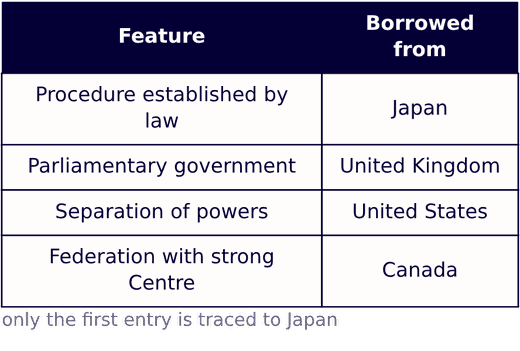 The American phrase "due process of law", under which a court may also test whether the law itself is just, was deliberately not adopted, although Maneka Gandhi v. Union of India (1978) read much of that fairness into Article 21.
The parliamentary form of government comes from the United Kingdom, the doctrine of separation of powers from the United States, and the federation with a strong Centre from Canada.
Hence the correct option is (a).
The American phrase "due process of law", under which a court may also test whether the law itself is just, was deliberately not adopted, although Maneka Gandhi v. Union of India (1978) read much of that fairness into Article 21.
The parliamentary form of government comes from the United Kingdom, the doctrine of separation of powers from the United States, and the federation with a strong Centre from Canada.
Hence the correct option is (a).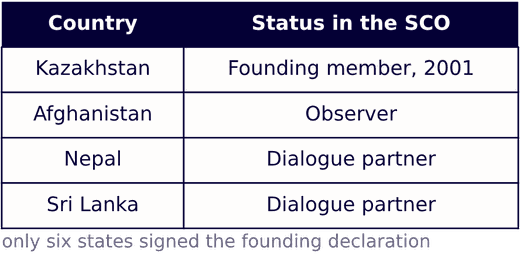 The body grew out of the "Shanghai Five" grouping of 1996, which had the same members except Uzbekistan.
India and Pakistan became full members in 2017 and Iran in 2023; Afghanistan holds only observer status, while Nepal and Sri Lanka are dialogue partners.
Hence the correct option is (d).
The body grew out of the "Shanghai Five" grouping of 1996, which had the same members except Uzbekistan.
India and Pakistan became full members in 2017 and Iran in 2023; Afghanistan holds only observer status, while Nepal and Sri Lanka are dialogue partners.
Hence the correct option is (d).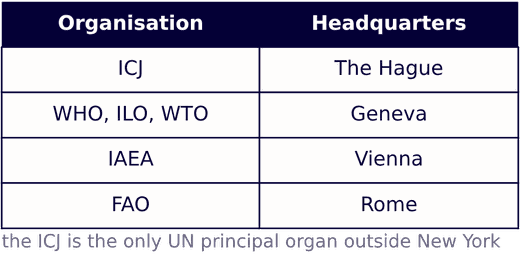 It is the only one of the six principal organs of the United Nations that does not sit in New York.
Geneva houses the WHO, the ILO and the WTO, Vienna the IAEA, and Rome the FAO, so the other options belong to different bodies.
Hence the correct option is (a).
It is the only one of the six principal organs of the United Nations that does not sit in New York.
Geneva houses the WHO, the ILO and the WTO, Vienna the IAEA, and Rome the FAO, so the other options belong to different bodies.
Hence the correct option is (a).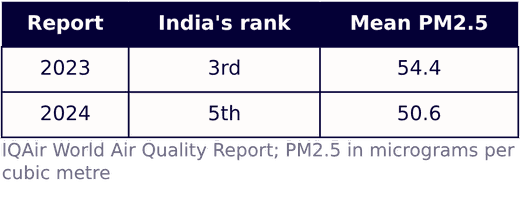 India had stood 3rd in the 2023 report, and the improvement came from average PM2.5 falling from about 54.4 to 50.6 micrograms per cubic metre — still more than ten times the WHO guideline of 5.
Byrnihat in Meghalaya was named the most polluted city in the world and Delhi remained the most polluted capital city, so the improvement in rank did not mean clean air.
Hence option (b) is correct.
India had stood 3rd in the 2023 report, and the improvement came from average PM2.5 falling from about 54.4 to 50.6 micrograms per cubic metre — still more than ten times the WHO guideline of 5.
Byrnihat in Meghalaya was named the most polluted city in the world and Delhi remained the most polluted capital city, so the improvement in rank did not mean clean air.
Hence option (b) is correct.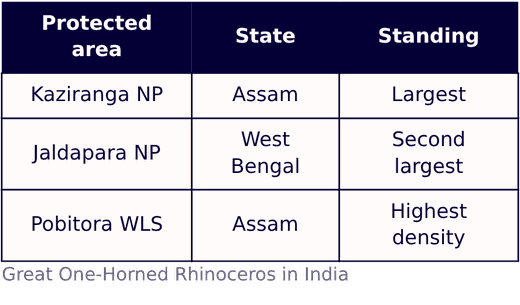 Kaziranga carries well over two thousand rhinos and Jaldapara a little over three hundred, while Pobitora Wildlife Sanctuary in Assam has the highest density of rhinos anywhere in the world.
Manas National Park is a rhino site too but a much smaller one, and Bandhavgarh and Pench are tiger reserves of Madhya Pradesh with no rhinos at all.
Hence option (b) is correct.
Kaziranga carries well over two thousand rhinos and Jaldapara a little over three hundred, while Pobitora Wildlife Sanctuary in Assam has the highest density of rhinos anywhere in the world.
Manas National Park is a rhino site too but a much smaller one, and Bandhavgarh and Pench are tiger reserves of Madhya Pradesh with no rhinos at all.
Hence option (b) is correct.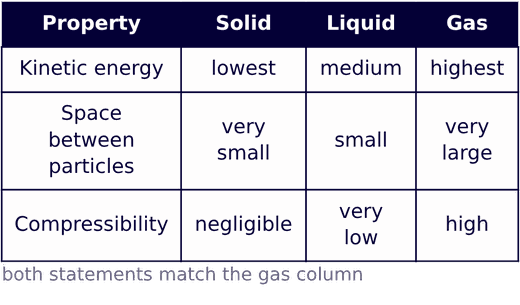 This is why a large volume of gas such as CNG or LPG can be stored in a small cylinder, whereas solids and liquids, whose particles are already close together, are almost incompressible.
Both statements therefore describe the gaseous state correctly, exactly as the kinetic theory of matter states.
Hence option (c) is correct.
This is why a large volume of gas such as CNG or LPG can be stored in a small cylinder, whereas solids and liquids, whose particles are already close together, are almost incompressible.
Both statements therefore describe the gaseous state correctly, exactly as the kinetic theory of matter states.
Hence option (c) is correct.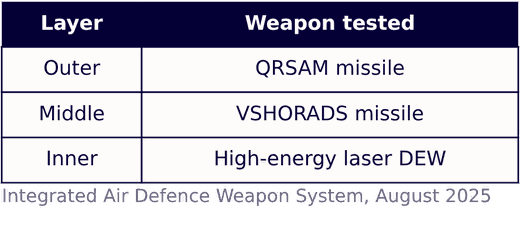 Mission Sudarshan Chakra was announced by the Prime Minister in the Independence Day address of 15 August 2025 as a national security shield to be ready by 2035, both defensive and offensive in character.
What was tested was thus an air-defence system built around a laser, and not a hypersonic glide vehicle, an interceptor of the separate Ballistic Missile Defence programme, or an underwater vehicle.
Hence option (d) is correct.
Mission Sudarshan Chakra was announced by the Prime Minister in the Independence Day address of 15 August 2025 as a national security shield to be ready by 2035, both defensive and offensive in character.
What was tested was thus an air-defence system built around a laser, and not a hypersonic glide vehicle, an interceptor of the separate Ballistic Missile Defence programme, or an underwater vehicle.
Hence option (d) is correct.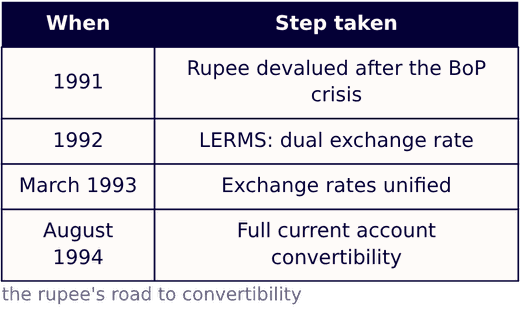 With that step India accepted the obligations of Article VIII of the IMF Articles of Agreement, undertaking not to impose restrictions on payments for current international transactions.
The capital account is still only partly convertible; the Tarapore Committees of 1997 and 2006 laid down the road map for opening it further.
Hence option (a) is correct.
With that step India accepted the obligations of Article VIII of the IMF Articles of Agreement, undertaking not to impose restrictions on payments for current international transactions.
The capital account is still only partly convertible; the Tarapore Committees of 1997 and 2006 laid down the road map for opening it further.
Hence option (a) is correct.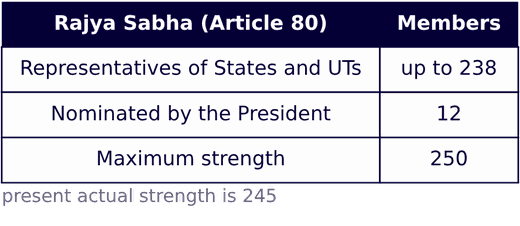 The nominated members are chosen for special knowledge or practical experience of literature, science, art and social service, so that eminent persons can serve the House without fighting an election.
They have all the rights of an elected member except one: they cannot vote in the election of the President, though they may vote in the election of the Vice President.
In the Lok Sabha, by contrast, the President's power to nominate two members of the Anglo-Indian community was ended by the 104th Amendment of 2019.
Hence option (b) is correct.
The nominated members are chosen for special knowledge or practical experience of literature, science, art and social service, so that eminent persons can serve the House without fighting an election.
They have all the rights of an elected member except one: they cannot vote in the election of the President, though they may vote in the election of the Vice President.
In the Lok Sabha, by contrast, the President's power to nominate two members of the Anglo-Indian community was ended by the 104th Amendment of 2019.
Hence option (b) is correct.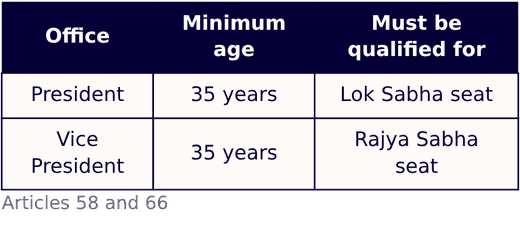 The qualification is tied to the Rajya Sabha because the Vice President is its ex-officio Chairman, whereas the President's qualification is tied to the Lok Sabha; the minimum age is 35 years in both offices.
He must also not hold any office of profit under the Union, a State or a local authority, though holding the office of President, Vice President, Governor or a Minister is not counted as an office of profit.
Hence option (c) is correct.
The qualification is tied to the Rajya Sabha because the Vice President is its ex-officio Chairman, whereas the President's qualification is tied to the Lok Sabha; the minimum age is 35 years in both offices.
He must also not hold any office of profit under the Union, a State or a local authority, though holding the office of President, Vice President, Governor or a Minister is not counted as an office of profit.
Hence option (c) is correct.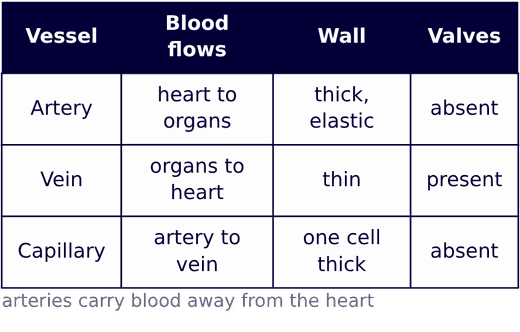 Veins bring blood back from the organs to the heart and not into arteries, and it is veins — not capillaries — that carry valves to stop the blood from flowing backwards.
Capillaries are the smallest vessels, with a wall only one cell thick so that gases, food and wastes can be exchanged with the surrounding cells; that is the opposite of thick and muscular.
Hence option (a) is correct.
Veins bring blood back from the organs to the heart and not into arteries, and it is veins — not capillaries — that carry valves to stop the blood from flowing backwards.
Capillaries are the smallest vessels, with a wall only one cell thick so that gases, food and wastes can be exchanged with the surrounding cells; that is the opposite of thick and muscular.
Hence option (a) is correct.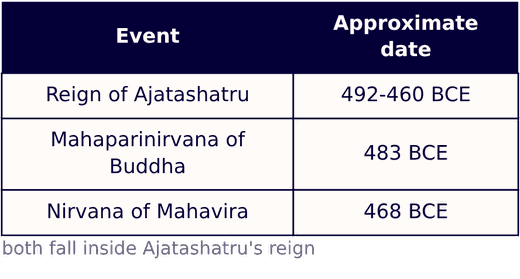 He is remembered for hosting the First Buddhist Council at Rajagriha under Mahakassapa, for fortifying Rajagriha, and for annexing Kosala and the Vajji confederacy with the help of the rathamusala and the mahashilakantaka.
His father Bimbisara was put to death by him, his son Udayin later founded Pataliputra, and Pushyamitra Shunga belongs to the second century BCE, long after both teachers had gone.
Hence option (c) is correct.
He is remembered for hosting the First Buddhist Council at Rajagriha under Mahakassapa, for fortifying Rajagriha, and for annexing Kosala and the Vajji confederacy with the help of the rathamusala and the mahashilakantaka.
His father Bimbisara was put to death by him, his son Udayin later founded Pataliputra, and Pushyamitra Shunga belongs to the second century BCE, long after both teachers had gone.
Hence option (c) is correct.