SSC GD Constable 19 February 2025 · Shift 3 · General Intelligence & Reasoning — questions with answers · ShikshaSphere
Chapter 161 of 210
19 February 2025 · Shift 3
General Intelligence & Reasoning
20 questions ~20 min readFree
20 questions
A
1
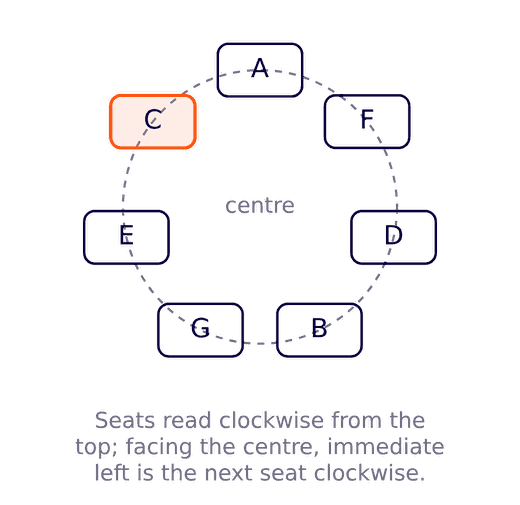
A, B, C, D, E, F and G are sitting around a circular table facing the centre (but not necessarily in the same order). G is sitting to the immediate left of B. E is sitting to the immediate left of G. C is sitting to the immediate left of E. F is sitting to the immediate right of D and the immediate left of A. D is sitting to the immediate right of B. Who is sitting to the immediate left of C?
A.E
B.B
C.A
D.F
Solution
Circular seating
All seven face the centre, so a person's immediate left is the next seat clockwise and the immediate right is the next seat anticlockwise.
G is immediately left of B, E immediately left of G and C immediately left of E, so clockwise the chain reads B → G → E → C.
D is immediately right of B, so D → B; F is immediately right of D and immediately left of A, so A → F → D.
Joining the two chains, the clockwise order round the table is A → F → D → B → G → E → C.
One seat clockwise from C brings us back to A, so A sits to the immediate left of C. Hence option (c) is correct.
2
Select the Venn diagram that best illustrates the relationship between the following classes.
Shoe, Jacket, Bow
A.
B.
C.
D.
Solution
Venn diagram of classes
Test the three classes in pairs: no shoe is a jacket, no jacket is a bow and no bow is a shoe.
None of the three is a kind of, or a part of, either other one, so the three classes share nothing at all.
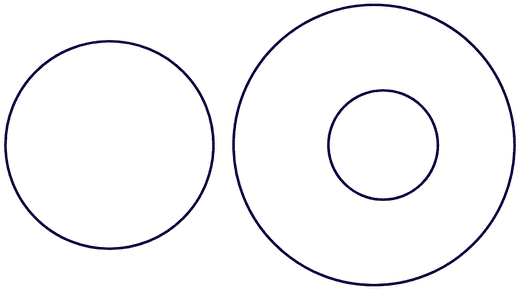
That is shown by three completely separate circles, which is the diagram in option (a).
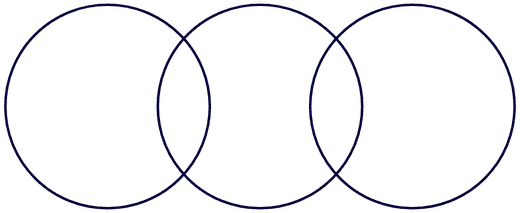
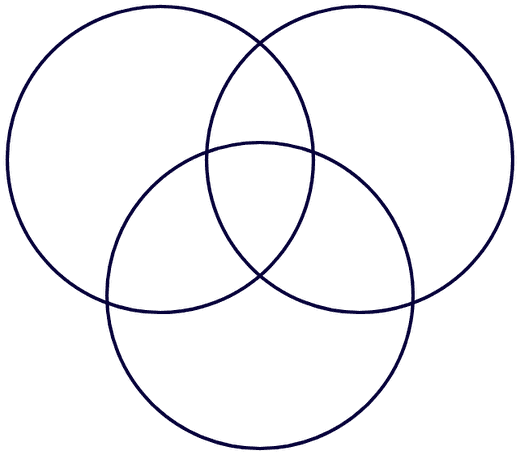
Option (b) puts one class inside another, (c) makes neighbouring classes overlap and (d) makes all three overlap - none of which is true here. Hence option (a) is correct.
3
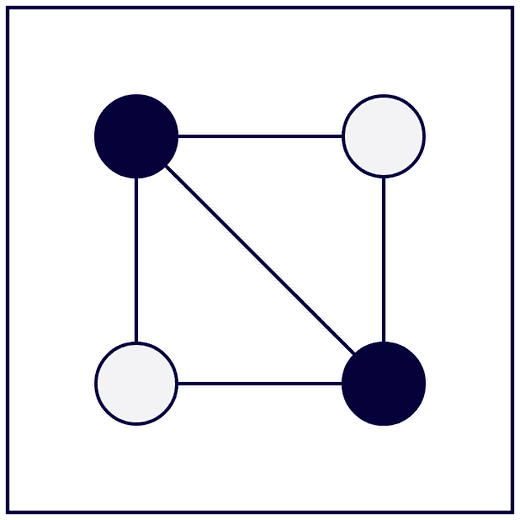
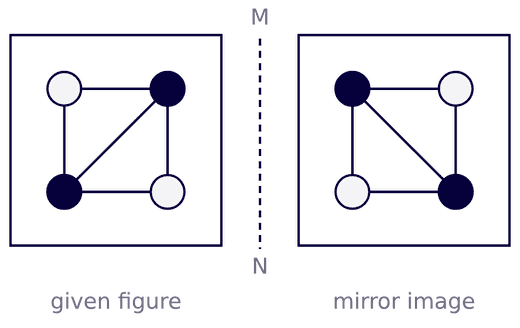
Select the correct mirror image of the given figure when the mirror is placed at MN as shown below.
A.
B.
C.
D.
Solution
Mirror image
MN is a vertical mirror standing to the right of the figure, so the image is a left-right flip: top and bottom stay where they are, left and right change places.
In the given figure the two filled dots are at the top-right and bottom-left corners, and the two hollow dots at the top-left and bottom-right.
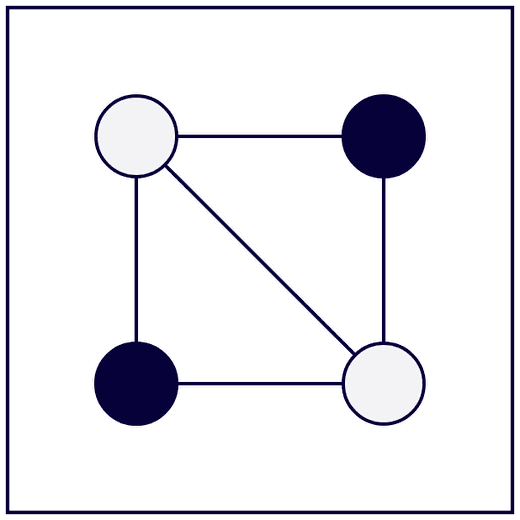
After the flip the filled dots move to the top-left and bottom-right corners and the hollow dots to the top-right and bottom-left.
The diagonal runs from the bottom-left corner up to the top-right corner; flipped left-right it must run from the top-left corner down to the bottom-right corner.
Option (b) gets the dots right but keeps the diagonal sloping the same way as in the question, so it is not a mirror image; only option (c) has both the swapped dots and the reversed diagonal. Hence option (c) is correct.
4
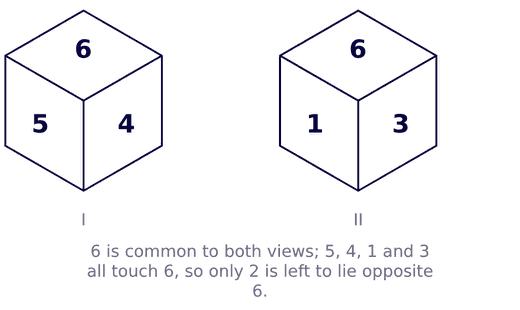
Two different positions of the same dice are given below. Which is the number on the face opposite to the face containing 2 ?
A.3
B.1
C.6
D.4
Solution
Dice - opposite faces
The number 6 shows on the top face in both positions, so 6 is the face common to the two views.
In the first view the faces 5 and 4 stand beside 6; in the second view the faces 1 and 3 stand beside 6.
So 5, 4, 1 and 3 are all adjacent to 6, and of the six numbers only 2 is left to sit opposite 6.
Opposite faces come in pairs, so if 2 is opposite 6 then 6 is opposite 2. Hence option (c) is correct.
5
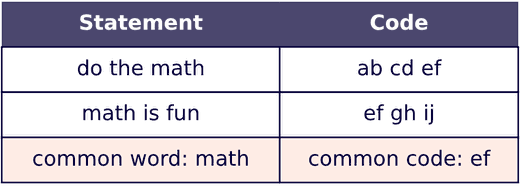
In a certain code language, 'do the math' is coded as 'ab cd ef' and 'math is fun' is coded as 'ef gh ij'. How is 'math' coded in the given language?
A.ab
B.gh
C.ef
D.cd
Solution
Coded language
Write the two statements one under the other: 'do the math' → 'ab cd ef' and 'math is fun' → 'ef gh ij'.
The only word that appears in both statements is 'math', and the only code group that appears in both code sets is 'ef'.
A word common to two statements must carry the code common to their code sets, so 'math' is coded as 'ef'. Hence option (c) is correct.
6
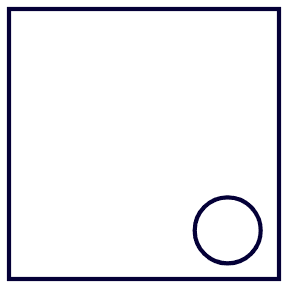
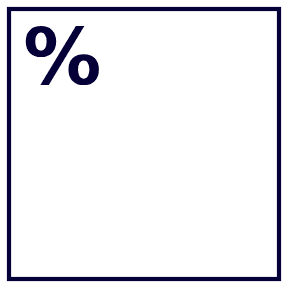
Identify the figure given in the options, which when put in place of the question mark (?) will logically complete the series.
A.
B.
C.
D.
Solution
Figure series
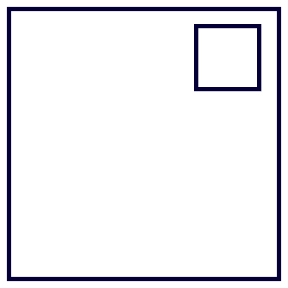
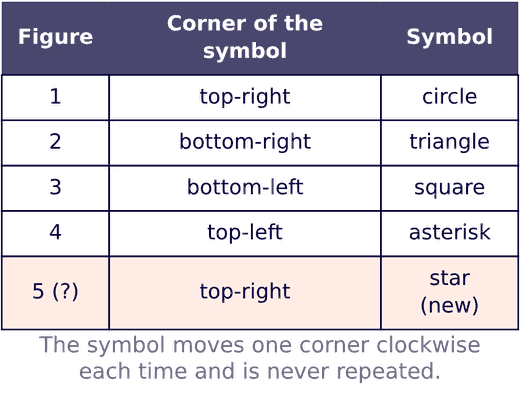
Note the corner in which each symbol sits: circle at the top-right, triangle at the bottom-right, square at the bottom-left, asterisk at the top-left.
Those four corners are being visited one step clockwise each time, so the fifth figure must carry its symbol at the top-right corner again.
Note also that every figure of the series shows a symbol that has not been used before.
Option (b) puts its symbol at the bottom-right and option (c) at the top-left, so both fail the position rule; option (d) is at the top-right but repeats the square already used in the third figure.
Only option (a) shows a fresh symbol - a star - at the top-right corner. Hence option (a) is correct.
7
What will come in the place of the question mark '(?)' in the following equation, if ' ÷ ' and ' × ' are interchanged and ' + ' and ' − ' are interchanged?
69 − 2 ÷ 7 + 35 × 7 = ?
A.78
B.79
C.77
D.80
Solution
Interchange of signs
Given equation:
Swap the signs as instructed - becomes , becomes , + becomes - and - becomes +:
By BODMAS do the division and the multiplication first: and .
69+14-5=83-5=78
Hence option (a) is correct.
8
PQTU is related to LMPQ in a certain way based on the English alphabetical order. In the same way, EHLN is related to ADHJ. To which of the given options is FMRW related, following the same logic?
A.JQVA
B.BINS
C.CHMR
D.DKPU
Solution
Letter-cluster analogy
Compare PQTU with LMPQ letter by letter: P → L, Q → M, T → P, U → Q, so every letter moves 4 places back in the alphabet.
The second pair obeys the same rule: EHLN → ADHJ is E → A, H → D, L → H, N → J, again -4 each.
Apply -4 to FMRW: F → B, M → I, R → N, W → S, which gives BINS. Hence option (b) is correct.
9
G, H, I, J, K, L and M are sitting around a circular table, facing the centre of the table (but not necessarily in the same order). Only one person sits between M and L when counted from the right of M. Only one person sits between L and I. Only one person sits between M and H. Only two people sit between K and I. Only one person sits between J and H. Who sits to the immediate right and left of G, respectively?
A.M and H
B.I and M
C.M and I
D.H and M
Solution
Circular seating
Number the seven seats 1 to 7 clockwise and put M at seat 1. Everyone faces the centre, so a person's right is the anticlockwise side and the left is the clockwise side.
Counted from M's right there is one person between M and L, so going anticlockwise 1 → 7 → 6 puts L at seat 6.
Only one person sits between M and H, and the anticlockwise gap is already taken up by L, so H must take seat 3 (1 → 2 → 3).
Only one person sits between J and H; on one side of H that seat is 1, which is M, so J takes seat 5.
Only one person sits between L and I, and seat 5 is J, so I takes seat 4.
Only two people sit between K and I: seats 5 and 6 lie between seat 4 and seat 7, so K takes seat 7 - which leaves seat 2 for G.
From G at seat 2, the anticlockwise side (G's right) is seat 1 = M and the clockwise side (G's left) is seat 3 = H. Hence option (a) is correct.
10
In a certain code language, 'A + B' means 'A is the father of B', 'A − B' means 'A is the wife of B',
'A × B' means 'A is the brother of B' and 'A ÷ B' means 'A is the daughter of B'.
How is F related to C if 'C − D × E ÷ F + G'?
A.Husband's father
B.Brother's son
C.Daughter's daughter
D.Mother's father
Solution
Coded blood relation
Break the expression 'C − D × E ÷ F + G' at each sign and read off what that sign stands for.
C-D: C is the wife of D. : D is the brother of E. : E is the daughter of F. F+G: F is the father of G.
E is F's daughter and D is E's brother, so D is F's child too - and since D has a wife, D is F's son.
C is the wife of D and D is the son of F, so F is the father of C's husband, i.e. C's husband's father. Hence option (a) is correct.
11
What should come in place of the question mark (?) in the given series?
410, 408, 404, 398, ?, 380
A.386
B.388
C.392
D.390
Solution
Number series
Take the gaps between consecutive terms: 410-408=2, 408-404=4, 404-398=6.
The number subtracted grows by 2 every step, so the next two subtractions are 8 and 10.
Missing term =398-8=390, and the pattern checks out because 390-10=380, the last term given. Hence option (d) is correct.
12
The position(s) of how many letters will remain unchanged if each of the letters in the word 'IDENTITY' arranged in reverse English alphabetical order?
A.Four
B.Two
C.Three
D.One
Solution
Positions unchanged on re-ordering
The given word is IDENTITY, whose letters in order are I, D, E, N, T, I, T, Y.
Arranged in reverse English alphabetical order (Z first, A last) the same eight letters become Y, T, T, N, I, I, E, D.
Now compare the two rows place by place: only place 4 (N in both) and place 6 (I in both) hold the same letter.
So the positions of two letters stay unchanged. Hence option (b) is correct.
13
Select the option that represents the letters that, when sequentially placed from left to right in the blanks below, will complete the letter series.
_ _ L M _ G _ L _ D _ P L _
A.PMGDPDM
B.GPDPMGM
C.MGGDPPM
D.DPNPDMG
Solution
Letter series with blanks
The series has 14 places and seven of them are blank, so the answer must be a seven-letter string - which every option is.
Try a repeating block of five and split the 14 places as 1-5, 6-10 and 11-14.
The printed letters are L, M at places 3 and 4; G at place 6; L at place 8; D at place 10; P, L at places 12 and 13 - and all of them fit the block G P L M D.
Filling the blanks from that block gives G, P, D from the first group, P, M from the second and G, M from the third, i.e. GPDPMGM.
The completed series reads GPLMD / GPLMD / GPLM. Hence option (b) is correct.
14
In a certain code language, 'DENS' is coded as '8976' and 'SENT' is coded as '6739'. What is the code for 'T' in the given code language?
A.9
B.6
C.7
D.3
Solution
Letter-to-digit coding
The digits are not matched to the letters position by position, so compare the two words as groups of letters instead.
DENS and SENT have the letters E, N and S in common; their codes 8976 and 6739 have the digits 9, 7 and 6 in common.
So the letters E, N and S together stand for the digits 9, 7 and 6 in some order.
In DENS the letter left over is D and the digit left over is 8; in SENT the letter left over is T and the digit left over is 3.
Therefore T is coded as 3. Hence option (d) is correct.
15
Read the given statements and conclusions carefully. Assuming that the information given in the statements is true, even if it appears to be at variance with commonly known facts, decide which of the given conclusions logically follow(s) from the statements.Statements: All pants are trousers.
No pant is a shirt.
All shirts are coats.
Conclusions: (I) No coat is a trouser.
(II) Some coats are pants.
A.Only conclusion (I) follows.
B.Only conclusion (II) follows.
C.Neither conclusion (I) nor (II) follows.
D.Both conclusions (I) and (II) follow.
Solution
Syllogism
'All pants are trousers' puts the Pants circle wholly inside the Trousers circle.
'No pant is a shirt' keeps Pants and Shirts apart, and 'All shirts are coats' puts the Shirts circle wholly inside the Coats circle.
Conclusion (I) 'No coat is a trouser': nothing in the statements stops a coat from also being a trouser, so this is only a possibility, not a certainty - it does not follow.
Conclusion (II) 'Some coats are pants': pants are shut out of shirts, but no statement forces any pant inside the coats circle, so this too is only a possibility - it does not follow.
Neither conclusion follows. Hence option (c) is correct.
16
Based on the English alphabetical order, three of the following four letter-clusters are alike in a certain way and thus form a group. Which is the one that DOES NOT belong to that group? (Note: The odd one out is not based on the number of consonants/vowels or their position in the letter-cluster.)
A.LMJ
B.ONL
C.EFC
D.FGD
Solution
Odd one out - letter clusters
Find the two steps inside each cluster. LMJ: L → M is +1 and M → J is -3.
EFC: E → F is +1 and F → C is -3; FGD: F → G is +1 and G → D is -3 - the same pair of steps.
ONL: O → N is -1 and N → L is -2, a completely different pair.
ONL is therefore the cluster that does not belong to the group. Hence option (b) is correct.
17
OQUT is related to QSWV in a certain way based on the English alphabetical order. In the same way, IKON is related to KMQP. To which of the given options is ZBFE related, following the same logic?
A.BDHG
B.BCGG
C.BDGG
D.BEGP
Solution
Letter-cluster analogy
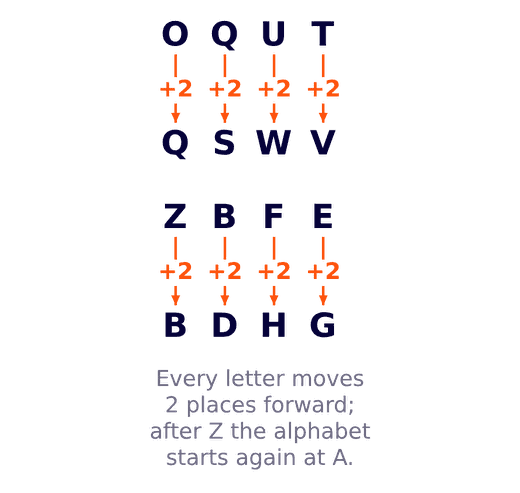
Compare OQUT with QSWV: O → Q, Q → S, U → W, T → V, so every letter moves 2 places forward.
IKON → KMQP repeats the rule: I → K, K → M, O → Q, N → P.
Apply +2 to ZBFE: Z → B (after Z the alphabet starts again at A), B → D, F → H, E → G, which gives BDHG. Hence option (a) is correct.
18
What should come in place of the question mark (?) in the given series? 11, 19, 27, 35, 43, ?
A.53
B.50
C.52
D.51
Solution
Number series
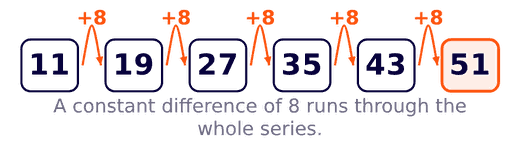
Take the differences: 19-11=8, 27-19=8, 35-27=8, 43-35=8.
The difference is the same every time, so the series simply adds 8 at each step.
Next term =43+8=51. Hence option (d) is correct.
19
A paper is folded and cut as shown below. How will it appear when unfolded?
A.
B.
C.
D.
Solution
Paper folding and cutting
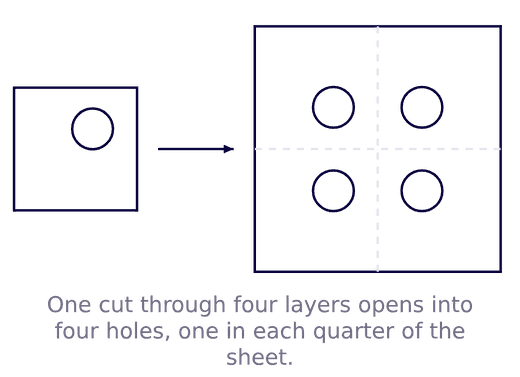
The square sheet is folded twice: first the right half onto the left half, then the top half onto the bottom half, so what remains is the bottom-left quarter and every part of it is four layers thick.
One hole is punched in that quarter, so the cut goes through all four layers.
Opening the second fold mirrors the hole about the horizontal centre line and gives two holes; opening the first fold mirrors both about the vertical centre line and gives four.
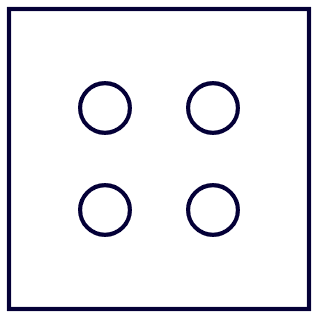
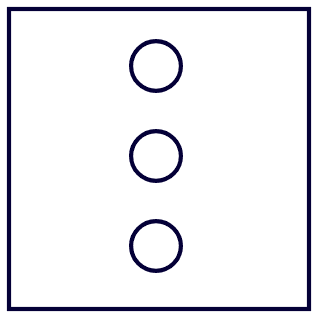
So the opened sheet must show four holes, one in each quarter, each at the same distance from the two centre lines - a 2 by 2 pattern.
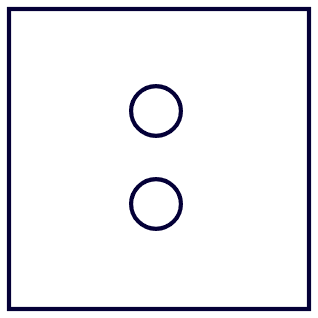
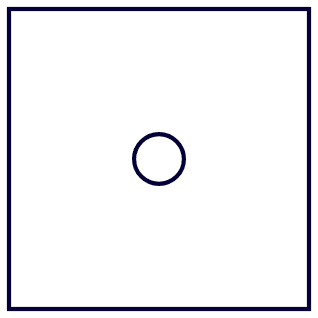
Options (b), (c) and (d) show three, two and one hole, which would need fewer than four layers. Hence option (a) is correct.
20
What should come in place of the question mark (?) in the given series based on the English alphabetical order? RQP, LKJ, FED, ?, TSR
A.ZYX
B.YXZ
C.XYZ
D.ABC
Solution
Alphabet series
Each group is three consecutive letters written backwards: RQP, LKJ, FED and TSR are all of that shape.
So only the first letter has to be tracked: R (18), L (12), F (6) - it falls 6 places each time.
6-6=0, which is before A, so the count runs round the alphabet and starts again from the end: the next first letter is Z (26).
Z with the two letters before it, written backwards, is ZYX, and the check holds because 26-6=20, which is T - exactly the last group TSR.
Hence option (a) is correct.
Finished reading? Now test yourself.
The same 20 questions, but with a timer and the answers hidden — 15 minutes.

 One seat clockwise from C brings us back to A, so A sits to the immediate left of C. Hence option (c) is correct.
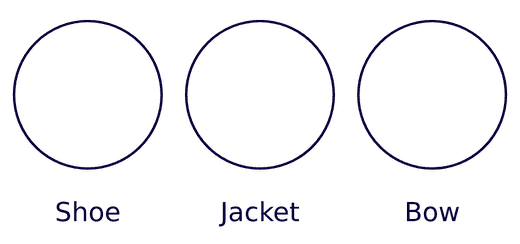 That is shown by three completely separate circles, which is the diagram in option (a).
Option (b) puts one class inside another, (c) makes neighbouring classes overlap and (d) makes all three overlap - none of which is true here. Hence option (a) is correct.
That is shown by three completely separate circles, which is the diagram in option (a).
Option (b) puts one class inside another, (c) makes neighbouring classes overlap and (d) makes all three overlap - none of which is true here. Hence option (a) is correct.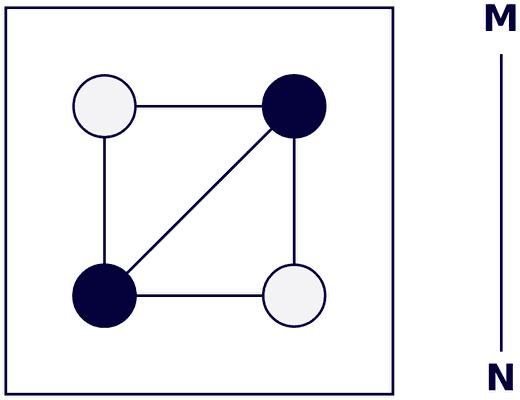
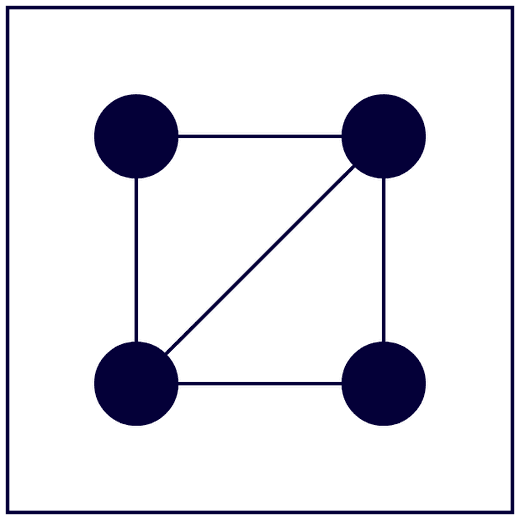
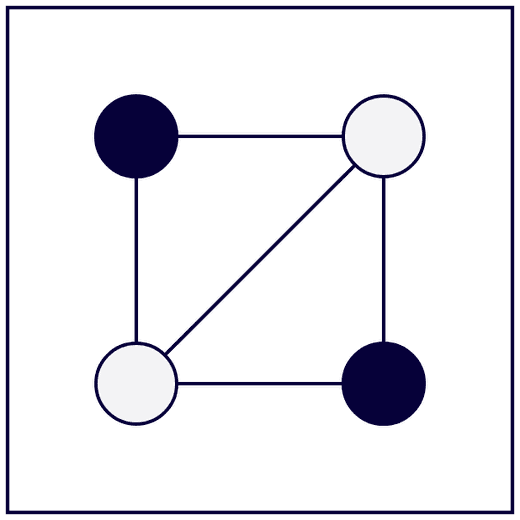
 Option (b) gets the dots right but keeps the diagonal sloping the same way as in the question, so it is not a mirror image; only option (c) has both the swapped dots and the reversed diagonal. Hence option (c) is correct.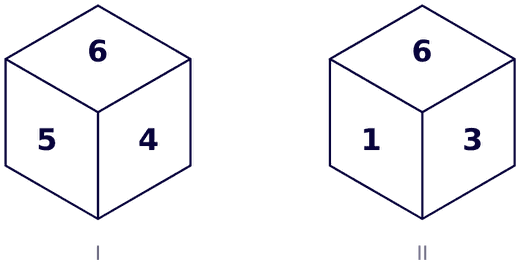
 Opposite faces come in pairs, so if 2 is opposite 6 then 6 is opposite 2. Hence option (c) is correct.
 A word common to two statements must carry the code common to their code sets, so 'math' is coded as 'ef'. Hence option (c) is correct.

 Option (b) puts its symbol at the bottom-right and option (c) at the top-left, so both fail the position rule; option (d) is at the top-right but repeats the square already used in the third figure.
Only option (a) shows a fresh symbol - a star - at the top-right corner. Hence option (a) is correct.
Option (b) puts its symbol at the bottom-right and option (c) at the top-left, so both fail the position rule; option (d) is at the top-right but repeats the square already used in the third figure.
Only option (a) shows a fresh symbol - a star - at the top-right corner. Hence option (a) is correct.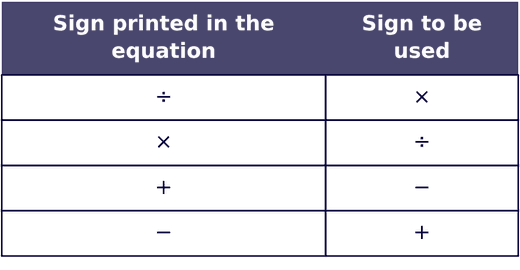 Given equation:
Swap the signs as instructed - becomes , becomes , + becomes - and - becomes +:
By BODMAS do the division and the multiplication first: and .
69+14-5=83-5=78
Hence option (a) is correct.
Given equation:
Swap the signs as instructed - becomes , becomes , + becomes - and - becomes +:
By BODMAS do the division and the multiplication first: and .
69+14-5=83-5=78
Hence option (a) is correct.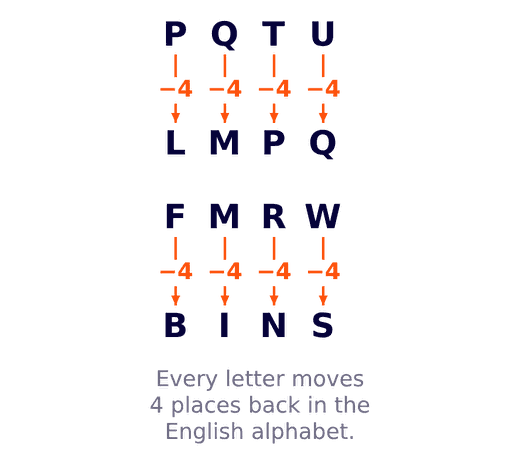 Apply -4 to FMRW: F → B, M → I, R → N, W → S, which gives BINS. Hence option (b) is correct.
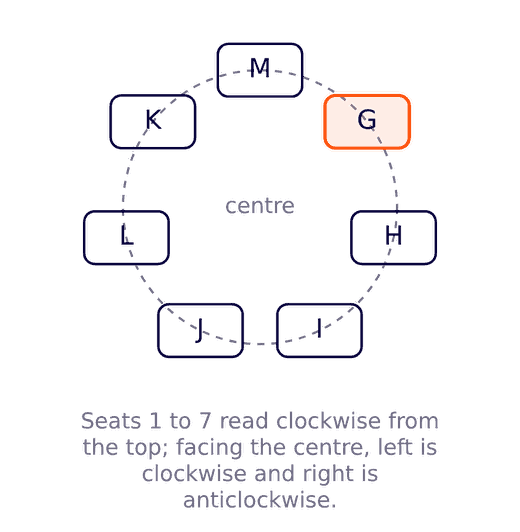 From G at seat 2, the anticlockwise side (G's right) is seat 1 = M and the clockwise side (G's left) is seat 3 = H. Hence option (a) is correct.
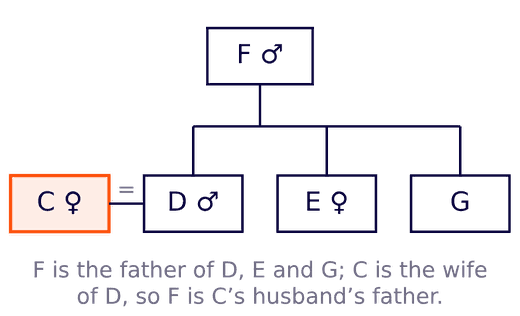 C is the wife of D and D is the son of F, so F is the father of C's husband, i.e. C's husband's father. Hence option (a) is correct.
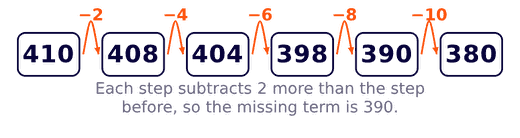 Missing term =398-8=390, and the pattern checks out because 390-10=380, the last term given. Hence option (d) is correct.
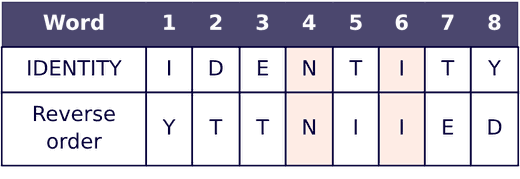 Now compare the two rows place by place: only place 4 (N in both) and place 6 (I in both) hold the same letter.
So the positions of two letters stay unchanged. Hence option (b) is correct.
Now compare the two rows place by place: only place 4 (N in both) and place 6 (I in both) hold the same letter.
So the positions of two letters stay unchanged. Hence option (b) is correct.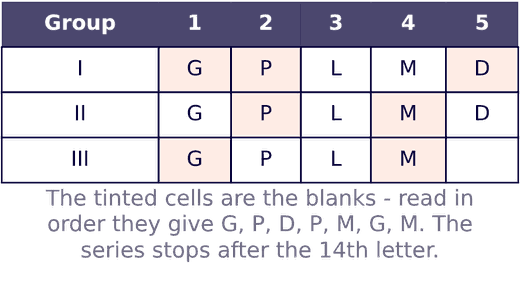 Filling the blanks from that block gives G, P, D from the first group, P, M from the second and G, M from the third, i.e. GPDPMGM.
The completed series reads GPLMD / GPLMD / GPLM. Hence option (b) is correct.
Filling the blanks from that block gives G, P, D from the first group, P, M from the second and G, M from the third, i.e. GPDPMGM.
The completed series reads GPLMD / GPLMD / GPLM. Hence option (b) is correct.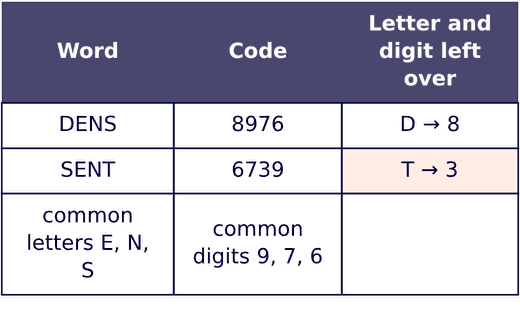 In DENS the letter left over is D and the digit left over is 8; in SENT the letter left over is T and the digit left over is 3.
Therefore T is coded as 3. Hence option (d) is correct.
In DENS the letter left over is D and the digit left over is 8; in SENT the letter left over is T and the digit left over is 3.
Therefore T is coded as 3. Hence option (d) is correct.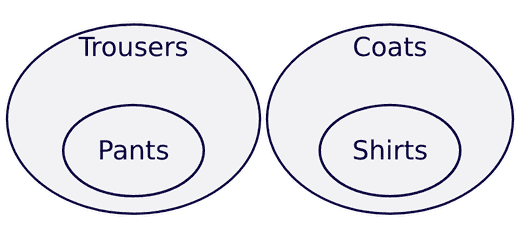 Conclusion (I) 'No coat is a trouser': nothing in the statements stops a coat from also being a trouser, so this is only a possibility, not a certainty - it does not follow.
Conclusion (II) 'Some coats are pants': pants are shut out of shirts, but no statement forces any pant inside the coats circle, so this too is only a possibility - it does not follow.
Neither conclusion follows. Hence option (c) is correct.
Conclusion (I) 'No coat is a trouser': nothing in the statements stops a coat from also being a trouser, so this is only a possibility, not a certainty - it does not follow.
Conclusion (II) 'Some coats are pants': pants are shut out of shirts, but no statement forces any pant inside the coats circle, so this too is only a possibility - it does not follow.
Neither conclusion follows. Hence option (c) is correct.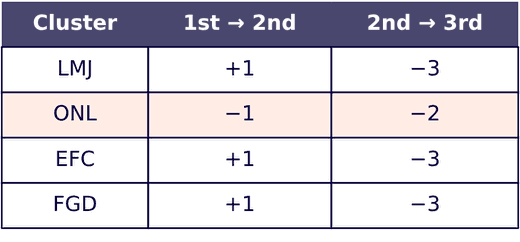 ONL is therefore the cluster that does not belong to the group. Hence option (b) is correct.
 Apply +2 to ZBFE: Z → B (after Z the alphabet starts again at A), B → D, F → H, E → G, which gives BDHG. Hence option (a) is correct.
 Next term =43+8=51. Hence option (d) is correct.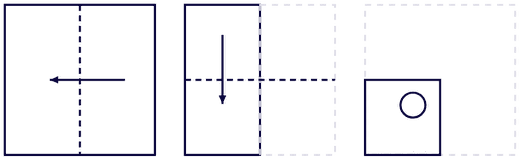
 So the opened sheet must show four holes, one in each quarter, each at the same distance from the two centre lines - a 2 by 2 pattern.
Options (b), (c) and (d) show three, two and one hole, which would need fewer than four layers. Hence option (a) is correct.
So the opened sheet must show four holes, one in each quarter, each at the same distance from the two centre lines - a 2 by 2 pattern.
Options (b), (c) and (d) show three, two and one hole, which would need fewer than four layers. Hence option (a) is correct.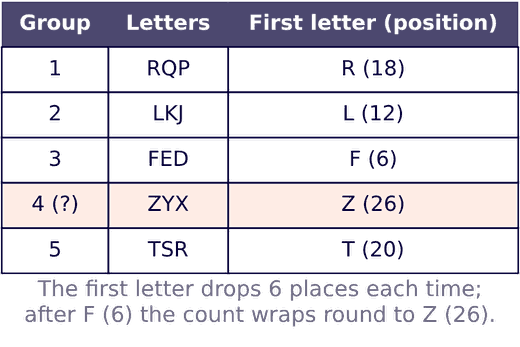 Z with the two letters before it, written backwards, is ZYX, and the check holds because 26-6=20, which is T - exactly the last group TSR.
Hence option (a) is correct.
Z with the two letters before it, written backwards, is ZYX, and the check holds because 26-6=20, which is T - exactly the last group TSR.
Hence option (a) is correct.